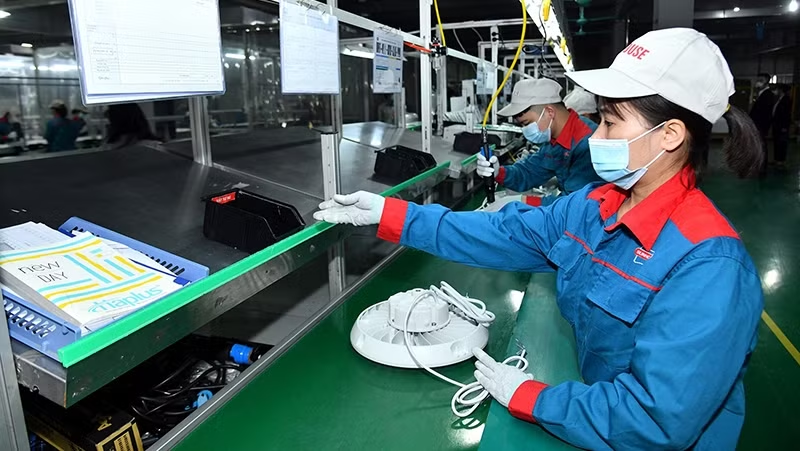
However, enterprises are still surrounded by many difficulties, including capital shortage, lack of raw materials, market contraction, high transportation costs, and others. Businesses have also had to rearrange production lines to ensure distancing and COVID-19 testing for workers, facing the risk of shortage of human resources due to the fracturing of the labour market after the COVID-19 pandemic.
Efforts to resume production chains
According to the Southern Special Working Group of the Ministry of Industry and Trade, 100% of enterprises in industrial clusters in Binh Duong province have returned to operation, but their capacity is less than 50% compared to that before the pandemic.
The Binh Duong Department of Industry and Trade has agreed to give rights for enterprises to actively reopen and state management agencies will review their performance. The province has also allowed enterprises to self-test their workers and issue certificates for the workers to travel while introducing test kits with reasonable prices for enterprises. Enterprises are also allowed to combine three to five samples to reduce testing costs.
Currently, workers in Binh Duong have been injected with the first dose of COVID-19 vaccine and 100% of them will have received the second dose by the end of November.
Enterprises in Dong Nai province are also making efforts to restore production while ensuring safety against the pandemic. About 1,176 enterprises in industrial zones are implementing the “three-on-the-spot” production model with a total of 154,699 resident workers. Meanwhile, 139 enterprises are allowing 42,000 workers to go home every day.
In areas outside industrial zones, 253 enterprises are implementing the "three-on-the-spot" plan with the number of resident workers at 18,500 while 104 enterprises are implementing the “one road, two locations” plan with more than 10,000 workers and 12 enterprises with nearly 3,000 workers implementing both the aforementioned plans.
In Hanoi, since the city eased social distancing, more than 95% of businesses are now operating normally across nine industrial parks. About 97% of Hanoi workers have been administered the first dose of COVID-19 vaccine while 48% of workers have been given a second dose.
Hanoi recorded more than 13,100 newly established enterprises in the past eight months with total registered capital of VND165.73 trillion while the number of enterprises returning to operation was 5,687, up 74% over the same period last year.
Increasing support for enterprises
Despite great efforts to quickly restore production, enterprises are facing many difficulties. After months of stagnation, many businesses are at risk of running out of cash flow while they are facing increasing prices of imported materials, transportation, and logistics as well as the cost of pandemic prevention and control.
Human resources are also a difficult problem for enterprises. According to the Employment Department under the Ministry of Labour, Invalids and Social Affairs, there is a risk of a shortage of labour in big cities and provinces, industrial parks and export processing zones.
Deputy Director of the Institute for Economic Policy Research under the University of Economics (Hanoi National University) Tran Quoc Viet said that it is necessary to continue to build more solutions to protect the maintenance of business activities in the context of the pandemic remaining unpredictable.
First of all, the Government and localities need to find solutions to get workers to return to work by providing them with social security support or help them overcome difficulties caused by the pandemic.
Another important solution is to help enterprises maintain working capital flow, reduce banking interest rates, and extend or postpone the payment of taxes and fees.
The Ministry of Industry and Trade has also said that the ministry's top priority is to coordinate with all parties to come up with solutions to support businesses to maintain production, facilitate the convenient circulation of goods, and promote the connection of supply chains.
In the long term, the ministry will continue to perfect the legal framework to promote the potential of the industry and its role as the lifeblood of the economy while supporting the capacity building of domestic industrial enterprises and raising the localisation rate, so that domestic industry can develop sustainably.