To achieve double-digit growth targets, chemical enterprises have rolled out a range of coordinated solutions to respond to challenges while boosting production and exports.
Vu Viet Tien, General Director of DAP No. 2–Vinachem Joint Stock Company, said that conflicts in the Middle East have led to rising input material prices, logistics and transportation costs, as well as longer delivery times, posing risks of supply chain disruptions and affecting business efficiency.
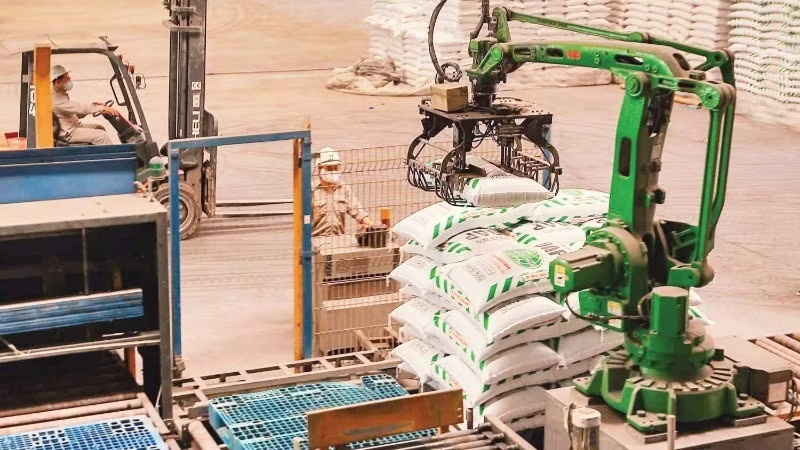
Thanks to the implementation of various solutions, the company produced 70,250 tonnes of DAP in the past three months, up 6%. Its industrial production value exceeded 1.213 trillion VND, up 11%; net revenue reached more than 1.237 trillion VND, up 13% against the plan and 48% year-on-year; profit surpassed 51 billion VND, fulfilling 42% of the annual target; and exports totalled 1.35 million USD.
In the second quarter, the company aims to produce 69,000 tonnes of DAP, with net revenue of nearly 1.249 trillion VND and profit of over 38.2 billion VND. To meet these targets, it will continue implementing technological solutions, stabilising equipment operations, and improving product quality.
Similarly, Nguyen Van Dong, General Director of Viet Nam Apatit One Member Limited Liability Company, noted that in addition to rising input costs and supply disruptions, the company continues to face challenges related to resources, mining sites, waste dumps, and raw material supply for ore processing.
In 2026, the company targets the production and consumption of 1.99 million tonnes of apatite ore, revenue of 4.447 trillion VND, pre-tax profit of 652 billion VND, and an average monthly income of 26 million VND per employee. Key immediate solutions include addressing bottlenecks in site clearance, completing legal documentation for mining areas, investing in waste dump infrastructure, and improving the efficiency of processing low-grade and difficult ores. The company is also stepping up digital transformation in equipment management and production operations.
According to leaders of Southern Battery Joint Stock Company (Pinaco), in the face of recent challenges, the company aims to achieve growth of over 10% this year, with revenue of 4.8 trillion VND, profit of 200 billion VND, and exports of at least 1.2 trillion VND. To this end, it plans to increase battery sales by 20%, expand B2B channels (business-to-business transactions), and develop OEM customers (manufacturing under clients’ designs and brands).
At the same time, it is diversifying export markets to North America and Russia, optimising costs, improving equipment efficiency, and reducing warranty rates to 1.2–1.4%.
Nguyen Huu Tu, General Director of the Viet Nam National Chemical Group (Vinachem), said that current conditions have driven up key input factors such as fuel, raw materials, and transportation costs, placing significant pressure on business operations. To meet its full-year targets — industrial production value exceeding 65.4 trillion VND (up 6.6%), revenue of over 71.4 trillion VND (up 11%), and profit of 3.041 trillion VND (equivalent to 78.8% of 2025 levels) — the group has instructed its member units to proactively implement comprehensive solutions to respond to adverse fluctuations, maintain stable production, and seize opportunities to expand market share.
This includes promptly assessing the impact of external factors such as supply chain disruptions, exchange rate volatility, and challenges in import–export activities, and developing appropriate response scenarios to avoid disruptions in business operations.
According to Tu, one of the key priorities is to review reserve resources and expand and diversify supply systems to ensure uninterrupted access to raw materials and fuels, particularly as global logistics continues to face significant risks.