Creating opportunities for those passionate about science
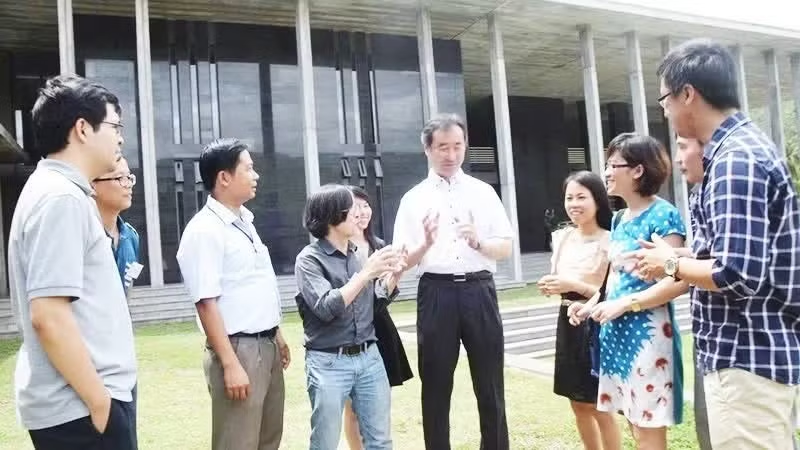
ICISE was inaugurated in August 2013 and is closely associated with the Rencontres du Viet Nam Association, founded by Professor Jean Tran Thanh Van. Unlike many international scientific centres established with large-scale investment, ICISE was created through the dedication of an individual and a non-profit organisation. Its primary objective is to promote international scientific exchange, particularly between the Asia-Pacific region and other academic communities, while creating opportunities for young Vietnamese scientists to engage with international standards.
For over a decade, ICISE has organised hundreds of international conferences, attracting thousands of scientists, including many leading figures in their fields. This has provided young researchers in Viet Nam with the chance to engage directly with some of the world's foremost scholars. However, its reach within the Vietnamese scientific community remains limited, as not every student or lecturer can attend.
Nguyen Thao, a doctoral student in physics at the Ho Chi Minh City University of Science, recalled her first conference at ICISE: “I never thought I would have the chance to listen to a Nobel Prize-winning scientist speak in person. The atmosphere there was very different, both formal and open. I was able to ask questions and exchange views directly. When I returned, I felt more motivated to pursue research.”
Like Thao, many other students and young lecturers have described the experience as one that “broadens horizons.” They can explore new research trends and learn how international scientists approach problems and conduct professional research. However, travel and accommodation costs, along with the limited number of available spots, mean that such experiences have not yet become widely accessible.
This raises an important question: How can the academic values generated by ICISE extend beyond a small group and reach more universities and research institutes across the country? With stronger support mechanisms, such as participation scholarships, online networking programmes, or training partnerships, these valuable experiences could become not merely personal memories but shared resources contributing to the improvement of scientific research quality in Viet Nam.
Difficulties and challenges
More than a decade after its establishment, ICISE has made its mark through a wide range of international academic activities. Nevertheless, maintaining and developing the centre continues to face considerable challenges, particularly financially.
Unlike many international scientific centres supported by state budgets or major private foundations, ICISE relies largely on the personal reputation and international networks of its founders. This limits the long-term stability of its resources, while the growing demand for international conferences requires substantial expenditure on facilities, logistics, and human resources.
Moreover, although the centre has attracted many leading scholars from around the world, its direct impact on the domestic scientific system remains limited. Not all students, lecturers, and young researchers have the opportunity to participate, leaving a gap between international conferences and their dissemination to universities and research institutes throughout the country.
To illustrate this point, a few comparisons may be useful. In the US, the Aspen Institute was founded in 1949 and initially served as a venue for seminars. It quickly evolved into an intellectual ecosystem where business leaders, artists, and scholars discuss the major issues of their time. Aspen benefits from a strong financial foundation and support from industrial and cultural circles, enabling it to maintain long-term influence.
In Europe, CERN in Switzerland stands as a leading example of a large-scale international scientific institution jointly funded by multiple countries. CERN has not only produced revolutionary innovations such as the World Wide Web but has also trained thousands of young scientists, becoming one of the world's foremost research centres.
By contrast, ICISE remains largely a personal initiative and has yet to be closely integrated into the country's broader science and technology development strategy, making it difficult to generate strong synergy with national policies.
Dr Nguyen Huu Ha, Deputy Director of the Gia Lai Department of Science and Technology, noted that the challenges facing ICISE are not unique to a single centre but reflect the broader realities of science in Viet Nam. These include limited resources, ranging from finance to human capital, and the lack of synchronised mechanisms and policies. As a result, scientific initiatives often lack long-term support, making it difficult for global knowledge to spread deeply throughout the domestic system.
These issues must be viewed objectively and comprehensively. Without appropriate solutions, initiatives such as ICISE may struggle to maintain their effectiveness over the long term. Conversely, with clear policies, stable financial mechanisms, and coordination among the State, universities, research institutes, and businesses, models such as ICISE could become important drivers of international academic exchange while also helping to enhance Viet Nam's research capacity.


![[Photos] Central and local agencies extend congratulations to Nhan Dan Newspaper on 101st anniversary of Viet Nam Revolutionary Press Day](https://en-cdn.nhandan.vn/images/8f440db7b9bfe62cb5397a6750a8b01b6b986b08e85d95c29b159dd4741de5aff02eaf4af770af868e24c1ae769f44d98bc8cb607db0056294178f08a73f9f09b210979a02378495c655160931f18fcc/doan-thu-truong-bo-cong-anjpg.jpg.avif)