The province aims to develop a cultural and entertainment industry, linking socio-economic development with the preservation of culture and nature, opening a new phase for tourism development as the Central Highlands connect with the blue sea.
Opportunities and development goals
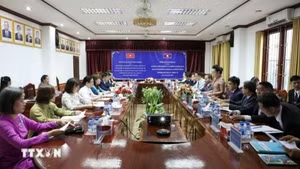
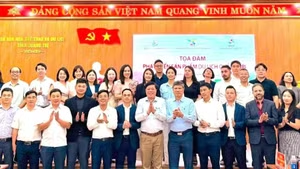
At a recent workshop in Quy Nhon titled “Gia Lai 2026: Activating the Sea–Highlands Axis,” aviation experts and businesses all emphasised the role of aviation infrastructure as a gateway to promoting socio-economic development. Dao Xuan Hoach, Deputy Director of the Civil Aviation Authority of Viet Nam, said that if aviation develops alone, its effectiveness cannot be fully realised. Aviation must lead the way, but to create momentum for localities, it must be linked with other sectors, especially tourism.
According to Hoach, the deployment of charter flights (tourist charter services) in 2026 and the move towards regular flights from 2027 will help quickly meet market demand. The amended Civil Aviation Law, which is expected to take effect in July 2026, will also remove many bottlenecks in infrastructure investment.
From a business perspective, Nguyen Huy Cuong, Deputy General Director of Bamboo Airways, assessed that Gia Lai has a rare advantage in connecting with Binh Dinh (former) through the Phu Cat and Pleiku airports. This can be seen as a “dual-airport cluster” that helps increase operational capacity and ensure safety.
When transport infrastructure is improved, travel time between Quy Nhon and Pleiku is expected to be shortened to 1.5–2 hours, opening flexible connections between domestic and international aviation.
However, to take advantage of this, it is necessary to complete accompanying services. For example, arranging dedicated areas for large tourist vehicles at airports and improving the experience from the very first point of arrival is an important factor that needs attention, he said.
Assoc Prof, Dr Tran Dinh Thien, former Director of the Viet Nam Institute of Economics and member of the Prime Minister’s Policy Advisory Council, noted that tourism should be regarded as a distinctive economic sector with a strategic position in overall national development, rather than merely a service industry. Correctly positioning tourism will help effectively tap into potential, turning natural and cultural advantages into real growth drivers.
Gia Lai has many outstanding potentials: majestic nature, diverse cultures of Central Highlands ethnic groups, and a favourable geographical position for regional connectivity. However, these advantages have not yet been fully exploited. To create a breakthrough, it is necessary to restructure the sector, clearly define management authority, and develop a long-term strategy aligned with global trends. Tourism must be viewed as a comprehensive economic sector capable of spreading to many other fields such as trade, services, culture, and even the creative industries.
Gia Lai tourism deserves to be positioned at a national, even international level. If its advantages are properly harnessed with a fast and breakthrough development strategy, Gia Lai will become a distinctive destination with its own identity, contributing to enhancing Viet Nam’s tourism position on the world map.
Assoc Prof, Dr Tran Dinh Thien
According to Thien, for Gia Lai to achieve a breakthrough in tourism, it is necessary to create a transparent and favourable investment environment, along with close coordination between authorities and businesses. The authorities must truly act as a “companion” to enterprises, from survey and implementation to final outcomes.
In the context of global competition, if Gia Lai develops slowly, it will miss out on opportunities. Therefore, strong and decisive solutions are needed to seize the moment and create a major boost for the tourism sector.
“Gia Lai tourism deserves to be positioned at a national, even international level. If we properly exploit our advantages and adopt a fast and breakthrough development strategy, Gia Lai will become a distinctive destination with its own identity, contributing to elevating Viet Nam’s tourism position on the global map,” he said.
Repositioning tourism products
Beyond infrastructure, many opinions suggest that Gia Lai needs to reposition its tourism products, especially by tapping into cultural depth. Assoc Prof, Dr Nguyen Thien Tong, founding head of the Aeronautical Engineering Department at the University of Technology (Viet Nam National University - Ho Chi Minh City), said that alongside connecting aviation infrastructure with tourism, it is necessary to focus on promoting historical and cultural values through museums and experiential spaces. Destinations and stories associated with famous artists and writers can become unique tourism products through music nights and poetry nights.
According to Tong, Gia Lai tourism should not only serve domestic visitors but also strongly target international markets by promoting works of renowned figures associated with the region to build globally appealing cultural products.
Positioning should not merely describe what exists but must create a clear and distinctive brand story that allows visitors to associate Gia Lai with a characteristic image. Just as Paris evokes romance, Singapore evokes greenery and discipline, and Ha Noi evokes heritage and elegance, Gia Lai also needs a “defining adjective” to imprint itself in visitors’ minds.
Nguyen Thi Hoa Mai, Deputy Director General of the Viet Nam National Authority of Tourism
Nguyen Thi Hoa Mai assessed that correctly positioning Gia Lai tourism is a strategic issue that determines direction, investment in product development, and communication.
According to Mai, brand positioning is not only a local matter but is also associated with the national image, as each locality forms a piece of the overall Viet Nam tourism brand. Therefore, positioning principles must be based on core values, unique differences and existing advantages, rather than subjective desires.
For Gia Lai, it is necessary to clearly identify distinctive values to create a different destination. Gia Lai possesses unique cultural features: the cultures of Central Highlands ethnic minorities, Tay Son martial arts culture, and a favourable geographical position to become a transit hub connecting the Central Highlands with the South Central Coast. These elements, if combined, will create a deeply immersive and emotionally rich experience for visitors.
“Positioning should not merely describe what exists but must create a clear and distinctive brand story that allows visitors to associate Gia Lai with a characteristic image. Just as Paris evokes romance, Singapore evokes greenery and discipline, and Ha Noi evokes heritage and elegance, Gia Lai also needs a ‘defining adjective’ to imprint itself in visitors’ minds,” Mai shared.
Assessing Gia Lai’s tourism development potential in the new phase, Deputy Prime Minister Ho Quoc Dung emphasised that thoroughly implementing the Politburo’s Resolution No. 80-NQ/TW (dated January 7, 2026) on developing Vietnamese culture, and closely following the Government’s action programme to implement the Resolution of the 14th National Party Congress, culture must be regarded as the spiritual foundation and a driving force for breakthroughs in the tourism sector.
For Gia Lai, culture is not only found in epic tales or the resonating sound of gongs, but this heritage must truly exist in daily life, bringing livelihoods and prosperity to local communities.
A strong shift in thinking is needed: unlocking and transforming heritage values into development resources; and harmoniously and delicately combining preservation with sustainable value promotion.
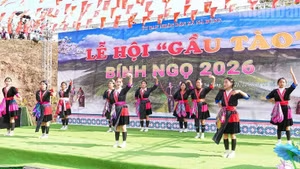
Transforming the cultural space of gong performances, wooden architectural art, ancient villages, and traditional festivals into distinctive tourism experiences with high competitiveness both domestically and internationally.
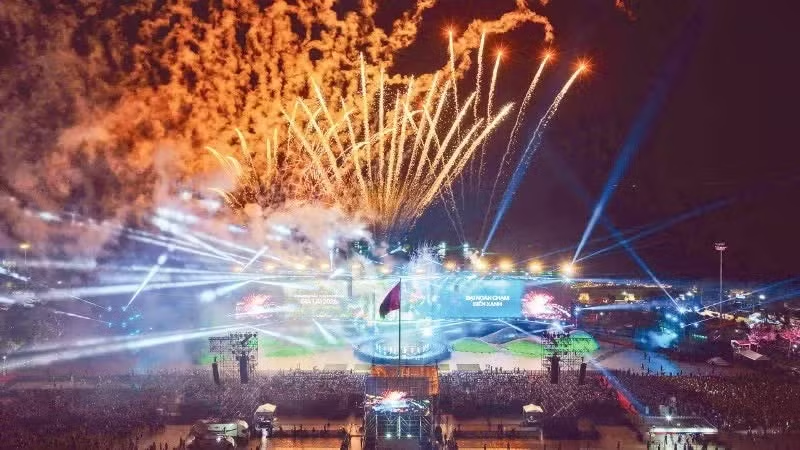
At the same time, Gia Lai needs to focus on mobilising resources and synchronously planning complexes of cultural–historical–spiritual tourism, making breakthroughs in developing the night-time economy, ecological agricultural tourism, green economy, and circular economy.
The harmonious and skilful connection between the cultural identity of the Central Highlands and the vast openness of the central coast’s blue sea will create a multi-sensory journey that touches emotions, retains visitors and generates sustainable added value for the community. Thereby, Gia Lai can rise to become a key tourism growth pole of the region and the country.
![[Video] Viet Nam among Top three Asian destinations for return visitors](https://en-cdn.nhandan.vn/images/nyM650OGFWrOVWc-xajqN-rTZ68Rlmc1fiGJOhBRYHErj-E25MBpvJqrpphXazfrpe9t-fYCGuQU4CN0yXo3Rg/du-lich-vietnam.jpg.avif)
![[In Pictures] Nui Chua Rock Park: A million-year-old outdoor museum of landforms on the Khanh Hoa coast](https://en-cdn.nhandan.vn/images/nyM650OGFWrOVWc-xajqNz57td8idIAL_VG9puyG2UZEKOnmq1DVlT1--ZclbO3z2WBaWZhbt6O3e8kjPZqJMWkfEz7RO9qhcwg8o8LQFK8/ndo-br-cao-nguyen-da-moi.jpg.avif)