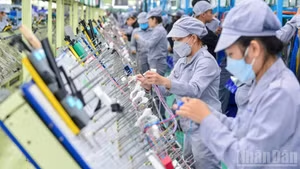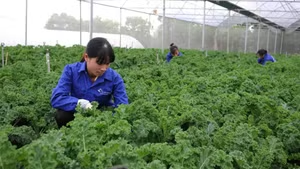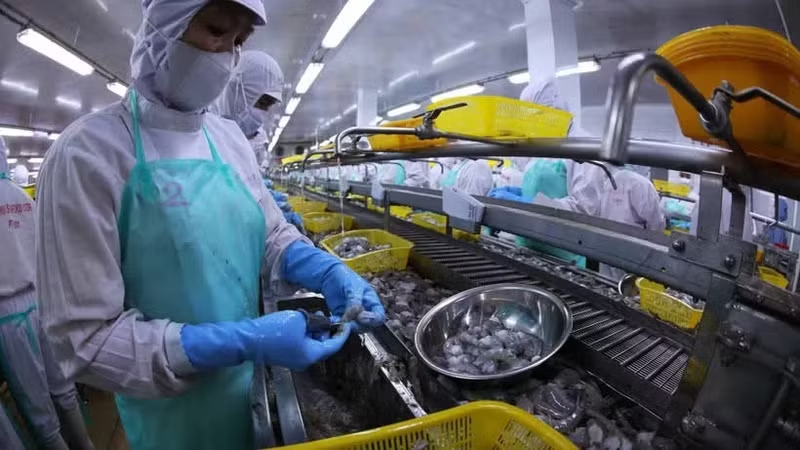
Notably, all three sectors posted solid growth: agriculture, forestry, and fisheries expanded by 3.58%; industry and construction by 8.92%; and services by 8.18%.
These results indicate that the economy has achieved a certain recovery and maintained relatively stable growth momentum, reflecting significant efforts in economic governance and the resilience of the entire nation.
Growth from the supply and demand perspectives
From the supply side, the General Statistics Office noted that while growth has shown positive signs, it remains uneven, with momentum still concentrated in several key sectors, while many others have yet to recover proportionately.
Agriculture, forestry, and fisheries continue to act as a stable pillar of the economy, while the processing and manufacturing industry remains the “engine” of growth, expanding by 9.73% and contributing the most to overall growth. This development reflects the recovery of export orders and production capacity, particularly in sectors such as electronics, textiles, and metal production.
The mining sector has maintained positive growth since the fourth quarter of 2025, reaching 5.42%. In the services sector, wholesale and retail trade, along with the repair of automobiles, motorcycles, and motorbikes, grew by 9.62%, indicating a strong recovery in domestic demand.
In addition, knowledge-intensive service sectors such as professional, scientific, and technological services, as well as education, recorded stable growth, initially reflecting a structural shift towards higher quality.
However, several key sectors have yet to achieve the expected breakthroughs, including construction (up 8.36%); transportation and warehousing (up 8.95%); accommodation and food services (up 7.49%); electricity, gas, steam, and air conditioning supply (up 6.54%); information and communications (up 7.65%); real estate activities (up 4.71%); and administrative and support services (up 7.06%).
From the demand side, the General Statistics Office highlighted domestic consumption as a bright spot, growing by 8.45% and serving as an important pillar amid external volatility. Final consumption by the government rose by 11.66%, reflecting increased public spending to support major political and administrative tasks, particularly the organisation of Party congresses and elections at various levels, as well as expenditures aimed at stabilising the administrative apparatus following the merger of administrative units.
Beyond seasonal factors, this increase also underscores the leading role of the public sector in stimulating aggregate demand and maintaining economic momentum. Final household consumption grew by 7.95%, driven mainly by heightened spending during the extended festive and Lunar New Year period.
Notably, the structure of consumption is undergoing a clear shift towards a more modern and sustainable pattern, as consumers increase spending on environmentally friendly products such as electric vehicles and energy-efficient appliances, while prioritising experience-based services such as tourism, leisure, and entertainment. Gross capital formation rose by 7.18%, reflecting efforts to accelerate disbursement and expand production. Nevertheless, investment efficiency and spillover effects remain limited and have yet to generate a sufficiently strong impetus for related sectors.
The external sector continues to serve as an important growth driver, with import–export activities expanding robustly: exports increased by 19.1%, while imports grew even faster at 27%. This reflects a recovery in demand for production inputs, but also indicates that domestic value added remains limited and heavily dependent on imports.
Key drivers of economic growth in the first quarter of 2026
Economic developments in the first quarter continued to rely primarily on traditional growth drivers, including production and exports, investment, and domestic consumption. Meanwhile, new drivers such as science and technology, innovation, the digital economy, and institutional reform have shown improvement but remain insufficient to become genuine engines of growth in the short term.
Production and exports remained the main pillars of growth, reaffirming Viet Nam’s resilient supply capacity. In particular, the processing and manufacturing industry maintained strong growth momentum, reflecting a recovery in production activities and domestic supply capabilities. At the same time, export activities remained vibrant, providing a solid foundation for domestic production.
Domestic consumption showed signs of improvement, playing a stabilising role in aggregate demand. Consumption in the first quarter was significantly boosted by seasonal effects from the extended Lunar New Year holiday, creating a stimulus for domestic demand in the early months of the year. Household consumption remained the core driver, making the largest contribution. This trend was reflected in the solid increase in total retail sales of goods and consumer service revenues, estimated to rise by around 10.9%, while international tourist arrivals to Viet Nam surged (reaching nearly 6.8 million in the first quarter, up 12.4% year-on-year). The positive recovery of domestic consumption and tourism helped offset adverse fluctuations in external markets.
Science and technology, innovation, and the digital economy have been further promoted, increasingly penetrating high-tech industries and services. However, these factors have so far played only a supporting role rather than a leading one.
Despite these positive results, growth in the first quarter of this year still fell short of the 9.1% target. The General Statistics Office identified several core reasons.
First, geopolitical tensions in the Middle East have heightened risks in global energy markets, driving up oil prices and input fuel costs, thereby increasing production costs for businesses. This impact is particularly evident in energy-intensive sectors such as transport, logistics, and manufacturing, and has indirectly affected construction, trade, and services. Rising input costs, coupled with incomplete demand recovery, have narrowed profit margins, making businesses more cautious about expanding production and investment.
Second, persistent internal bottlenecks have not been fully addressed, reducing the economy’s capacity to absorb and translate growth drivers. Structural weaknesses remain evident, including relatively low labour productivity, limited competitiveness of enterprises, modest participation in global value chains, and a business environment and policy framework that have yet to achieve breakthrough improvements to support production, investment, and business activities.
Third, domestic purchasing power has recovered more slowly than expected. Although the first quarter included the Lunar New Year holiday, total retail sales and service revenues rose by only 10.9% in current prices and around 7% in constant prices, falling short of the level needed to push GDP growth to 9.1%. Consumers have tended to tighten spending due to concerns over inflation driven by rising energy and food prices.
Therefore, the General Statistics Office noted that to achieve the full-year growth target, more comprehensive and decisive measures are required to reduce input cost pressures and remove institutional bottlenecks, thereby strengthening confidence and creating room for businesses to expand production and operations in the period ahead.