Despite its large scale and purchasing power, it is also a highly competitive market with strict standards and rapidly changing policies, requiring export activities to be flexible and adaptable to geopolitical fluctuations and global supply chains.
Le Hang, Deputy Secretary General of the Viet Nam Association of Seafood Processing and Export (VASEP), stated that Viet Nam’s seafood exports to the US in Q1 decreased by more than 10%, continuing to be the biggest “bottleneck” in the industry’s overall growth. This is partly due to declining consumer demand and partly due to technical barriers and tariffs.
Notably, import regulations under the Marine Mammal Protection Act (MMPA), requiring a certificate of acceptance (COA), officially took effect on January 1, 2026, along with tax measures such as anti-dumping duties on shrimp.
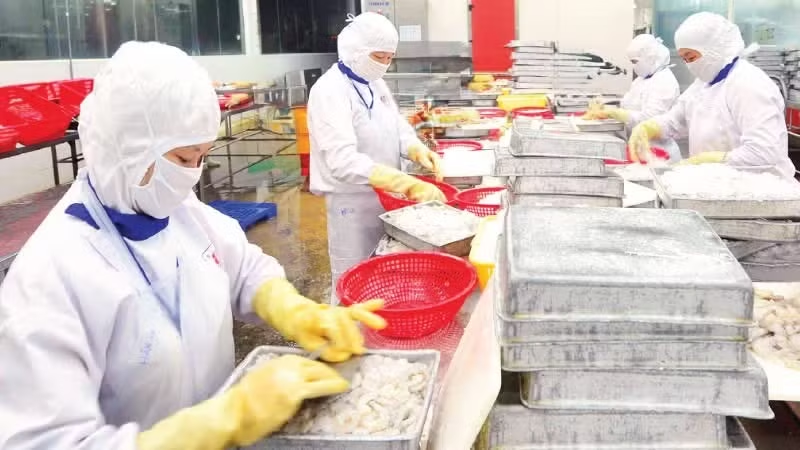
The impact on shrimp products is clearly evident, with export turnover to the US reaching only 16 million USD in February 2026, a 61% decrease compared to the same period last year; cumulative figures for the first two months of the year reached nearly 60 million USD, a 22% decrease.
Viet Nam’s seafood exports to the US in the first quarter decreased by more than 10%, continuing to be the biggest bottleneck in the industry’s overall growth. This is partly due to declining consumer demand and partly due to technical barriers and tariffs.
Le Hang, Deputy Secretary General of the Viet Nam Association of Seafood Processing and Export (VASEP)
It is predicted that promoting shrimp export growth to the US will continue to face many difficulties in the second quarter. Along with tariff policies, the US market is also tightening technical controls with requirements related to antibiotics, food safety and hygiene, traceability, and an enhanced import alert mechanism since the beginning of March. This creates risks, affects customs clearance and delivery schedules, and increases costs for shrimp exporting businesses.
Besides seafood, some wood and wood products have also seen a decline in the US market. In the first two months of the year, Viet Nam continued to be the largest supplier of wooden furniture to the US with a turnover of 1.3 billion USD, but this was down 21.3% compared to the same period in 2015.
The reason is the sharp decrease in import demand from the US due to the trend of tightening consumer spending on non-essential goods, along with pressure from logistics costs and the volatility of the global economy.
Simultaneously, the share of kitchen furniture imports from Viet Nam also decreased from 42.3% to 39.4%, reflecting the impact of trade protection measures and changes in demand for home renovations in the US.
Conversely, cashew nuts emerged as a rare “bright spot” in the export picture. In the first two months of 2026, cashew exports to the US increased by 1.6% in volume and 0.6% in value compared to the same period in 2025, thereby raising Viet Nam’s market share in total US imports from 88.19% to 88.68%.
Given the mixed performance, exports to the US in the second quarter of 2026 are projected to continue to be affected by many factors, with quality and transparency requirements becoming increasingly urgent.
For the cashew industry, exporting businesses acknowledge that the US remains a large consumer market, but consumer trends are clearly differentiating towards highly processed, branded products with full traceability.
To increase value and market share, businesses must comply with new regulations such as FSMA 204 (Food Traceability Rule), which require maintaining Key Data Elements (KDEs) at Critical Tracking Events (CTEs). This means the entire chain, from harvesting and cleaning to packaging and transportation, must be coded and traceable within 24 hours.
On the other hand, ensuring transparent certificates of origin (C/O), especially for imported raw materials, has become a crucial condition for taking advantage of tariff preferences and overcoming technical barriers.
From a trade promotion perspective, Do Ngoc Hung, Commercial Counsellor and Head of the Vietnamese Trade Office in the US, stated that after years of market expansion, the biggest challenge now is no longer “entering the market” but “maintaining the market,” “retaining customers,” and “expanding market share” in the face of fierce competition and increasingly stringent standards.
This requires businesses to invest more systematically in internal management systems, supply chain control, raw material data, origin documentation, labour and environmental standards, and mechanisms for responding to inspections.
Beyond purely commercial factors, businesses currently need to consider the ripple effects of the conflict in the Middle East and the volatility of the global oil, energy, and logistics markets.
Therefore, from trade promotion and transaction networking to pricing, contract negotiation, and delivery planning, businesses need to proactively calculate scenarios regarding freight costs, transit times, and supply chain disruption risks in order to respond flexibly and minimise adverse impacts.