According to the Viet Nam Trade Office in France, the EU Deforestation Regulation (EUDR) will officially apply to medium-sized and large enterprises from December 30, 2026, turning forest protection into a legally binding “hard” requirement. Although end consumers may not fully grasp the technical provisions of the EUDR, supermarket systems and furniture distributors will act as “filters” from the outset to avoid legal risks.
As a result, a furniture shipment’s ability to “pass through” will depend on geolocation (GPS) data to trace its origin. Products that fail to demonstrate transparent sourcing will be blocked at the border, with no opportunity to access distribution channels. Meanwhile, the Packaging and Packaging Waste Regulation (PPWR), effective from August 12, 2026, will directly affect the food sector, requiring businesses to optimise packaging design, minimise plastic use and adopt environmentally friendly materials.
The EU remains a major export market for Viet Nam’s seafood, with significant growth potential ahead.
Deputy Secretary General of the Viet Nam Association of Seafood Exporters and Producers (VASEP) Le Hang
Regarding the seafood sector, Le Hang, Deputy Secretary General of the Viet Nam Association of Seafood Exporters and Producers (VASEP), noted that the EU remains a major export market for Viet Nam’s seafood, with significant growth potential ahead. However, as European consumers shift towards convenient, easy-to-prepare and low-waste seafood products such as fillets and pre-processed frozen items at reasonable prices, supermarkets are becoming increasingly stringent. Imported seafood must not only meet ecological standards (ASC/MSC) but also fully comply with new packaging regulations. Businesses must therefore take note to avoid export disruptions.
In addition, from September 27, 2026, the EU will tighten measures against “greenwashing”, completely banning vague advertising claims such as “environmentally friendly” unless supported by verifiable data. Accordingly, the Digital Product Passport (DPP) will be introduced as a mandatory traceability tool. This regulation will shift European consumers from trusting advertising to adopting “evidence-based consumption”.
The requirement for customers to demand comprehensive digitised data on material origins, chemicals, emissions and product life cycles before making purchasing decisions will result in any brand lacking data transparency being immediately eliminated.
From September 27, 2026, the EU will tighten measures against “greenwashing”, completely banning vague advertising claims such as “environmentally friendly” unless supported by verifiable data.
Nguyen Thi Hoang Thuy, Trade Counsellor at the Viet Nam Trade Office in Sweden, concurrently in charge of Denmark, Norway, Iceland and Latvia, stated that Northern Europe is considered a “global laboratory” for green transition, as countries in the region have set ambitious climate targets and are ahead of the rest of Europe. Denmark, Finland, Sweden, Norway and Iceland have all outlined strong greenhouse gas emission reduction roadmaps towards 2030 and aim to achieve carbon neutrality earlier than the EU’s common commitments.
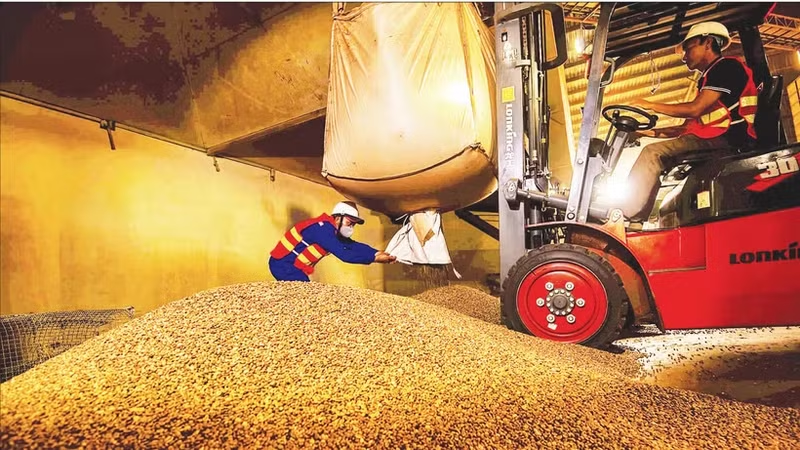
Therefore, to avoid losing market share in this region, Viet Nam’s agricultural exporters must transition to green technologies, particularly for high-emission sectors such as seafood, coffee and timber. For example, coffee exporters need to change their production and business practices to protect the environment and workers. Businesses must maintain comprehensive records on farming methods, labour conditions, water and chemical usage, emissions, and environmental impacts from cultivation and transportation.
Furthermore, enterprises are advised to ensure ethical labour practices, as from December 2027, the EU will prohibit products made with forced labour from circulating within the EU market. This regulation applies to all companies selling coffee in the EU, regardless of size.
Accordingly, cooperatives and enterprises should identify stages with potential labour risks; establish clear requirements for suppliers regarding fair labour; train farmers and workers on labour rights; create safe mechanisms for reporting violations; and regularly monitor and supervise supplier compliance, in order to best meet the “green consumption” requirements of this market.