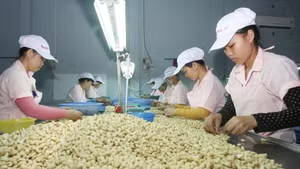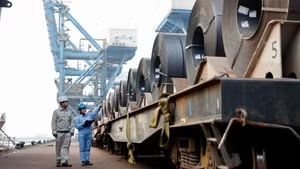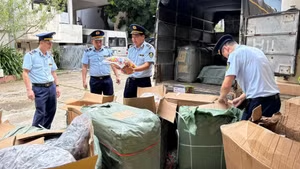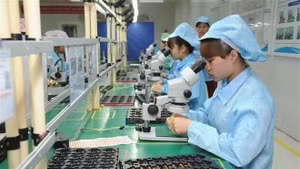
Many businesses have proactively restructured their operations, tightened cost controls, and developed contingency plans to maintain production, safeguard markets, and ensure jobs and income for workers.
Mounting pressures
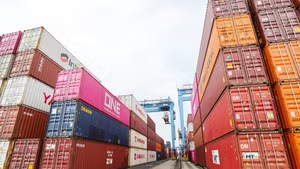
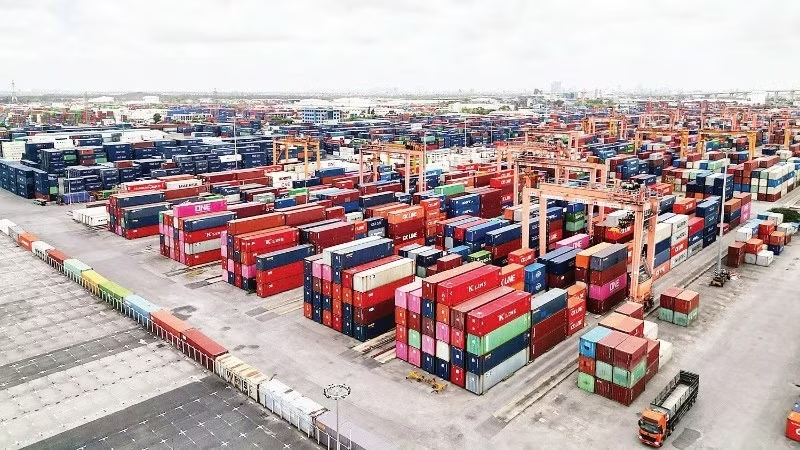
Recent fluctuations in petrol and oil prices have significantly driven up logistics costs. According to Bui Manh Toan, Chairman and Chief Executive Officer of Vietnox Joint Stock Company, an export business based in Ha Noi, transportation costs have surged by 30–60%, including domestic freight, sea freight, and container expenses. Previously, transporting a container from Long An (now Tay Ninh Province) to Lang Son cost around 70 million VND (2,600 USD), but it has now exceeded 100 million VND (3,800 USD).
For enterprises where logistics accounts for a large proportion of total costs, the pressure directly affects competitiveness. Vietnox Agri, an agricultural exporter and subsidiary of Vietnox, reported that rising transportation costs have significantly inflated product prices, while the ability to adjust selling prices remains limited due to dependence on international markets. Supply chain disruptions have extended delivery times, leading to additional warehousing and container storage costs. For fresh agricultural products, delays also directly affect quality, increasing the risk of reputational damage with partners.
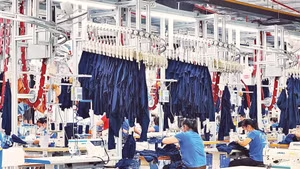
In the textile and garment sector, Tran Minh Hieu, Director of TNG Investment and Trading Joint Stock Company in Thai Nguyen Province, which specialises in garment exports, said that the costs of transporting raw materials and finished products have risen in line with fuel prices. Transport partners have proposed price increases of around 10% compared with the period before the Middle East conflict, while customers in the US and Europe are demanding faster delivery to minimise risks.
Raw material prices are also trending upwards due to higher energy and transport costs, squeezing profit margins. Meanwhile, in a still-challenging consumption market, many foreign partners are delaying or reducing orders.
Duong Quang Trung, Director of Thien Loc Thanh Import-Export Services Co., Ltd (Ho Chi Minh City), noted that since early March 2026, rising fuel prices have led to a sharp decline in export orders. Previously, the company handled the shipment and export procedures for around 2,000–3,000 containers per month, but volumes have now fallen by more than 50%. Businesses are maintaining exports only for essential goods such as food, while wood products and garments have slowed considerably.
According to the Ho Chi Minh City Export Processing and Industrial Zones Authority (HEPZA), a survey of 231 enterprises in Ho Chi Minh City showed that 52 companies (around 22%) have had to adjust their production plans to cope with rising input costs, while nearly 12% have extended delivery times due to increased transport costs and changes in logistics routes.
Proactive adjustments and flexible responses
In response, businesses have swiftly implemented a range of solutions to mitigate impacts and sustain production, focusing on controlling and optimising internal costs. Vietnox Agri has reviewed its entire process—from raw material procurement to production and operations—to reduce losses, improve efficiency, and keep costs at reasonable levels.
The company has actively engaged with multiple logistics partners, flexibly selecting routes and renegotiating delivery terms with customers to share risks. It has also restructured its market strategy by focusing on higher-efficiency orders and exploring new markets, while maintaining a stable workforce through appropriate support and welfare policies and encouraging its sales teams to expand the customer base.
At TNG Investment and Trading Joint Stock Company, alongside negotiations with transport providers to maintain reasonable rates, the firm has proactively secured raw material supplies for production. It has also accelerated the adoption of technology and automation in its sewing lines. The company has installed rooftop solar power systems at several factories, significantly reducing electricity costs. On sunny days, reliance on the national grid can fall by up to 50%.
Many enterprises have developed multiple financial scenarios, actively managing cash flow and contingency plans to ensure uninterrupted operations under all circumstances. Some are even willing to accept lower short-term profits to retain orders, sustain production, and preserve employment.
To enhance resilience, Dr Mac Quoc Anh, Vice Chairman and Secretary-General of the Ha Noi Small and Medium Enterprises Association, emphasised the need for businesses to swiftly restructure cost management and export contracts in a more flexible manner. This includes negotiating risk-sharing clauses with partners, diversifying transport routes and markets, and prioritising energy savings, internal logistics optimisation, and the application of technology in transport management to reduce storage time.
Amid ongoing market uncertainties, experts note that business resilience depends not only on capital scale but also on the quality of management and the ability to adapt flexibly.