However, as this is a particularly important issue, alongside the State’s flexible governance, enterprises themselves must also take the initiative in building production and business strategies and remain agile in seizing new opportunities.
Applying flexible governance mechanisms
The global energy market has undergone a period of strong volatility as military tensions in the Middle East pushed oil prices to their highest levels in years. However, following remarks by President Donald Trump regarding developments in the military campaign in Iran, concerns over prolonged supply disruptions have eased considerably. Signals pointing to a potential de-escalation prompted investors to quickly adjust expectations, leading oil prices to decline again. Nevertheless, many energy experts believe the market remains highly sensitive to geopolitical developments.
For Viet Nam, the impact of global oil price fluctuations is still evident in the domestic market, with retail fuel prices remaining at high levels. The Government has promptly introduced several measures to ease domestic supply pressures. One notable measure is the reduction of preferential import tariffs on various petroleum products to 0%, enabling key importers greater flexibility in sourcing supplies from diverse markets.
According to Tran Huu Linh, Director General of the Agency for Domestic Market Management and Development under the Ministry of Industry and Trade, the Petroleum Price Stabilisation Fund currently holds more than 5.6 trillion VND. The combination of flexible pricing mechanisms and the use of the stabilisation fund has significantly mitigated increases in domestic fuel prices, thereby helping to stabilise the market and consumer sentiment. At the same time, thanks to proactive diversification of supply sources and strengthened import coordination, fuel supply has generally met domestic demand through the end of April 2026.
From an economic perspective, experts note that these measures also reflect efforts by regulators to balance market stability with budget revenue objectives. In the long term, energy security will become increasingly important. Proactively securing supply, expanding import markets, and developing alternative energy sources will be key factors in reducing dependence on global geopolitical fluctuations.
While chairing a series of meetings with the Task Force on Energy Security on solutions to ensure national energy security amid the impact of Middle East conflicts on global energy supply chains, Prime Minister Pham Minh Chinh has consistently stressed the need to ensure sufficient energy for production, business, and consumption; prevent disruptions to production and fuel supply chains; and maintain political stability and social order.
In particular, the Prime Minister assigned the Ministry of Finance to coordinate with the Ministry of Industry and Trade in reviewing and reducing taxes, fees, and charges related to petroleum products to support businesses and citizens in the current context, with submission required before March 20. If the Middle East conflict persists, relevant authorities are to review and propose budget allocations for price stabilisation, guided by the principle that production, business, and people’s livelihoods remain the core foundation of policymaking.
Proactively seeking opportunities amid market volatility
Rising geopolitical tensions in the Middle East are posing strategic risks to the stability of global transport routes. For the transport and logistics sector, the issue lies not only in regional instability but also in the risk of disruptions to key maritime and aviation routes that underpin global trade flows.
Although Viet Nam is geographically distant from the Gulf region, disruptions there can still affect its trade through various channels. These indirect impacts may reduce the competitiveness of exports and complicate supply chain planning for manufacturers in Viet Nam. In this regard, Pham Quang Long, Sales and Market Development Director of Allied Movers in Viet Nam, noted that the country’s long-term challenge lies not only in responding to short-term disruptions but also in strengthening its position within the evolving global trade structure. He added that Viet Nam is well placed to reinforce its role in regional supply chains as its supply systems become increasingly adaptable to global fluctuations.
From another perspective, a representative of Ha Quang Import-Export Company said that while geopolitical volatility in the Middle East poses challenges to international trade, it also opens up new opportunities for adaptable enterprises.
According to the company, Viet Nam’s ability to “turn risks into opportunities” stems from several inherent advantages. The country lies along major international maritime routes and has an extensive network of free trade agreements with major markets in Europe, Asia, and the Middle East, allowing Vietnamese goods to penetrate global markets more deeply. After the current cycle of conflict, import demand may recover from mid-2026, particularly for goods serving consumption and reconstruction. This presents an opportunity for Vietnamese enterprises to boost exports if they are well prepared in terms of supply.
Market signals have already shown positive signs. According to a representative of Dawnsky Company, demand for agricultural products from overseas markets has risen sharply following recent geopolitical disruptions. Export orders have increased approximately 10-fold compared to the period before the conflict, particularly from markets in the Middle East and Europe. In this context, importers tend to increase purchases to compensate for shortages, creating opportunities for new suppliers. Viet Nam is emerging as a stable sourcing destination thanks to its sustained economic growth, abundant supply, and the flexibility of its enterprises in meeting orders.
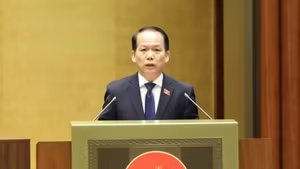
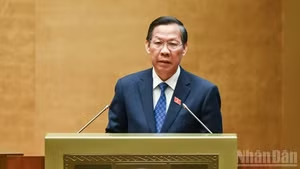
Minister of Finance Nguyen Van Thang
Consistent with a proactive approach in fiscal and budgetary management, the Ministry of Finance has synchronously implemented tasks across specific sectors. In the context of a global economy fraught with risks, this approach enables management agencies to maintain sufficient information, policy options, and flexibility to respond to emerging situations, ensure major economic balances, and lay the foundation for achieving growth targets despite global volatility. At the same time, it maximises internal economic strengths and prepares support measures for businesses while maintaining flexible budget management.
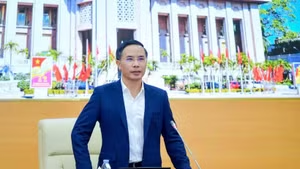
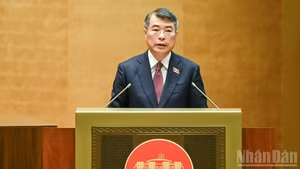
Chairman of the Viet Nam National Petroleum Association Bui Ngoc Bao
In the domestic petroleum market, the main bottleneck in ensuring supply through imports lies in pricing that must fully reflect costs. At the same time, sufficient financial resources must be ensured so that key petroleum traders can meet their assigned supply volumes, avoiding localised shortages at certain times and locations.
Head of the Macroeconomic Research Group, University of Economics, Viet Nam National University, Ha Noi — Dr Nguyen Quoc Viet
The use of the Petroleum Price Stabilisation Fund with high disbursement levels in recent days has been an important tool in “cooling down” the market, limiting impacts on people’s livelihoods, and production and business activities. In addition to maintaining macroeconomic stability and supporting production recovery to create a “buffer” for continuous operations, attention should also be paid to vulnerable labour groups. If instability affects certain segments of workers, the Government should consider appropriate fiscal measures to support low-income groups.