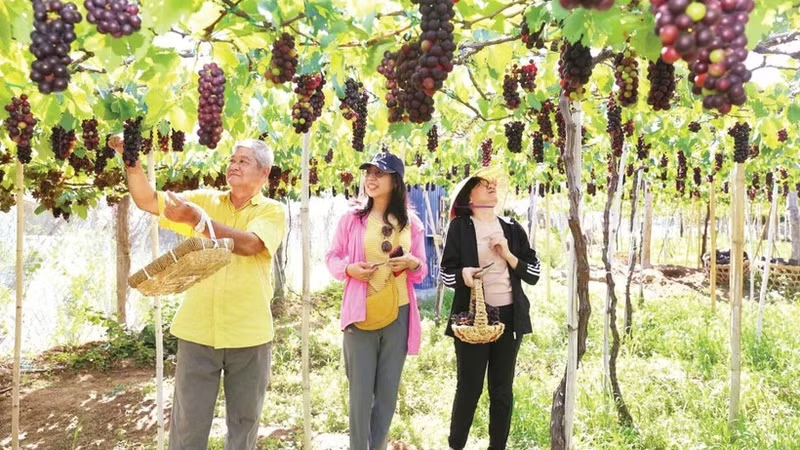
The southern region of Khanh Hoa Province encompasses more than 1,052 hectares of vineyards, concentrated mainly in communes such as Phuoc Hau, Ninh Phuoc, Ninh Hai, Ninh Son and Xuan Hai. Varieties include Red Cardinal, NH01-48, NH01-152, and Black grapes. New cultivars such as Shine Muscat, black seedless grapes, and Sweet Sapphire are also being propagated. Each year, the region supplies 26,000–28,000 tonnes of fresh grapes to the market.
Recalling over three decades of grape cultivation, Le Van Loi from Truong Tho Hamlet (Phuoc Hau Commune) noted that in the 1990s, grapes were hailed as the “queen of crops”, helping many families escape poverty. Grown on alluvial soil along the Quao River, the grapes possess a uniquely clear sweetness unmatched elsewhere.
In earlier years, one hectare of grapes yielded only 200–300 million VND annually. Today, households applying VietGAP standards, cultivating in net houses, using water-saving irrigation, biological preparations, and integrated pest management (IPM) have raised incomes to over 1.2 billion VND per hectare. Grapes now contribute 19–20% of total crop production value in southern Khanh Hoa.
Each year, farmers in southern Khanh Hoa supply 75,000–80,000 litres of processed grape products, 8–10 tonnes of dried grapes, and other items, generating substantial profits.
According to Dang Nang Tom, Chairman of Phuoc Hau Commune People’s Committee, the commune alone has more than 22 hectares under grape cultivation. Farmers increasingly focus on clean, high-quality production, making grapes more marketable and commanding higher prices. Many households have risen out of poverty through grape farming.
Beyond supplying fresh grapes, enterprises, cooperatives, and households have invested in machinery and technology to process grape products, enhancing value further. Around 30 enterprises, over 10 facilities, and 200 households in Khanh Hoa are engaged in processing, producing grape wine, syrup, chewy dried grapes, dried grapes, and juice to meet rising market demands.
Each year, farmers in southern Khanh Hoa supply 75,000–80,000 litres of processed grape products, 8–10 tonnes of dried grapes, and other items, generating substantial profits. Provincial authorities have prioritised investment in modern production lines, with 25 drying systems and three grape processing and preservation lines now in operation. Many products have achieved 3–4 star OCOP standards, securing a firm market position.
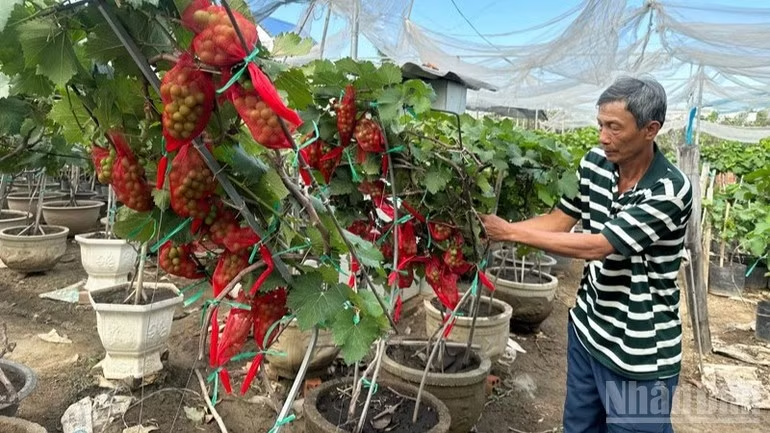
Ba Moi Production, Trading, and Services Limited Liability Company in Phuoc Huu Commune exemplifies this transformation. Director Nguyen Dai Ve revealed that in 2025, the company invested over 360 million VND in an automatic filling and labelling system, of which 140 million VND funded by agricultural extension support. This upgrade not only improved efficiency but also transformed product presentation, enabling access to major supermarket chains.
Previously, the company’s dried grapes and dried apples were highly rated by consumers for quality, but the packaging was simple and lacked professionalism, making it difficult to access major supermarket chains. Now, with modern machinery support, every filling and labelling step is carried out synchronously and precisely. As a result, the product appearance has completely changed, meeting the stringent standards of modern distribution markets.
Enterprises affirm that automation ensures consistent quality, reduces labour and operating costs, and lays the foundation for confident market expansion. Trade promotion has also intensified through fairs, supply-demand conferences, and e-commerce platforms, boosting grape product value.
Nguyen Khac Phong, Director of Thai An Comprehensive Agricultural Services Cooperative in Vinh Hai Commune, shared that thanks to effective promotion, the cooperative’s grape honey, wine, and dried grapes sell briskly, while its NH01-152 vineyard has become a popular year-round tourist destination.

The Nha Ho Research Institute for Cotton and Agriculture Development under the Ministry of Agriculture and Environment plays a pivotal role in enhancing grape value. The Institute, regarded as the “cradle” of new grape varieties adapted to the hot, dry climate of south-central Viet Nam, preserves over 230 grape germplasm samples in its gene bank orchard, ranging from table grapes and wine grapes to drying grapes and rootstocks.
Deputy Director Dr Phan Cong Kien highlighted varieties such as NH01-152, NH04-102, and NH01-205, which offer high yields, attractive appearance, and fruit quality comparable to imported grapes. Notably, the seedless NH04-102 variety fetches 150,000–250,000 VND/kg at the farm gate, far surpassing traditional varieties.
The grape has become not just an agricultural product, but a symbol of aspiration rising from the sun-baked soil of south-central Viet Nam
Beyond breeding, the Institute has transferred modern techniques including net-house cultivation, Y-trellis systems, water-saving irrigation, organic fertiliser use, biological preparations, and IPM. These methods boost yields, protect soil, and preserve ecosystems. New varieties have quickly proven effective, with selling prices three to four times higher, while production costs have fallen thanks to eco-friendly cultivation processes.
Deputy Chairwoman of Khanh Hoa Provincial People’s Committee, Le Huyen, affirmed that with over 1,000 hectares of grapes and 1,350 hectares of apples, the southern region of Khanh Hoa is poised for major opportunities in specialised agriculture linked to ecotourism. Authorities are reviewing and adjusting planting area planning, expanding new varieties under VietGAP standards, building value chain linkage models, and promoting high-quality grape and apple brands.
From lush green grapevines thriving on arid land, a sustainable agricultural value chain is taking shape. Science and technology serve as the “key”, farmers remain at the centre, and the grape has become not just an agricultural product, but a symbol of aspiration rising from the sun-baked soil of south-central Viet Nam.