Accounting for nearly 30% of global GDP and population, RCEP is widely regarded as the world’s largest free trade area, opening up vast opportunities for the consumption of Viet Nam’s agricultural, forestry, and fishery products. Le Hang, Deputy Secretary General of the Viet Nam Association of Seafood Exporters and Producers (VASEP), said that seafood exports to RCEP markets currently account for more than 50% of the sector’s total export value. In 2025, exports to China alone exceeded 2.2 billion USD, up around 33% year on year. In Japan, seafood exports also recorded growth of 14.6%, reaching nearly 1.7 billion USD. Exports to the Republic of Korea (RoK) and Australia rose by 9.6% and 3.2% respectively.
Accounting for nearly 30% of global GDP and population, RCEP is widely regarded as the world’s largest free trade area, opening up vast opportunities for the consumption of Viet Nam’s agricultural, forestry and fishery products.
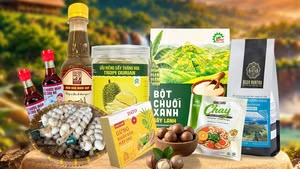
Alongside seafood, fruit and vegetables have also been among the fastest-growing export items within the RCEP region. Data from the Viet Nam Fruit and Vegetable Association show that China continues to dominate, accounting for around 65% of the market, with total export turnover in 2025 exceeding 5 billion USD. Notably, fruit and vegetable exports to Malaysia surged by nearly 80% in 2025, while exports to Australia rose by about 30%. According to many businesses, exports to RCEP markets have been significantly boosted by flexible rules of origin.
While many free trade agreements require products to have wholly Vietnamese origin in order to qualify for tariff preferences, RCEP allows for intra-bloc cumulation of origin. Under this mechanism, agricultural, forestry, and fishery raw materials can be imported from one or more RCEP member countries and then processed in Viet Nam, while still qualifying for a certificate of origin to enjoy preferential tariffs.
That said, exports to the RCEP region have also revealed new “bottlenecks”, reflected in stagnating and declining imports in several ASEAN markets. Nguyen Chanh Trung, Director of Hung Viet Rice Co., Ltd, noted that rice exports in 2025 no longer maintained the growth momentum seen in previous years, as key markets such as Indonesia and the Philippines sharply reduced imports — a trend expected to continue this year. To capitalise on RCEP advantages, he said, businesses need to shift more quickly towards markets such as Japan, the RoK, and China, focusing on high-quality rice, specialty rice, and deeply processed rice products.
Another major challenge lies in the high degree of similarity in product categories between Viet Nam and many other RCEP member countries, intensifying competition. Viet Nam faces direct competition from Thailand, Malaysia, the Philippines, Laos, and Australia in products traditionally considered its strengths, including rice, seafood, and tropical fruit.
According to the Agency of Foreign Trade under the Ministry of Industry and Trade, although Thailand and Viet Nam together supply the bulk of China’s durian market, Malaysia, Myanmar, and Laos are accelerating exports, particularly in the processed segment. For pomelo, Laos has now emerged as China’s largest supplier, while Viet Nam — despite its abundant supply — has yet to achieve a comparable position.
Across the vast RCEP space, stretching from Northeast Asia and Southeast Asia to Australia, Viet Nam’s agricultural exports still have considerable room for growth. However, each market operates according to its own characteristics, requiring businesses to pivot towards more targeted approaches by product segment and partner, rather than pursuing uniform exploitation. Specifically, China offers a huge market but intense competition; ASEAN is entering a phase of restructuring demand and supply; while Australia and New Zealand impose high standards and require long-term commitments.
If these characteristics are properly understood, the advantages of RCEP will extend beyond tariff preferences or geographic scope, encompassing enhanced market adaptability, stronger production chain organisation, and the genuine competitiveness of each industry.