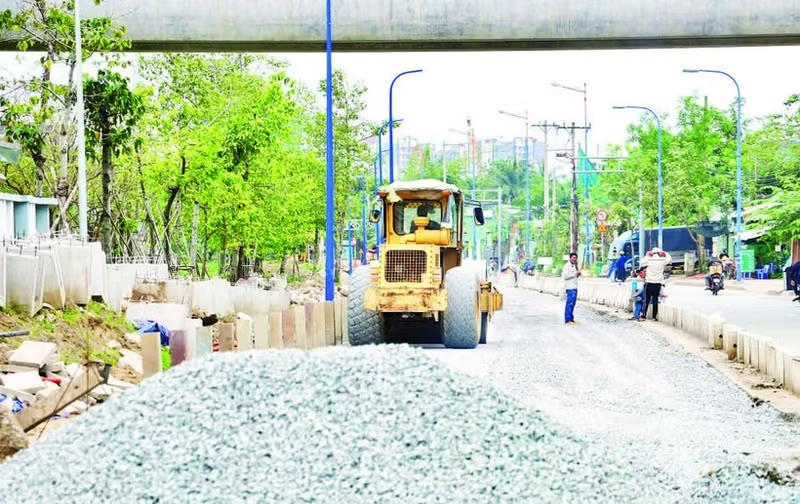
Unlocking resources will not only determine the progress of individual projects but will also have a direct impact on the city’s competitiveness, quality of growth and role as the nation’s economic engine in the 2026-2030 period.
Identifying the bottlenecks
The year 2025 was identified as a period in which Ho Chi Minh City would concentrate its resources on implementing public investment projects, particularly key transport projects with regional connectivity.
On the ground, a number of major projects are being fast-tracked, including Ring Road 3, the Bien Hoa-Vung Tau Expressway, the Tham Luong-Ben Cat-Nuoc Len Canal upgrading project, along with many other important infrastructure works.
In the 2026-2030 period, the city plans to continue implementing very large-scale projects such as Ring Road 4, the Ho Chi Minh City-Moc Bai Expressway, the expansion of the Ho Chi Minh City-Long Thanh-Dau Giay Expressway and the Ho Chi Minh City-Trung Luong Expressway, as well as Metro Line 2, among others.
This underscores that public investment is not merely a short-term task but a strategic pillar for expanding development space, easing pressure on existing infrastructure and creating long-term growth momentum.
However, practical implementation shows that the pace of public investment remains heavily affected by familiar bottlenecks.
Nguyen Thi Ngoc Thuy, Deputy Director of the city’s Department of Agriculture and Environment, said that in 2025 the city is implementing 290 projects, with more than 60 trillion VND allocated for site clearance.
These figures reflect considerable efforts by the authorities. Nevertheless, for public investment capital to truly flow quickly and efficiently, two decisive input factors remain: cleared land and construction materials.
Of these, the scarcity of certain materials, especially filling sand and construction stone, is emerging as a new bottleneck, posing major challenges amid increasingly stringent environmental protection requirements. This is not only a difficulty for the city but also a common reality across many localities in the Southeast region and nationwide.
According to Phan Tan Dat, Chairman of the city’s Mineral Industry Association, although the central government has issued a number of special mechanisms, shortages of materials are still putting many projects at risk of delays and significant cost overruns.
More worryingly, the prioritisation of material supplies for state-funded projects has left the market serving residential needs and non-public-sector businesses almost depleted. As overall infrastructure investment across society continues to rise sharply, pressure on material supply will only intensify without fundamental solutions.
From a policy perspective, Nguyen The Minh, Deputy Director of the Department of Construction Economics and Investment Management at the Ministry of Construction, pointed out that inadequate material supply is seriously affecting the annual public investment disbursement plans of ministries, sectors and localities.
The causes also stem from long-standing shortcomings in the previous legal framework, particularly regarding access to and licensing of material mines.
A typical example is negotiations over land-use right transfers in areas with mineral deposits. In reality, many landowners are unwilling to transfer land or deliberately inflate prices once they know a project will pass through, creating major obstacles to licensing mines for nationally important projects.
Although the revised Land Law allows land recovery in mineral exploitation areas, truly unlocking resources requires management policies and decentralisation to be implemented in a more open and consistent manner.
An integrated and comprehensive management model needed
Beyond materials, site clearance continues to be seen as a decisive factor determining the success or failure of public investment.
Pham Viet Thuan, Director of the city’s Institute of Natural Resources and Environmental Economics, cited the Ho Chi Minh City-Moc Bai Expressway as an example illustrating stark disparities between localities.
While Tay Ninh has largely completed compensation work, Ho Chi Minh City is still facing numerous obstacles due to compensation rates that are low compared with actual market prices.
According to Thuan, when residents are adequately compensated, site handover proceeds swiftly. Even if compensation prices are slightly higher, in the long term the city still benefits when opportunity costs from earlier project completion, reduced congestion, and savings in time and logistics costs for society as a whole are taken into account.
Nguyen Thi Ngoc Thuy stressed that for public investment projects to be highly effective, decisive engagement from the entire political system is required, along with close coordination among all levels and sectors, local authorities, investors, contractors and the business community.
In the coming period, the Department of Agriculture and Environment will continue to work closely with relevant units to effectively implement special mechanisms, linking construction material management to the actual progress of each project and ensuring a balance between economic development, resource protection and sustainable growth objectives.
From a long-term perspective, many experts argue that public investment should not be assessed solely by disbursement rates but should instead be viewed as a lever to enhance the economy’s total factor productivity.
Priority should be given to evaluating the life-cycle effectiveness of public investment capital, thereby creating momentum for the parallel development of social infrastructure and the private sector.
In a context where Viet Nam still lacks a national-level master plan for common construction materials such as soil, sand and stone, unlocking and efficiently utilising available resources has become ever more urgent.
Only when these bottlenecks are removed can public investment truly play its guiding role, paving the way for rapid and sustainable growth in Ho Chi Minh City and the entire Southern Key Economic Region in a new phase of development.