In the broader flow of global development, DE&I is no longer a purely social concept, but has become a pillar of sustainable growth and national competitiveness.
In many developed economies, DE&I is regarded as the “soft infrastructure” of growth, where every individual and every social group has the opportunity to participate, contribute and benefit from development outcomes. In Viet Nam, alongside deepening integration and the transformation of the growth model, thinking on DE&I is gradually shifting from a narrative of social responsibility to an element constituting institutional quality and the internal strength of the economy.
Expanding access to education, employment, finance and technology for all segments of society, especially young people, women, rural areas and small businesses, not only promotes social equity, but also unlocks latent resources, helping to form the foundation for an inclusive, innovative and long-term growth phase with strong momentum.
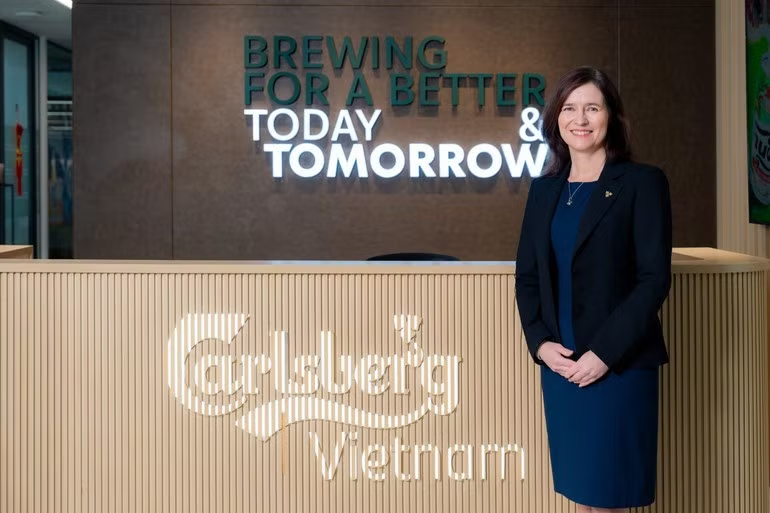
In an interview with Nhan Dan Newspaper, Susanne Skippari, Senior Vice President for People and Culture at Carlsberg Group, shared insights drawn from global management practice on the role of DE&I in enhancing leadership quality, organisational effectiveness and long-term competitiveness.
Q: Why is “inclusion” increasingly becoming a key factor in the long-term effectiveness of businesses?
A: Because it directly affects the quality of decision-making. When people feel safe to speak up, to challenge and to be different, organisations see more, learn faster and avoid dangerous “blind spots”. Inclusion, in its deepest sense, is not a moral issue but a condition for organisations to operate sustainably in a volatile environment.
Q: At senior leadership levels, standards are often “unspoken”. How does this affect women?
A: When criteria are unclear, bias can easily creep in. Women often face “double expectations”: they must be decisive but not too direct, confident but not too prominent. If evaluation systems rely more on perceptions than on transparent criteria, opportunities are no longer truly fair.
Q: In your view, what is the biggest barrier for women on the leadership journey?
A: Not capability, but access to opportunities and trust in the system. Many people have potential but are not “on the radar”, and lack someone to proactively nominate or sponsor them when important personnel decisions are made. When the “rules of the game” are not clearly stated, those who are less present in spaces of power must work harder to be recognised.
Q: So what is the key to creating substantive change?
A: It requires a combination of individual effort and system design. Leaders need a high level of self-awareness, the ability to build trust and to prioritise deliberately. But equally important is that organisations must clarify expectations, standardise feedback and assess potential consistently. Leadership cannot rely on “unwritten rules”; it must be a capability that can be built and scaled.
Q: Many companies talk about DE&I but struggle to implement it in practice. Why is that?
A: Because they treat it as a programme rather than a way of operating. DE&I only has meaning when it is embedded in everyday people decisions, from recruitment and training to task allocation and promotion. When linked to a culture of learning and development, inclusion spreads naturally rather than requiring constant pressure.
Q: Carlsberg has set a target that by 2030, 40% of senior leadership positions will be held by women. Why is developing female leadership a strategic priority for the Group?
A: Developing female leadership is a strategic priority because it strengthens the leadership pipeline and improves the quality of decision-making. These are critical factors for organisations to operate effectively and sustainably in the long term.
Carlsberg aims for women to hold 40% of senior leadership roles by 2030, and globally this figure has already surpassed 30%. However, the focus is not solely on numbers. More importantly, it is about building a leadership team that is diverse in perspectives and ensuring that development opportunities are allocated based on capability, potential and real contribution.
For progress to be sustainable, discipline in implementation is essential. Representation at a single point in time is not enough; what truly makes a difference is the strength of the leadership pipeline, the pace of development and the fairness of opportunity. That is why we focus on strengthening succession planning, building development pathways and setting clear leadership expectations so that progress is not only measurable but also maintainable over time.

Q: From your perspective, why does developing female leadership have strategic significance?
A: Not only because of equity, but because of decision quality and succession capability. An organisation is only sustainable when it has a diverse leadership base that reflects multiple perspectives and experiences. A snapshot ratio is not enough; what matters more is the development pipeline, the pace of growth and the fairness of opportunity.
Q: Carlsberg often refers to a growth culture. How does this culture connect with DE&I in building a workplace where everyone feels a sense of belonging and has opportunities to grow?
A: Growth Culture is a mindset and a set of principles that help people and teams at Carlsberg continuously learn, improve and develop, thereby creating sustainable value for the business.
In a context of rapid market change, constantly shifting consumer expectations and intensifying competition, strategy is a necessary condition. But culture determines whether strategy actually translates into reality. A growth culture shapes how we work and create value every day, from decision-making and cross-team collaboration to maintaining empathy and closeness with consumers, and sustaining proactiveness and positive energy for continuous improvement.
DE&I strengthens that foundation by ensuring fair access to opportunities, so that each individual feels safe to contribute, ready to grow and confident to step forward, regardless of their starting point. When growth culture and DE&I go hand in hand, they do not merely deliver results, but also build trust and a sense of belonging. And it is precisely this that enables people to perform at their best, develop sustainably and remain engaged with the organisation over the long term.
Q: What message would you like to send to women who are nurturing leadership aspirations?
A: Do not wait until you feel “perfect enough”. Seek feedback early, choose experiences that are sufficiently challenging and build a network of allies. And most importantly, choose organisations where opportunities are granted based on real capability, rather than constrained by invisible biases.
Q: Thank you very much!
According to a report by Vice Chairwoman of the National Assembly Nguyen Thi Thanh at the 69th Session of the Commission on the Status of Women of the United Nations Economic and Social Council, women in Viet Nam currently account for nearly one third of National Assembly deputies and almost 40% of the workforce in STEM fields—Science, Technology, Engineering and Mathematics.
Women own 26.5% of all businesses and make up 68.5% of the labour force, higher than the global average of 48.7%. They account for 14.4% of Viet Nam’s personnel participating in peacekeeping missions, exceeding the United Nations average of 10.2%. At present, the country is also vigorously promoting digital literacy nationwide, including for women and girls.
This reflects the ongoing expansion of women’s roles in key sectors of the economy.