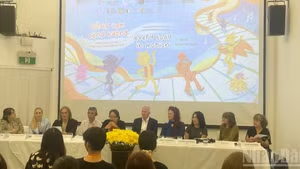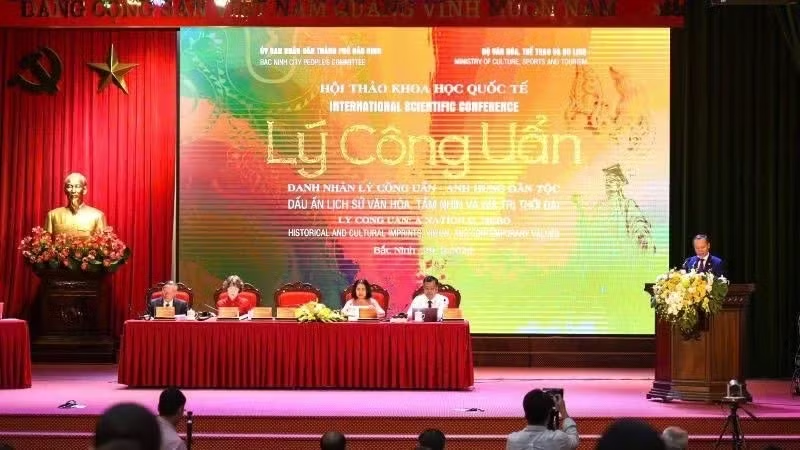
The conference aimed to deepen research and reinforce the scientific basis for compiling a dossier to submit to UNESCO, seeking recognition of Ly Cong Uan on the occasion of the 1,000th anniversary of his passing (1028–2028).
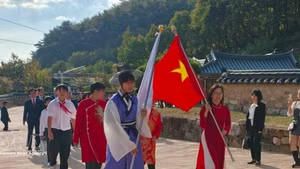
The event convened scientists, experts, and administrators from domestic and international state agencies, universities, and research institutes, alongside representatives of the Ly clan’s descendants from the Republic of Korea.
Ly Cong Uan (974–1028) — a native of Co Phap District, Bac Giang Circuit (present-day Bac Ninh City) — was the founding monarch of the Ly Dynasty. He laid the foundation for the long-term stability, independence, and autonomy of the Dai Viet nation. Through the strategic vision demonstrated in the “Edict on the Transfer of the Capital” in 1010, he relocated the capital from Hoa Lu to Thang Long (now Ha Noi), ushering in a new era of national development and establishing a political, economic, and cultural centre that has endured for over a millennium.
King Ly Cong Uan’s philosophy of humane governance — characterised by a spirit of alleviating the people’s burdens, fostering community harmony, and practising religious tolerance — embodies universal values that align with the ideals of cultural dialogue, peace, and sustainable development championed by UNESCO. In 2013, he was honoured by the Ministry of Culture, Sports, and Tourism as one of Viet Nam’s 14 exemplary national heroes.
The conference received over 60 papers covering a wide range of fields, including history, Han-Nom studies, culture, literature, Buddhism and religious beliefs, the arts, education, tourism, and heritage preservation and promotion.
The content focused on three main themes: the Kinh Bac–Hoa Lu–Thang Long axis (his homeland, the formation of his ideological foundation, and his strategic vision); his humanistic governance philosophy and its enduring contemporary relevance; and the preservation and promotion of cultural heritage associated with King Ly Cong Uan and the Ly Dynasty in the modern context.
Through these papers, the conference helped clarify the stature, value, and significance of the historical figure Ly Cong Uan within the course of Viet Nam’s history and culture, while also proposing practical solutions to preserve, promote, and disseminate the values associated with him in contemporary life.
The conference served as a significant academic forum, further acknowledging and affirming the historical stature, statecraft philosophy, and cultural heritage values of Ly Cong Uan — a national hero inextricably linked to the milestone of Thang Long and its thousand years of civilisation.