Socio-economic highlights
Overcoming the difficulties caused by the COVID-19 pandemic, Lang Son’s economy has recovered effectively. The province’s gross regional domestic product (GRDP) growth rate for 2021–2025 is estimated at 7.1%, with its economic structure continuing to shift in the right direction.
By the end of 2025, the agricultural–forestry sector will account for 20.51% (down 2.74% from 2020), industry–construction 28.06% (up 6.17%), services 47.22% (down 2.98%), and taxes on products minus subsidies 4.21% (down 0.46%). Per capita GRDP is expected to increase from 44.2 million VND in 2020 to 71.1 million VND in 2025 — rising from 1,917 USD to approximately 2,900 USD.
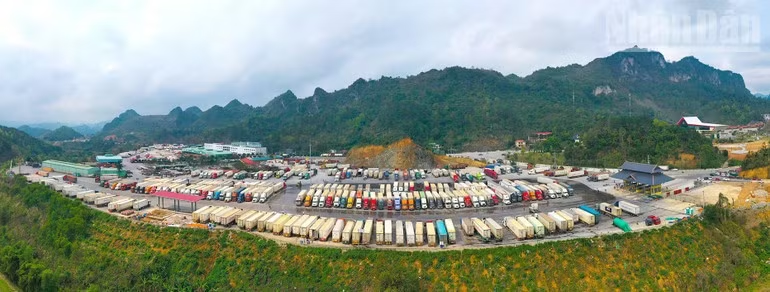
Lang Son has continued to focus on developing its border-gate economy — a key strength. The border-gate planning system has been expanded and improved, while infrastructure in border-gate areas has been synchronously developed. More than 10 trillion VND from public investment capital has been allocated to border-gate areas, which is over 6 trillion VND higher than in the previous period.
In the past five years, the total import–export turnover from all types of goods through Lang Son’s border gates reached 234.58 billion USD, while the import–export turnover declared at Lang Son Customs was about 24.2 billion USD. Local export turnover is estimated at 780 million USD, with an average annual growth rate of 8.81%.
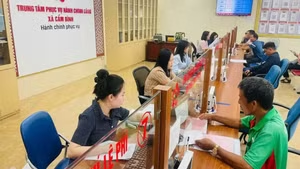
Administrative procedures have been gradually simplified, with digital transformation and technological applications introduced in import–export management, ensuring transparency, reducing costs, and saving time for citizens and enterprises. During this tenure, Huu Nghi International Border Gate was selected as the first in the country to pilot the “smart border gate” model.
Agriculture has undergone major changes in crop structure and production technology, with wide application of high-tech farming. Over 6,700 hectares of key specialty crops have been certified under VietGAP, GlobalGAP, organic, and other quality standards. Annual afforestation reaches 9,468 hectares, and the forest coverage rate is expected to reach 64.5% by 2025, up 1.5% from 2020.
In the past five years, the total import–export turnover from all types of goods through Lang Son’s border gates reached 234.58 billion USD, while the import–export turnover declared at Lang Son Customs was about 24.2 billion USD. Local export turnover is estimated at 780 million USD, with an average annual growth rate of 8.81%.
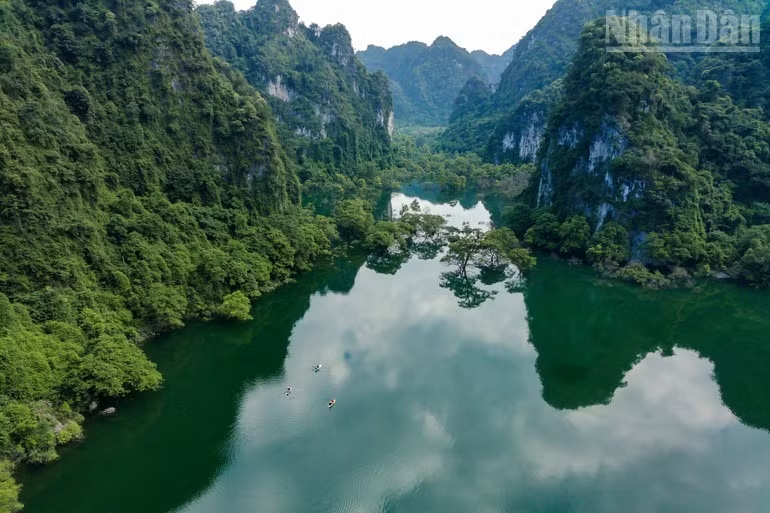
The industrial sector has developed steadily; trade and services have continued to expand, and tourism is gradually becoming an important economic sector. Lang Son Geopark has been recognised as a UNESCO Global Geopark, opening new opportunities to attract domestic and international visitors.
The province has focused on investing in and upgrading its socio-economic infrastructure, particularly transport, urban, and industrial zone infrastructure. The total social investment capital across the province for the 2021–2025 period is estimated at 181.7 trillion VND.
Several key projects have been launched, such as the Huu Nghi–Chi Lang Expressway, the Dong Dang (Lang Son)–Tra Linh (Cao Bang) Expressway, the upgrading of National Highway 4B from Km3+700 to Km18 and then from Km18 to Km80; the VSIP Lang Son Industrial Park; and several industrial clusters such as Dinh Lap, Ho Son 1, Hoa Son 1, and Bac Son 2.
By the end of 2025, 100% of communes will have asphalt or concrete roads connecting to their centres (up 12.7% from 2020), while 91% of villages will have hardened roads, marking an increase of 26%.
The investment environment continues to improve, helping attract capital and develop diverse economic sectors. During the tenure, 3,334 new enterprises were established, with total registered capital of 32.3 trillion VND — 1,496 more businesses than in the previous tenure.
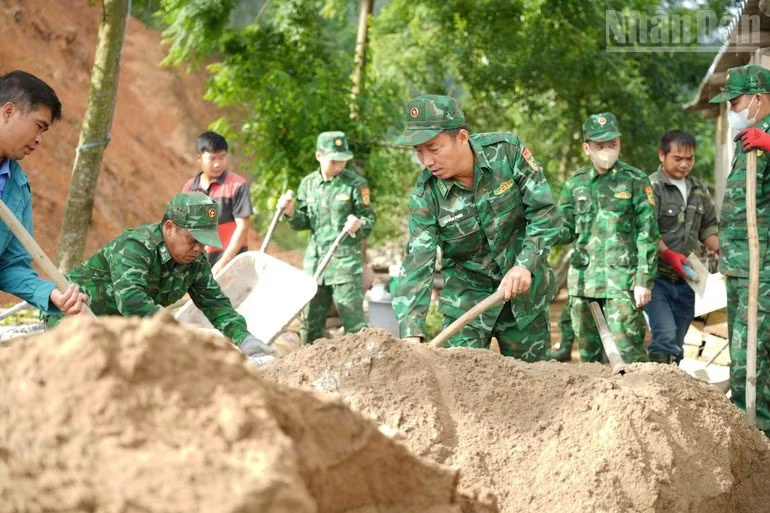
National target programmes for socio-economic development in ethnic minority and mountainous areas and for sustainable poverty reduction have been implemented effectively, with total allocated and disbursed funding of 5.43 trillion VND. As a result, 47 of 88 communes and 315 of 644 villages have escaped the “extremely difficult” category, meeting central targets.
The poverty rate has dropped by an average of 2.95% per year, with only 1.36% of households remaining poor by the end of 2025. The province has paid close attention to social housing development. The campaign to eliminate temporary and dilapidated houses has achieved full success, with all 6,508 substandard houses removed by August 2025.
Provincial Party Secretary Hoang Van Nghiem, Head of the Lang Son National Assembly delegation, affirmed: “The achievements of the 2020–2025 tenure provide a solid foundation and strong momentum for the Party, government, and people of Lang Son’s ethnic communities to overcome challenges, maximise their potential, and create new breakthroughs in the coming period.”
National defence and security consolidated
Lang Son has firmly strengthened its all-people defence posture in combination with people’s security, ensuring close and effective coordination between socio-economic, cultural, and foreign affairs development and national defence and security.
Lang Son Province stands out nationwide for its implementation of landmark inspection routes and border protection roads. As of April 25, the province has constructed and completed 310 routes with a total length of nearly 70 km, and installed 1,125 solar-powered lights, stretching 63.4 km, under the model of illuminating border patrol roads.
People-to-people and defence diplomacy activities, along with mass movements to safeguard national territorial sovereignty and border security in the new context, have been effectively implemented through various creative and practical models. These include pilot models encouraging local communities in border communes to participate in protecting national border sovereignty, and coordination between local authorities and functional forces to promote the operation of twinned residential clusters, villages, and communes across the border.
National security and social order have been firmly maintained. Lang Son Province has focused on building a clean, strong, disciplined, elite, and modern police force capable of fulfilling its tasks in the new context, while organising its apparatus in line with the principle of “comprehensive at the provincial level, strong at the communal level, and close to the grassroots level.” The movement for all people to protect national security has been renewed, enhanced, and proven increasingly effective.
Market management and the fight against smuggling and trade fraud have seen marked improvements. Relevant forces such as market surveillance, customs, border guards, and police have coordinated to launch major inspection campaigns, curbing smuggling and counterfeit goods.
Recognising that digital transformation and technological innovation are key drivers for socio-economic development, the Standing Board of the Lang Son Provincial Party Committee issued Resolution No. 49-NQ/TU (dated September 28, 2021) on digital transformation to 2025, with orientation to 2030.
To date, Lang Son’s digital transformation has been implemented comprehensively across five pillars: digital transformation within Party organisations, digital government, digital economics, digital society, and digital border gates.
Lang Son consistently ranks among the top 10 provinces and cities nationwide in digital transformation and has been recognised among the top five in ICT development across economic sectors. The province has received the “Viet Nam 4.0 Top Industry Award 2024” and the “Viet Nam Digital Transformation Award 2024” from the Viet Nam Union of Science and Technology Associations and the Viet Nam Digital Communications Association.
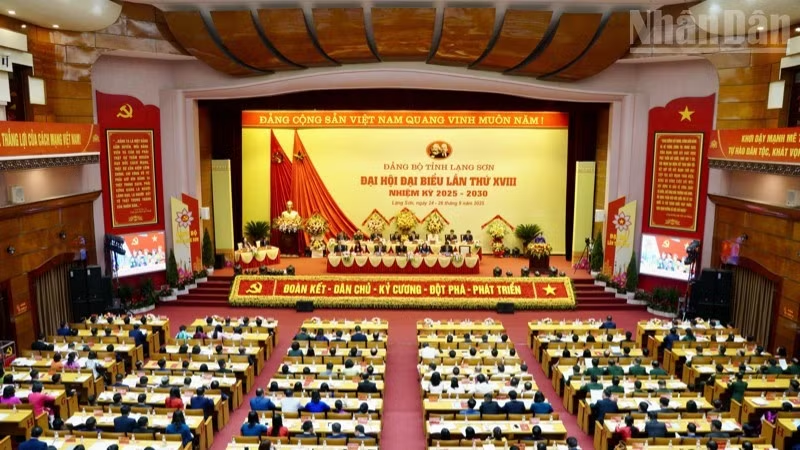
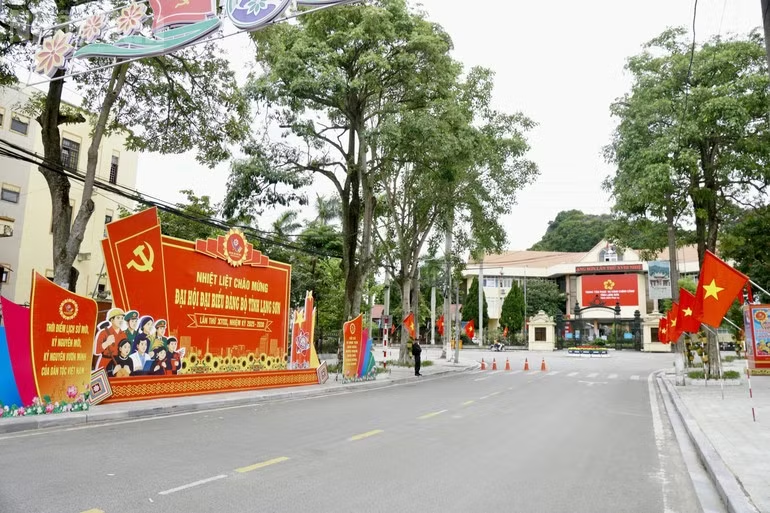
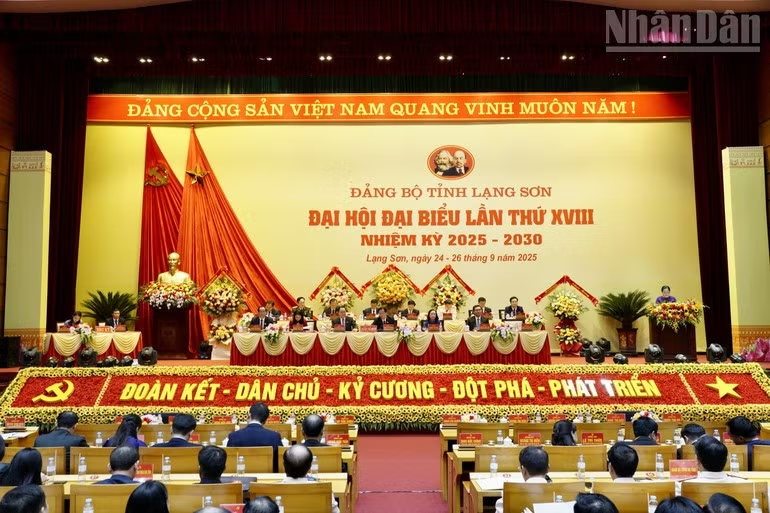
The 18th Lang Son Provincial Party Congress, held on September 24–26, 2025, took place as the country marks 40 years of Doi Moi, with its position, potential, and international reputation reaching new heights.
Secretary of the Provincial Committee Hoang Van Nghiem emphasised that this congress is a major political event and a significant milestone for the Party Committee, government, and people of Lang Son’s ethnic communities.
The 18th Lang Son Provincial Party Congress is a major political event and a significant milestone for the Party Committee, government, and people of Lang Son’s ethnic communities.
Hoang Van Nghiem, Secretary of the Lang Son Party Committee and Head of the Provincial Delegation to the National Assembly.
The congress adopted a resolution with practical, feasible, and effective targets and orientations, laying the groundwork for Lang Son to continue to promote its proud revolutionary traditions and past achievements, opening a new stage of development with higher goals and greater aspirations.
Its vision is clear: to build a clean, strong Party and political system; promote unity; mobilise all resources; and realise the aspiration for development — turning Lang Son into a new growth pole of the midland and northern mountainous region, advancing together with the nation into a new era of progress, prosperity, and national strength.
The Party Committee, authorities, armed forces, and people of all ethnic groups in Lang Son Province confidently embark on the new 2025–2030 tenure, marching in step with the nation into a new era of development — the era of Viet Nam’s national resurgence.