The lyrics of the Quan ho singers echo around the gentle incline leading up the pagoda on Lim hill. The 25 kilometre bike ride along grey, wet roads, whipped by wind and deafened by the thundering roar of trucks seems to suddenly belong to some far off distant future.
Despite the odd nod to modernism through the adoption of amplification and backing tapes in some cases, the lyrics of the Quan ho singers remain firmly rooted in the past, identifying the deep historical nature of this most ancient of Vietnamese folk music.
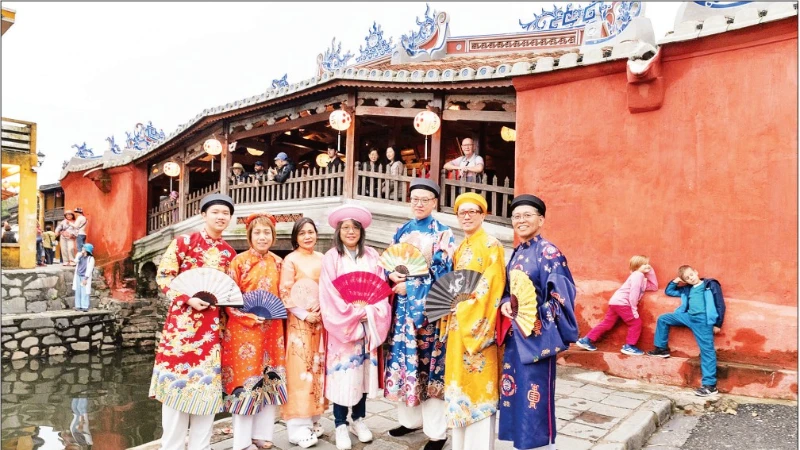
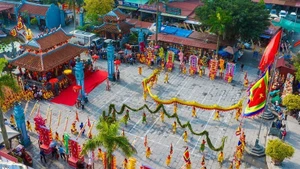
Women dressed in brightly coloured gauze tunics in rich purples and deep reds, green belts or magenta waist bands, men in more somber blues, silvers and grey are huddled beneath canvas roofed performance areas. Crowds gather around the singers eager to follow the deft catchy melodies, and savor the humorous, yet often heartfelt lyrics.
As each group performs, the crowd listens attentively, making small donations of VND 5,000 to the singers, while indulging in the traditional chewy festival food of An Trau- areca, lime, rose-petal and betel once used to colour teeth and wear away everyday troubles.
Quan ho songs are subtle and emotional pieces steeped in both Vietnamese and Chinese traditions common in northern Vietnam's Kinh Bac region. It is typified by alternate verses sung by different singers, either in pairs or in groups. The two most popular types of Quan ho are hat doi (call-and-response singing) and hat doi (duet singing) groups. Its origins stretch back hundreds of years, with some of the earliest songs dating as far back as the fifteenth century. Some scholars have dated the origins of the music even further back as far as the Ly dynasty (1009-1225), where men and women from neighbouring villages in Bac Ninh province began to sing alternate verses to each other.
Singing Quan ho is often the highlight of a festival or even regarded as an event in its own right. The demands are arduous to reach the peak of such a profession. Not only are the singers needed to be able to perform for very long stretches of time (often as long as 12 hours), but they also need a period of intense development.
Some singers have been now recognised by UNESCO as being "living human treasures". Vu Thi Chich who possesses a mental music library of 500 Quan ho songs is a slight, energetic woman of 84, however she ranks as a mere stripling compared to the venerable Nguyen Thi Khuou, of Ngang Noi village who is 103.
Quan ho singers pass the tradition down to younger vocalists. Older singers find girls and boys around 12 years old from their village and pair them with a member of the opposite sex for training. Once a duo has been formed, it will rarely be split up, and the pair are not permitted to marry each other.
While the melodies may be sweet and subtle, the images of rivers, boats, birds and objects common to village life and of course love, are strong characteristics of the folk songs.
Quan ho songs are unique in the sense that they place men and women on an equal basis, with mutual respect in spite of good-natured teasing, and place a high value on genuine feelings. The songs address the joy of nature and the satisfaction of hard field work when the labour is shared or lightened by singing together.
One of the characteristics of Quan ho that has endured throughout time is the proper verbal and poetic introduction to every tune. Quan ho singers are not only appreciated for their singing ability, but also for their skill in leaving an impression of their gracefulness and literary adeptness on the audience. Usually one of the singers will say something to praise the opposing pair and express how fortunate her/his pair has been to be allowed to sing with them, before she/he goes on to recite the verses of the song. The poetic introduction also provides listeners with the basic context of the song text, which otherwise can be difficult to follow in singing.
I spoke to Nguyen Thi Nhung Chairwoman of the local Quan ho and Senior People’s Club. She talked about the traditions of Quan ho ‘Our costumes are brightly coloured, and some of us wear belts with metal adornments, historically these would have been status symbols and signifiers of wealth’. She was delighted by the UNESCO recognition of Quan ho, and while welcoming continued interest by young people in the music, she emphasised it’s traditional motifs and roots ‘while I am happy by the development and evolution of the tradition, I am more interested in the original material, it is harder to sing, and perhaps recent songwriters have made life a little easier for younger singers with their compositions’.
As the festival began to wind down I become acquainted with some of the other singers. Ngo Thi Tuyet and Nguyen Thi Dung invite me to their house in a nearby village at the end of the festival for lunch, feasting on a delicious spread of fresh salad, nem and fresh eggs from their own chickens - a remarkably generous gesture and symbolic of the genuine warmth and hospitality that surrounds the Quan ho singers. After eating my fill, I began the journey back to Hanoi, the sounds of the Quan ho traditional farewell song ringing in my ears, blocking out for a moment the roar of 21st century traffic.
‘Dear friend! Stay here, do not return home. You went back home and made me weep silently. The two flaps of my dress were soaked with tears’
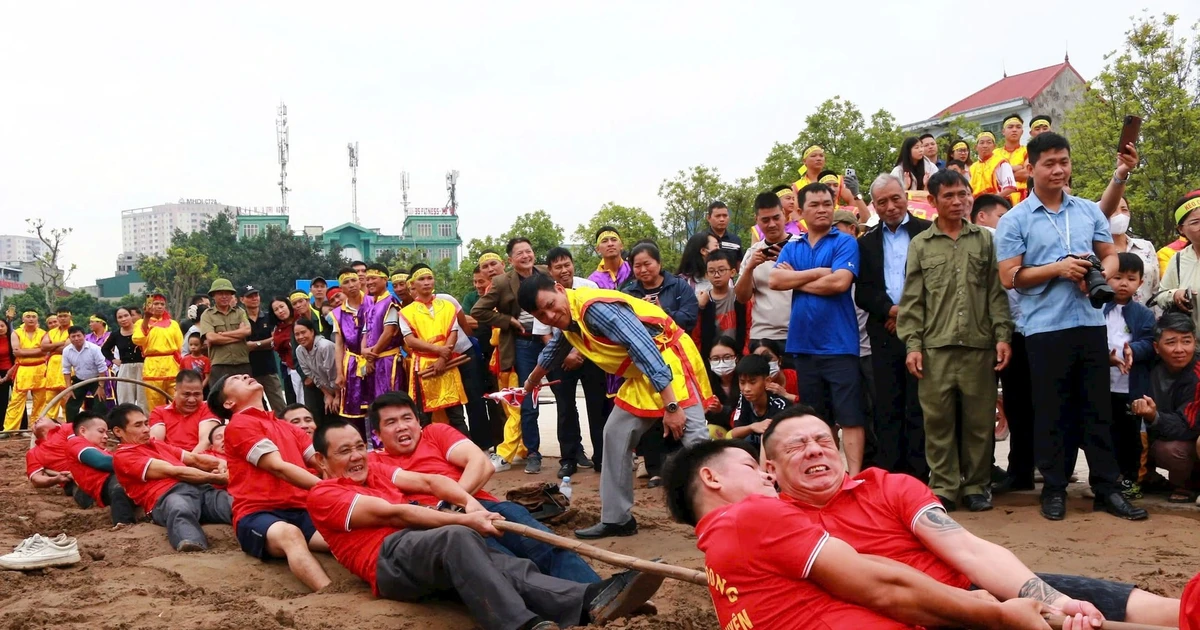
- In addition to the music that dominates the festival; traditional folk games are also played, including a game featuring a giant swing and human chess. The Lim festival runs from the 12th to the 14th of the first month of the Lunar calendar, with the 13th being the most popular day. Bac Ninh province (roughly 25km from Hanoi).