On the occasion of the club’s 25th anniversary, Van granted an interview to Nhan Dan Weekly reporter Luong Nhi, in which she looked back at her 35 years of falling in love with this folk art form.
Question: Can you please tell us the reason why you established the Hanoi Ca tru club when the art form was facing the threat of being lost at that time?
Meritorious Artist Bach Van: In 1980, when I happened to hear artisan Quach Thi Ho singing Ca tru, I was so captivated by her performance that I rushed to study Ca tru and I found that it was a one of Vietnam’s most unique art forms.
However, at that time many people held a prejudice towards Ca tru, considering it an unsound form of entertainment leftover from the old regime, receiving little care for preservation. There was no space for performing Ca tru; Ca tru singing groups broke up, and Ca tru artists retired from the world and sought other jobs to earn a living.
At that time, I was working at the Hanoi Department of Culture, Sports and Tourism. I convinced some artisans with a deep understanding of Ca tru to join the Hanoi Ca tru club.
From an outsider of Ca tru, how did you become a Meritorious Artist in the art form which requires high standards for practitioners?
My first mentor was veteran Ca tru singer Quach Thi Ho. At first, she refused my petition to learn Ca tru because she herself did not believe that Ca tru could be revived. It took me a long time to get her to agree to be my teacher. I was Ho’s student for four years.
I also went after artisans Chu Van Phuc, Chu Van Duc and Nguyen Kim Duc to learn from them.
You successfully defended your master thesis on Ca tru, and you are working on a doctoral thesis on the art form. You and your Ca tru club also provided support for UNESCO’s recognition of Ca tru as a world intangible cultural heritage. However, few people know that the Hanoi Ca tru club’s operations are financed by you personally. Can you please tell us about the financial obstacles you have faced?
Most Ca tru clubs, including ours, are self-sufficient in funding operations. We are lucky enough to receive support from benefactors; however, the club’s members and I have to spend our own money to pay for everything, from costumes and musical instruments to expenses for guest performers at our shows.
I personally have poured out all my salary to run the club, to conduct research on Ca tru in 18 northern cities and provinces, to host free Ca tru performing shows, and to teach Ca tru to younger generations.
The Hanoi Ca tru club recently celebrated its 25 anniversary on September 24. Can you please share some of your memories when looking back at the club’s establishment and operations?
After I spent over ten years leaning Ca tru, I established the Hanoi Ca tru club, which gathers those who have an understanding of the art with a determination to preserve this art form and bring it back to its deserving position in the country’s traditional culture.
Since its debut, the club has received enthusiastic participation and support from many Ca tru veteran artists, including People’s Artist Quach Thi Ho; Meritorious Artist Nguyen Thi Phuc; instrumentalist Chu Van Du; and deputy head of choir at Kham Thien art troupe, Dinh Khac Ban; among others.
There was a period in 2003, when the club had nearly 200 members. However, only a dozen of them are still with the club at the moment.
Our club has had to relocate its headquarters many times, from Quan Nhan, Chinh Kinh, Ngoc Ha, and Voi Phuc-Thu Le temples, before settling down at Bich Cau Dao Quan, at No.14 Cat Linh street, Dong Da district in 1993. However, when the temple underwent a restoration in 2009, the management board of Hanoi Old Quarter invited us to host performances three times a week at Kim Ngan temple, 42-44 Hang Bac street, Hoan Kiem district.
Since 2013, we have also delivered performances at 34 Hoang Cau street, Dong Da district every Saturday night.
Since the shows staged at the second venue are covered by a financial group, they are free for audiences. This show has attracted a larger number of people than the first one at Kim Ngan temple, where they had to buy tickets for the shows.
Sometimes, there are only a few foreigners coming to enjoy our performances at Kim Ngan temple. However, even with just a few people in the audience, we still go on the stage with our entire heart in our performance.
You have devoted most of your life to Ca tru. What is your greatest hope for this folk art form?
It is difficult to find Ca tru listeners who are truly in love with it, but it is even more difficult to find true Ca tru artists. There are so many talented Ca tru artists having to quit their performing career because it cannot support them financially.
My greatest aspiration is to bring Ca tru closer to the public and help Ca tru artists live well with their career so that they can fuel their love and enthusiasm for Ca tru to succeeding generations.
Our club is in need of financial support to stage regular performances and to train younger generations. I hope that the State will provide financial assistance to long-term projects and plans on developing Ca tru. It is also necessary to establish a centre for preserving the art of Ca tru, which can map out sound directions to safeguard Ca tru as well as manage and develop Ca tru clubs, which are currently disorganised in their operations.
Ca tru practitioners also need preferential treatment policies which encourage them to preserve and hand down the essence of Ca tru to following generations.
Thank you so much for your sharing!
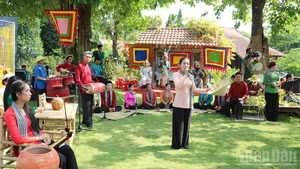
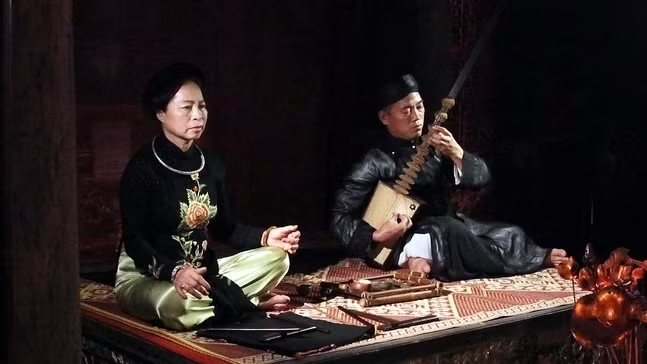
| Ca tru is a complex form of sung poetry found in the north of Vietnam using lyrics written in traditional Vietnamese poetic forms. Ca tru groups comprise three performers: a female singer who uses breathing techniques and vibrato to create unique ornamented sounds, while playing the clappers or striking a wooden box, and two instrumentalists who produce the deep tone of a three-stringed lute and the strong sounds of a praise drum. Some Ca tru performances also include dance. The varied forms of Ca tru fulfill different social purposes, including worship singing, singing for entertainment, singing in royal palaces and competitive singing. Ca tru was inscribed on the UNESCO’s list of Intangible Cultural Heritage in Need of Urgent Safeguarding in 2009. |
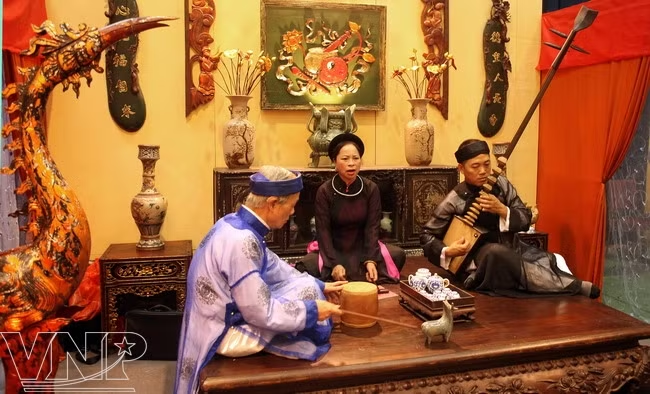
A Ca tru group comprise three performers: a female vocalist, a drummer and a lute player (Photo: Vietnam Pictorial)
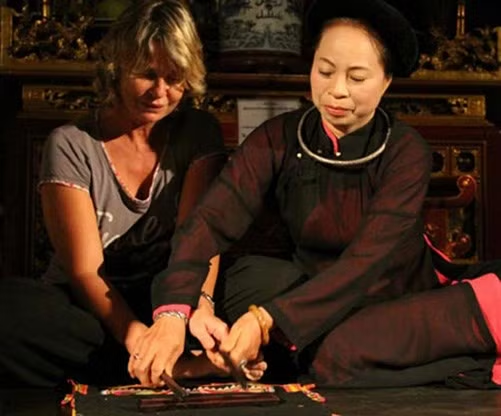
Meritorious Artist Bach Van instructs a foreigner to strike a wooden box, which is used in a Ca tru performance
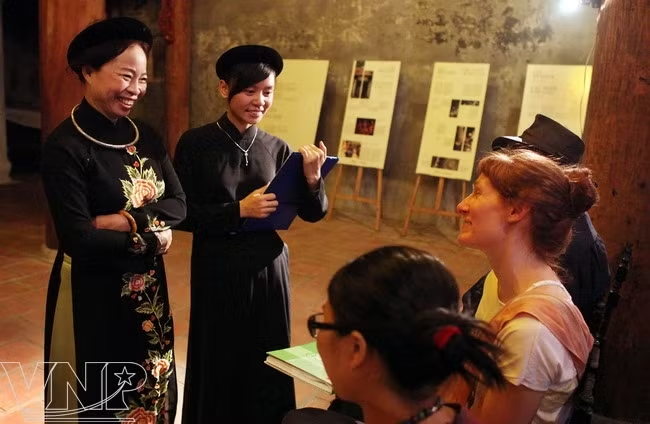
Bach Van (first from left) exchanging with audiences afer her club’s show at Kim Ngan temple (Photo: Vietnam Pictorial)
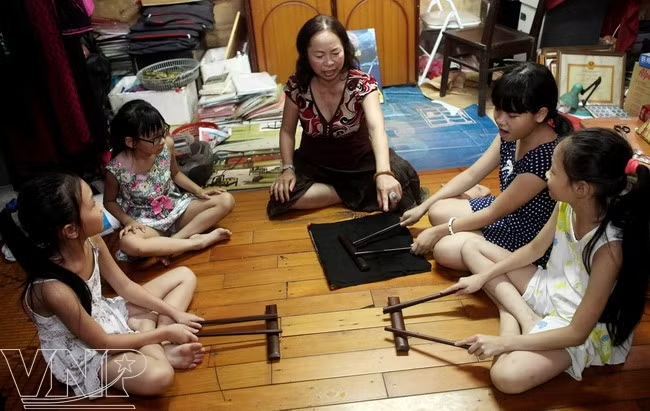
Fuelling love and enthusiasm for Ca tru to succeeding generations (Photo: Vietnam Pictorial)