>>> Don Ca Tai Tu receives UNESCO certificate
>>> Preserving the true spirit of Don Ca Tai Tu
The event promises festive days for local residents and Southerners in general. On the occasion, Party Central Committee member Vo Van Dung, who also serves as Secretary of the Bac Lieu provincial Party’s Committee and Chairman of the provincial People’s Council, granted Nhan Dan (People) newspaper an interview to discuss the locality’s preparations for the festival as well as the local authority’s plans to preserve the unique art form.
Can you tell us about the main features of Don Ca Tai Tu and the reasons why Bac Lieu is considered its birthplace?
Secretary Vo Van Dung: UNESCO’s recognition of Don Ca Tai Tu comes as heartening news for the Vietnamese people and southerners in particular. It is the eighth Vietnamese cultural practice to be honoured as UNESCO Intangible Cultural Heritage.
According to the UNESCO evaluation, the art form meets all the necessary criteria for the accolade as it has been passed down from generation to generation through official and unofficial educational channels across 21 southern provinces. It is constantly recreated through cultural exchanges between a diversity of ethnic groups, and represents mutual respect and harmony among the groups.
The acknowledgement affirmed the vitality of Vietnam’s traditional culture in its process of integration with global culture.
Although the genre was formed later than other Vietnamese folkloric music, Don Ca Tai Tu has extended its enormous vitality and influence on the public across the north to the south region as well as to Vietnamese communities abroad.
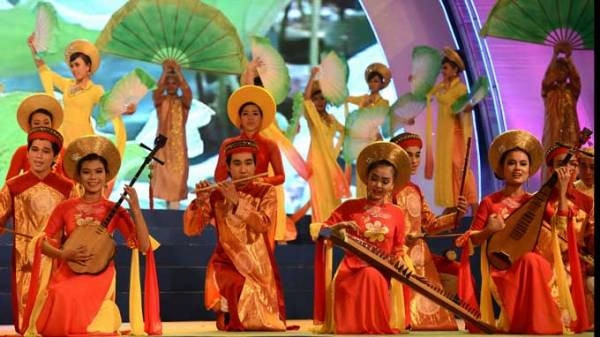
In the dossier submitted to the UNESCO, Don Ca Tai Tu is identified as an art form with scholarly and folk roots. It emerged in the southern region at the end of the 19th century as a mixture of the southerners’ ceremonial singing, Nha Nhac (Hue royal court music) and the folk music of the central and the southern region.
The roots from Nha Nhac made Don Ca Tai Tu a sort of academic music, as it has a skeletal melody, main rhythmic patterns and experienced performers. However, through their adjustment and creativity, southerners made the genre more popular and friendly to listeners. Blended with folk music, Don Ca Tai Tu has ear-pleasing lyrics, making it more familiar with workers. That’s why Don Ca Tai Tu embraces both academic and popular features. The two opposite features supplement each other nicely in Don Ca Tai Tu, making the genre a beautiful harmony of arts.
Don Ca Tai Tu has developed robustly in Bac Lieu province since the very early days.
At the end of the 19th century, Le Tai Khi—also known as Nhac Khi—formed the Bac Lieu Ancient Music Band, which rose quickly to fame across the southern region. He was considered the founder and most positive advocator of Bac Lieu’s ancient musical movements. His career and compositions had a strong influence on musical movements in many southern provinces in the early 20th century. He was also the first person to revise and systematically organise the 20 principal songs to make a firm foundation for the repertoire of Don Ca Tai Tu.
His most popular work, Da Co Hoai Lang, is a song about a wife’s longing for her husband to return home from battle. Composed in 1919, it is also the most famous song of Don Ca Tai Tu.
As far as I know, Bac Lieu is currently home to nearly 150 Don Ca Tai Tu clubs, with around 1,500 members. The figures may be bigger, as almost everyone in the province, particularly in rural areas, can sing several songs of Don Ca Tai Tu.
The festival is set to offer an opportunity for Don Ca Tai Tu artists in the southern region to exchange experience and honour folk music, as well as to affirm Vietnam’s commitment to UNESCO by sustainably protecting the Intangible Cultural Heritage of Humankind. How has the province prepared for the festival?
The first national Don Ca Tai Tu Festival–Bac Lieu 2014 is intended to honour the southern musical arts. The festival will arouse pride among Vietnamese people and southerners and reaffirm their determination to protect and promote the art form.
Bac Lieu provincial authorities always bear in mind the importance of southern cultural identity, considering it the motivation for the region’s development. In this regard, Don Ca Tai Tu plays an important role in forming the southern cultural identity.
Under the theme ‘Don Ca Tai Tu – Love of Southern People and Land’, the festival calls on everyone to preserve and practice this form of cultural identity.
As southerners are the creators of Don Ca Tai Tu, the festival has set the target of raising public awareness of the cultural value of Don Ca Tai Tu and to call on the people to preserve and develop an advanced Vietnamese culture imbued with national identity. These targets were set under the auspices of the National Action Program for the Safeguarding of Don Ca Tai Tu in the 2014–2020 period, which was announced at the recognition ceremony for the art form as intangible cultural heritage of humankind.
What is the highlight of the National Don Ca Tai Tu Festival–Bac Lieu 2014?
The festival attracts the participation of 21 provinces and cities in the southern region. It is the first time Don Ca Tai Tu has been selected as the main feature of a national-level festival.
As a highlight of the festival, the opening ceremony, which takes place in Hung Vuong Square on April 25, will honour Don Ca Tai Tu values, as well as contributions made by organisations, individuals and artists to protecting and promoting the art form. The ceremony will review the history and development of Don Ca Tai Tu, as well as the history, tradition and beauty of the southern land and people—Bac Lieu province in particular. At the same time, it will offer a cultural space for reflecting on Don Ca Tai Tu’s importance to southerners.
The second highlight of the festival is the closing ceremony, set in the Ho Nam eco-tourism site. It will be a poetic representation of the picturesque landscape of the southern region.
The festival is dedicated to the outstanding names who have contributed to Don Ca Tai Tu and Vietnam’s traditional music such as Trong Nguyen, Yen Lang and Cao Van Lau.
A series of activities, including the inauguration of a commemorative site of Don Ca Tai Tu and musician Cao Van Lau, the debut of a fund for developing Don Ca Tai Tu in Bac Lieu province, and a symposium on preserving and developing the art will also be held during the festival.
Leaders and delegates from the southern provinces’ Departments of Culture, Sport and Tourism will sign co-operation agreements on boosting tourism with travel agencies from across the country.
Under the framework of the festival, a ceremony has been planned to receive the Prime Minister’s decision recognising Bac Lieu as a second-grade city. The recognition is the city’s initial achievement during its implementation of the Bac Lieu Provincial Party Committee Resolution on developing the province’s culture.
After the festival, how does the province plan to preserve and promote this traditional art form?
Bac Lieu has realised the National Action Programme on Protecting Don Ca Tai Tu for the 2014–2020 period. Accordingly, the province has mapped out the major contents of a draft project on protection and promotion of Don Ca Tai Tu to submit to the Ministry of Culture, Sports and Tourism.
In the short term, the province has stepped up activities to raise public awareness, particularly among young generations, of upholding Don Ca Tai Tu values as well as strengthening the Don Ca Tai Tu singing movement.
The singing movement is designed to be associated with the 'Entire people unite to build a cultural life in residential areas' movement to spread Don Ca Tai Tu throughout the community, especially in rural areas.
The Cao Van Lau Literature and Arts Awards were launched five years ago. As part of the festival, a Support Fund for Preservation and Promotion of Don Ca Tai Tu will be established to provide preferential policies for artisans who make significant contributions to the protection and promotion of the art form.
The province will also create favourable conditions for the practice and training of the traditional art form in families, schools, clubs and the community. It will support composition contests to write new lyrics for Don Ca Tai Tu, and will provide support for methodical and systematic research.
In addition, the province will continue hosting the festivals and offering opportunities for artists to exchange and perform not only in the country but also abroad.
We believe that after the first festival, Don Ca Tai Tu will develop more strongly in Bac Lieu province and the southern region in general, contributing to the sustainable development of the province.
Thank you so much for the interview.