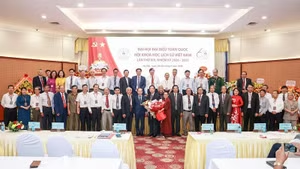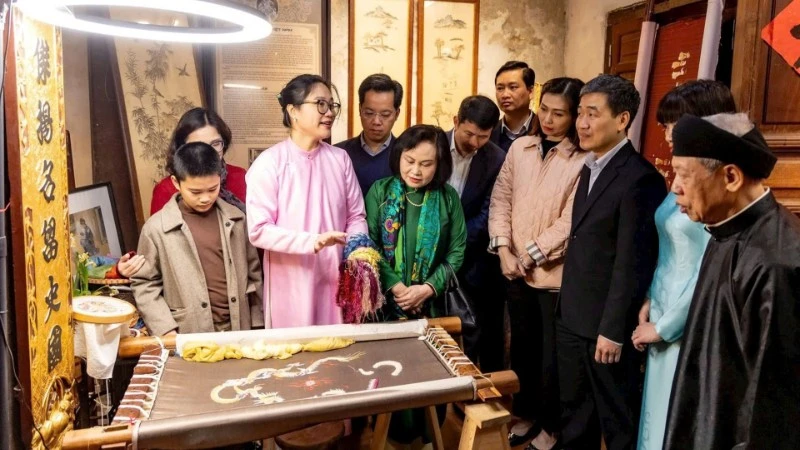
The programme aims to contribute to efforts to “turn heritage into assets” in service of the capital’s cultural industries, while linking this process with human resource training and the expansion of international cooperation.
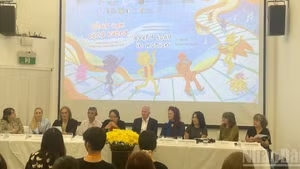
The project, titled “Ha Noi City Heritage Tourism Journeys”, falls within the framework of the FEF-R Patrimoine programme, funded by the French Ministry for Europe and Foreign Affairs, and implemented in coordination with diplomatic agencies and numerous reputable academic and research partners from Viet Nam and France.
In reality, amid Ha Noi’s increasingly vibrant pace of life and rapid urbanisation, ancient historical and cultural relics continue to exist quietly—some surrounded by high-rise buildings, others becoming hidden fragments within collective memory. The preservation and promotion of heritage values are no longer the sole concern of researchers, but require new, more flexible approaches that are closer to contemporary life.
In this context, the launch of four heritage tourism journeys is seen as a meaningful experiment, in which heritage is infused with new vitality through the language of technology and the development mindset of the cultural industries.
According to the project team, from more than 100 heritage sites surveyed across Ha Noi, 28 representative sites were selected to develop four pilot journeys associated with four major belief systems that play an important role in the spiritual life of the Vietnamese people.
The project brings together nearly 40 experts in culture, history and technology, along with around 100 students participating in field surveys, from the University of Social Sciences and Humanities, the School of Interdisciplinary Sciences and Arts – Viet Nam National University, Ha Noi, and Ha Noi Architectural University.
The four tours are designed to serve both sightseeing purposes and the creation of a data foundation for research and training.
A distinctive feature of the project is the digitisation of a large volume of materials in French, Han Nom and Vietnamese. Each heritage site has been developed into a comprehensive electronic dossier, including scientific descriptions, historical and contemporary images, videos, excerpts from stone steles, Han Nom documents, architectural diagrams and related research references. All data are integrated into an interactive digital map, QR codes installed at heritage sites, and the H-Heritage application, enabling residents, visitors, pupils and students to access information via smartphones.
Pham Thi Diem, Chairwoman of the Ba Dinh Ward People’s Committee, said: “In recent times, the ward has piloted a number of cultural tourism products applying modern technology, which have initially delivered positive results. The implementation of this project helps position Ba Dinh as a distinctive destination for both domestic and international visitors, in the spirit of being civilised and modern while remaining rich in identity.”
Results from the four pilot journeys show that when heritage is organised in an accessible manner, supported by integrated digital data and linked with training activities, the ‘awakening’ of heritage values goes beyond mere sightseeing.
Professor and Doctor Hoang Anh Tuan, President of the University of Social Sciences and Humanities, affirmed that this represents an entirely new approach to heritage, helping to bring historical and cultural values closer to young people and international visitors, while also expressing the hope that the project will continue to be expanded to other areas of Ha Noi and many localities nationwide.