Within this broader trajectory of development, the cultural industries are emerging as a key pillar, contributing not only to socio-economic growth but also to the formation of a robust “shield” that protects the Party’s ideological foundations from the complex impacts of globalisation.
From the very founding of the nation, the Party identified culture as one of the pillars of sustainable development. President Ho Chi Minh’s teaching that “Culture lights the way for the nation” has been translated into the Party’s and the State’s cultural guidelines and policies.
In particular, since the implementation of the renewal (Doi moi) policy, the Party and the State’s strategic orientation on cultural development has been clearly reaffirmed through major resolutions reflecting strategic vision in the new context—most notably Resolution No. 33-NQ/TW dated June 9, 2014 on building and developing Vietnamese culture and people to meet the requirements of sustainable national development.
In the documents of the 13th National Party Congress, under the section on building and promoting cultural values and the strength of the Vietnamese people, the Party called for a focus on improving the quality and effectiveness of cultural and artistic forms. Emphasis is placed on enhancing ideological and artistic value while ensuring freedom and democracy in literary and artistic creation; encouraging new explorations that further enrich Vietnamese cultural identity; and curbing distortions and tendencies to pander to trivial tastes.
The Cultural Development Strategy to 2030, approved by the Prime Minister on November 12, 2021, sets the goal of completing market mechanisms in the cultural sector in line with a socialist-oriented market economy, striving for the value added by cultural industries to contribute 7 per cent of GDP.
The Strategy also underscores the need to prevent and address creative and dissemination activities involving literary and artistic works that negatively affect social life. More recently, the draft Political Report of the 13th Party Central Committee for submission to the 14th National Party Congress stressed the task of building and refining institutions for the development of an advanced Vietnamese culture imbued with national identity, grounded in core values of nationalism, democracy, humanism and science; ensuring that cultural development is commensurate with political, economic and social development, so that culture truly becomes the foundation, an endogenous resource, a powerful driving force and a regulatory mechanism for the country’s rapid and sustainable development.
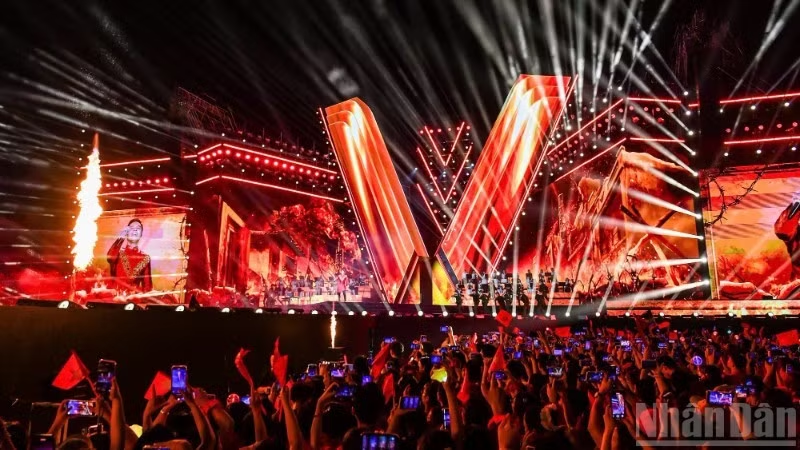
These orientations demonstrate that cultural development in general, and the cultural industries in particular, play an important role in socio-economic development and in upholding the socialist orientation. In recent years, many cultural products—films, songs, literary works and artistic programmes—have helped educate younger generations, guide thinking, build trust and nurture national aspirations, thereby countering the negative influences of foreign cultural imports and rejecting distorted, anti-cultural ideas.
However, the fields of culture and the arts are also becoming a heated battleground, where hostile forces seek by all means to undermine society and spread extremist, reactionary ideas.
At the same time, in accelerating the development of the cultural industries, the country faces internal challenges. Foremost is the risk of extreme commercialisation—chasing the lowbrow tastes of certain audiences and producing sensationalist, exploitative, anti-cultural products that erode aesthetic values, weaken ideological orientation, and may even be exploited to disseminate erroneous viewpoints and deny revolutionary achievements.
Second, the competitiveness of domestic cultural industries remains limited, as the creative–production–distribution value chain is not yet synchronised, market data and high-quality human resources are lacking, and many domestic cultural products have yet to meet social expectations.
Third, uneven progress in digital transformation has created wide gaps between localities and regions, resulting in disparities and inequality in access to cultural benefits. These factors expose the cultural industries to the risk of being overwhelmed by foreign products, potentially weakening their guiding role and their capacity to safeguard the ideological front if timely corrective measures are not taken.
These challenges call for fundamental and comprehensive solutions. First and foremost, cultural development in general, and the cultural industries in particular, must be recognised as a strategic task closely linked to the Party’s ideological and theoretical work. Culture should be regarded as a “front” on a par with the economy, politics, national defence and security. Priority should therefore be given to investing in cultural products of high artistic and ideological value that both reflect national aspirations and appeal to the public. The State needs mechanisms to encourage creativity and support artists and cultural enterprises, enabling them to commit long term to serving the Fatherland. Efforts should continue to promote the application of digital technologies in developing the cultural industries, so as to spread positive values and counter harmful and toxic information on social media.
Every literary and artistic work, every media programme and every entertainment product should be seen as a “brick” in building trust and inspiring patriotism, helping the nation move forward with confidence on its path of integration and development.