Accordingly, the key policy proposals in the draft resolution include:
The state will invest in and develop a system of cultural, artistic, and sports training institutions in a synchronised and modern manner, linked to cultural development and the cultural industries. Priority policies will be introduced to develop high-quality human resources in culture, arts, and sports through advanced and specialised training programmes both domestically and abroad.
Flexible mechanisms will be introduced to attract experts, artists and coaches from within the country, overseas Vietnamese and international specialists to participate in training, mentoring, and skills transfer. These individuals may benefit from negotiated salary, income and working arrangements suited to the specific nature of training activities in the cultural, artistic, and sports sectors.
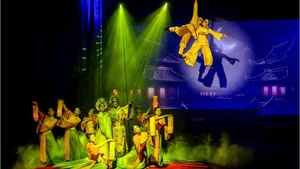
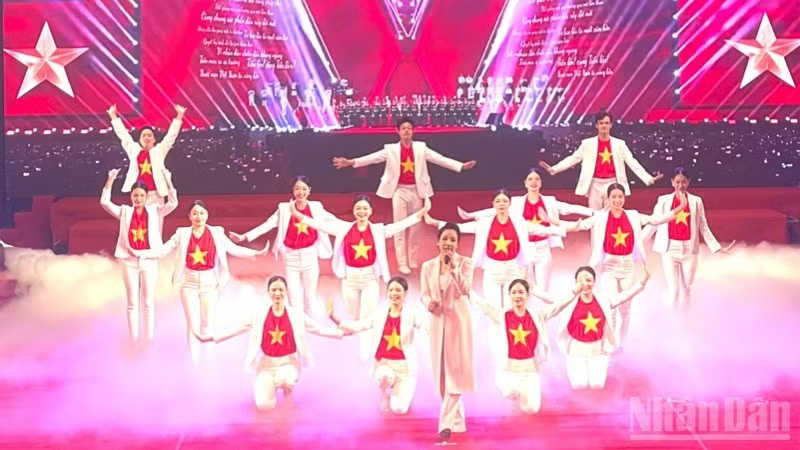
Professional artists working at public performing arts units and those affiliated with the armed forces will be entitled to occupational allowances as well as training and performance remuneration under a phased roadmap pending the introduction of new salary regulations. Specifically, an allowance of 70 percent of salary will apply to artists in traditional stage arts, circus, water puppetry, opera, musicals, ballet and symphony. A minimum of 40 percent will apply to performing arts professionals not belonging to these categories. In addition, training allowances will range from 8 to 15 percent of the base salary per session, while performance allowances will range from 30 to 50 percent per performance session.
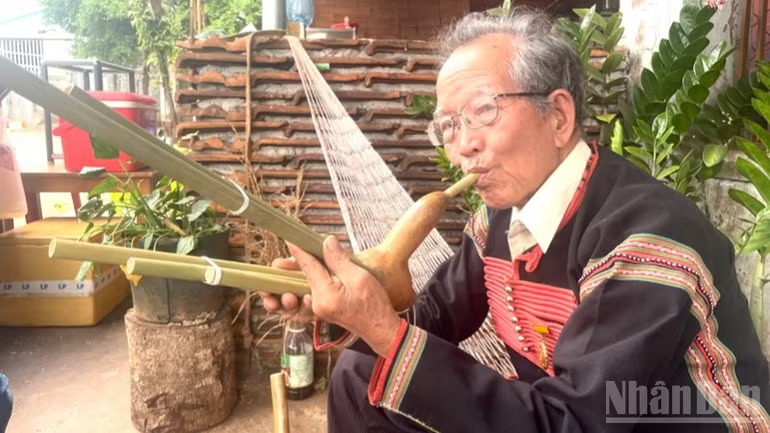
Provincial and municipal People’s Councils will allocate budgets and introduce policies to mobilise social resources to provide remuneration and support for artisans and artists engaged in the creation, practice, and transmission of traditional cultural and artistic heritage at the local level.
The development of human resources in culture, arts and sports has been addressed in several key policy documents. On July 8, 2016, the prime minister issued Decision No. 1341/QD-TTg approving a project on “Training Talents in Culture and the Arts for the 2016–2025 Period, with a Vision to 2030”, aimed at identifying and nurturing students with outstanding aptitude and building a high-quality pool of artists for creative work, performance, and teaching.
Subsequently, the Cultural Development Strategy to 2030, issued on November 12, 2021, underscored the need for breakthrough mechanisms to attract and retain talent, while also mobilising resources for cultural and human development.
On July 31, 2023, the prime minister approved the National Strategy on Attracting and Utilising Talent to 2030, with a vision to 2050, focusing on improving the legal framework and establishing a coherent and synchronised system for identifying, attracting, and effectively employing high-quality human resources across sectors, including culture, the arts, and sports.
In parallel, several programmes have been implemented, such as “Selection, Training and Development of Sports Talents and High-Performance Sports Human Resources to 2035” and “Training and Development of Cultural and Artistic Human Resources Abroad to 2030”, contributing to the gradual completion of the legal framework and strategic orientation for specialised human resource development in line with international integration requirements.
However, in practice, the quality of human resources in culture, arts and sports has yet to fully meet development demands. Facilities and training equipment remain inadequate and lack synchronisation; support policies are not yet strong enough; and shortages of highly qualified personnel persist. The linkage between training and practice remains weak, while mechanisms for identifying, nurturing, and utilising talent are still limited. Some regulations have not kept pace with practical requirements and have yet to provide sufficient incentives for creative activities.
In the context of deepening international integration, it is essential to continue improving mechanisms and policies, while innovating training approaches and human resource development in a coordinated and effective manner. This is a crucial factor in enhancing creative capacity and strengthening the sector’s position and competitiveness in the national development process.
The draft resolution is being developed to institutionalise the viewpoints, objectives, tasks, and solutions outlined in the Politburo’s Resolution No. 80-NQ/TW (dated January 7, 2026) on the development of Vietnamese culture.
At present, the draft dossier has been published on the official portal of the Ministry of Culture, Sports and Tourism of Viet Nam to solicit broad public feedback.
The draft resolution comprises 10 articles: Article 1 on scope and subjects of application; Article 2 on principles for applying breakthrough mechanisms and policies; Article 3 on Viet Nam Culture Day; Article 4 on mobilising investment resources for culture; Article 5 on incentives for investment, sponsorship, and activities in the cultural sector; Article 6 on the operation and effective utilisation of cultural and sports institutions; Article 7 on ensuring adequate resources for cultural development; Article 8 on policies for remuneration and talent development in culture and sports; Article 9 on implementation; and Article 10 on enforcement provisions.