This spirit is emphasised in Resolution No. 80-NQ/TW dated January 7, 2026, issued by the Politburo, which calls for renewed content and methods to disseminate cultural values in social life. From practical experiences in several localities, the “heritage passport” model has initially demonstrated its potential to concretise this requirement.
One of the current challenges is how to ensure that heritage is not only preserved but also becomes more visible in everyday life. In reality, many heritage sites and museums are still approached through traditional methods, with a lack of connectivity and interaction.
Hue City is among the pioneering localities adopting new approaches to heritage through the “tourism passport”. Originating from a destination publication in 2018, the “Hue Tourism Passport” has now evolved into the digital application “Hue City Passport”, with the heritage passport as its core, linking heritage sites into a structured journey.
According to Tran Thi Hoai Tram, Director of the Hue Department of Tourism, although the locality attracts large numbers of visitors, travel itineraries often lack connectivity and fail to encourage deeper exploration. Meanwhile, the locality holds an advantage with a concentrated heritage system, notably the Complex of Hue Monuments. The “tourism passport” is therefore designed to transform visits into interactive experiences rather than simple sightseeing.
Through the application, visitors check in at heritage sites using GPS, with each site corresponding to a confirmation stamp. Upon completing a certain number of sites, participants may receive incentives or rewards. Each destination is integrated with concise information and storytelling, helping visitors to better understand historical and cultural values.
According to representatives of Hue’s tourism sector, market feedback has been largely positive and can be grouped into three categories. Young visitors and international tourists have responded well, particularly appreciating the exploratory aspect and the “collection” format. Family groups consider it a useful interactive activity for children, while also extending their length of stay. Traditional visitors, though initially unfamiliar, have adapted quickly with guidance.
Building on the “heritage passport”, Hue City has further developed a “culinary passport”, expanding the approach towards a more comprehensive direction. Each dish is placed within a specific cultural context, enabling participants to not only “eat” but also “understand” its origin and meaning. This reflects a broader trend of expanding the concept of heritage from tangible to intangible, towards a more connected cultural ecosystem.
In Da Nang, the “heritage passport” has been implemented since 2025 as a creative product to refresh cultural engagement. According to Nguyen Thi Hong Tham, Director of the city’s Tourism Promotion Centre, the “heritage passport” initiative stems from the need to connect individual heritage sites into themed journeys while meeting the growing demand for personalised experiences. Integrated with digital platforms, the passport serves not only as a souvenir but also as a guide shaping deeper exploration.
From September to December 2025 alone, the city issued more than 5,000 heritage passports in multiple languages, with a high proportion of visitors completing between five and ten destinations. Feedback highlights the passport’s novelty, high interactivity, ease of use, and accompanying incentives.
Nguyen Thi Hong Tham emphasised that the “heritage passport” is one of the representative innovative products in the effort to revitalise Da Nang’s tourism sector. This approach helps enhance destination storytelling by connecting heritage sites into a coherent narrative journey; at the same time, it redistributes visitor flows, revitalises lesser-known destinations and creates additional creative touchpoints in communication, thereby strengthening local cultural identity.
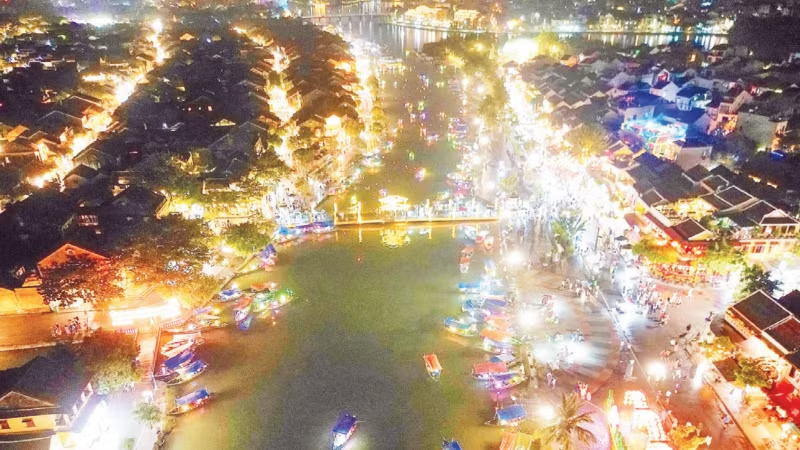
The “heritage passport” facilitates a shift from passive to active tourism. Through mechanisms such as point accumulation and milestone completion, participants do not merely pass through sites but actively engage in exploration. Gamification elements further enhance visitor engagement with heritage.
It also demonstrates the potential for integrating digital platforms with heritage content. Beyond improving accessibility to information, digitalisation contributes to building databases on visitor behaviour, thereby supporting more effective and sustainable management, preservation, and promotion of heritage values. This aligns with the requirement to accelerate digital transformation in the cultural sector, as outlined in Resolution No. 80-NQ/TW.
Globally, heritage organisation through experiential journeys has been implemented in many countries, notably the Japan Heritage programme and Europe’s European Heritage Label. However, this approach has not yet been widely applied in Viet Nam. A common feature of these models is the shift from static display to guided experiences, with visitors at the centre.
From practice in Viet Nam, it is evident that the “heritage passport” not only follows international trends but is also adapted to suit local characteristics.
The “heritage passport” is not merely a tool to support experiences, but a way to reorganise the relationship between people and heritage. When heritage is placed within interactive journeys, accessibility is expanded, thereby contributing to the protection and promotion of heritage values in contemporary life.