Entering a new era of development, the demands on the work of building and perfecting institutions and laws are increasingly high, requiring a strong renewal in the mindset of policy formulation and implementation.
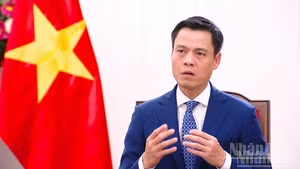
In an interview with reporters, Deputy Minister of Justice Nguyen Thanh Tinh provided deep insights into the role of institutions and laws over more than four decades of renewal, clarifying the spirit of “law as a driver of development.”
The Deputy Minister emphasised that the demands of the new era, the era of the nation’s prosperous development, require faster and more sustainable growth. The goal of double-digit growth demands that the legal system continues to lead, continuing its mission to pave the way for the country’s robust development.
Institutions ‘unshackling’ to drive development
Q: How do you assess the role of institutions and laws in the socio-economic achievements of the country after 40 years of renewal?
A: It can be consistently and clearly affirmed that throughout more than 40 years of renewal, institutions and laws have always held a foundational role, decisively influencing the socio-economic development of the country. In the early period of renewal, as we transitioned from a centrally planned, subsidised management mechanism to a socialist-oriented market economy, the most important breakthrough was the shift in thinking about institutions and law.
Previously, economic activity was largely confined to the state sector, involving only state-owned enterprises. Entering the renewal period, law truly became a tool to ‘unshackle’, establishing a legal corridor for other economic sectors to participate in investment, production, and business. This was not only a change in the economic operating mechanism but also a fundamental shift in the mindset of state management through law.
By promptly institutionalising the Party’s guidelines and policies, the legal system was gradually built and perfected, creating an increasingly open and transparent legal environment for production and business activities. This process helped mobilise and utilise social resources effectively, promoted economic growth, ensured social stability, and improved people’s livelihoods.
Experience over the past 40 years also shows that perfecting institutions and laws is not a static process but a continuous one, closely linked to the demands of practical development.
At the time of issuing Resolution No. 27-NQ/TW/2022 on continuing to build and perfect the socialist rule-of-law state of Viet Nam in the new phase, or more recently, Resolution No. 66-NQ/TW on innovating the work of building and implementing laws to meet the country’s development needs in the new era, the legal system has been assessed as quite comprehensive, consistent, and complete.
Therefore, it must be affirmed that to achieve such an evaluation, over the past 40 years we have continuously faced the truth, assessed reality, and taken measures to amend and supplement the legal system accordingly.
It can be said that it is the persistent innovation of institutions and laws, based on practical experience, that has created very tangible development achievements. From a country suffering from food shortages, we have become a leading rice exporter; from an underdeveloped economy, Viet Nam has gradually integrated deeply into the global economy. These results confirm the particularly important role of institutions and laws in the nation’s development.
Renewing the mindset in policy design and implementation
Q: In the current context, when the Party and State emphasise the requirement that “law drives development,” could you elaborate on the spirit of innovation in institution-building over recent years?
A: Law is essentially a management tool, and within management it has a component that establishes a framework to regulate the behaviour of citizens and businesses. In a market economy, law is the basis for people to participate in production and business. But with the principle of driving development, law must be renewed; it must establish legal frameworks to attract all resources. Whenever there is a bottleneck, immediate solutions must be provided, and new regulations created to ensure investor attraction.
For example, in the implementation of Resolution 57-NQ/TW, in a very short time we already had eight laws related to technology and digital transformation. This is true innovation, creating a new field. We have even proactively issued pilot policies, or sandbox mechanisms, such as the special mechanism under Resolution No. 206/2025/QH15 of the National Assembly, providing a legal basis for the Government to promote innovation. Other resolutions implement organisational reforms, establish a two-level local government, empower the Government temporarily with time-limited authority, which then needs to be reviewed and elevated into law.
Thus, under the Party’s leadership, lawmaking has become more proactive and flexible. Beyond state management and social governance, the law has genuinely removed bottlenecks and driven development.
I believe this is a unique feature of institution-building and law improvement in recent times. Later, when evaluating the results, it will certainly be recognised, just as 40 years ago we ‘unshackled’ institutions to attract multiple economic sectors to production and business activities. Our achievements today are no coincidence.
Q: To ensure that law genuinely enters everyday life and fully realises its role in driving development, what key tasks should continue to be prioritised in the near future?
A: To ensure law is truly effective, first we must continue to institutionalise the Party’s resolutions, especially those of the 14th National Congress. Party resolutions have strategic vision, clear objectives, and correct solutions, but if they are not timely, fully, and coherently institutionalised, implementation efficiency will be low. Therefore, a comprehensive and serious review of resolutions, particularly pillar resolutions, to translate them into law is extremely important.
Additionally, discipline and order must be strengthened in lawmaking. Experience shows that ministries and sectors that pay proper attention to institution-building can better resolve management and administrative obstacles. This responsibility is directly tied to the accountability of leaders, not only in state management but also in fulfilling the function of driving development.
Another crucial aspect is innovation in law enforcement. General Secretary To Lam also emphasised the need for discipline in the rule of law and in enforcement. Law must ensure its self-respect. We need to assess whether this requirement has been fully implemented and internalised as discipline, especially in policy planning. Legal drafts must be carefully prepared, policy impacts assessed, and the scope of regulations clarified — what should be in law, and what in decrees or circulars according to proper authority.
Law adoption schedules must be strictly finalised and approved promptly, and implementing documents issued on time and of high quality. While these may seem routine, we have not fully achieved them yet.
Simultaneously, awareness of citizens and businesses regarding responsibility in a socialist rule-of-law state must be raised. Compliance is both a duty and a right. Citizens and businesses should not merely expect a good legal system; they must also responsibly provide feedback, suggestions, and even participate in the process. This reflects the essence of socialist democracy and the socialist rule-of-law state, which must be promoted.
A breakthrough task is administrative reform. Administrative procedures directly reflect service to citizens and businesses. Moving forward, all procedures should be comprehensively reviewed based on risk assessment in state management, identifying which procedures are essential and which can be shifted to post-checking. The principle is to ensure freedom of business and competition under the law, while strictly controlling areas directly related to citizens’ legitimate rights, especially public health issues.
Finally, the role of policy and legal communication cannot be overlooked. Communication is the bridge between institutions and daily life, helping citizens and businesses understand the content and spirit of the law, thereby building trust and voluntary compliance. Communication must be conducted before, during, and after the lawmaking and implementation process. Only with effective communication can law truly enter life and become a driving force for fast and sustainable development in the country’s new era.