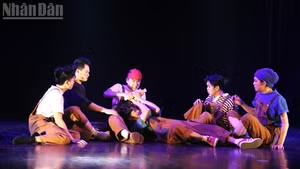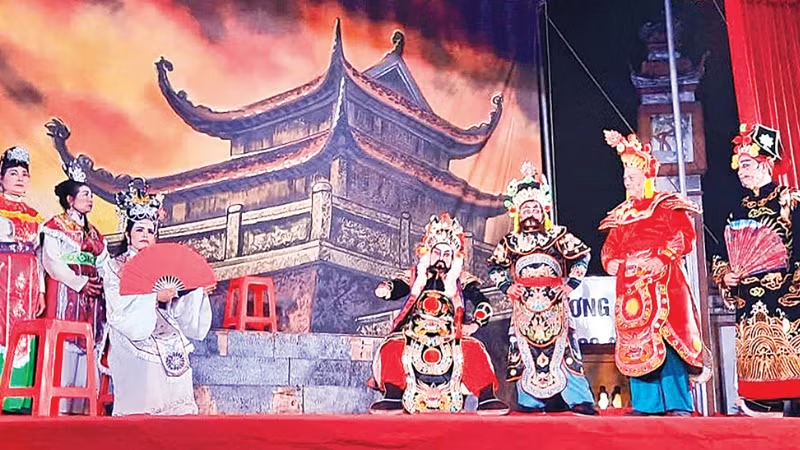
In the days leading up to the Lunar New Year (Tet) of Binh Ngo 2026, we returned to Phu Man Hamlet, Yen Phong Commune, an unusual corner of Bac Ninh Province, where people are more passionate about Tuong than Quan ho folk singing.
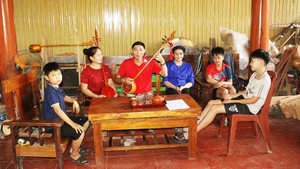
At the traditional room of the Phu Man Tuong Club, artisan Nguyen Duc Ty (74 years old), the club head, said Tuong arrived in Phu Man around 1871, brought from central Viet Nam by Dang Ba Cai, also known as “Trum Cai”, who helped spread the art locally.
In its heyday, the local Tuong troupe performed across villages and hamlets and travelled to many neighbouring provinces and cities to serve visitors from far and wide. Phu Man residents were so “addicted” to Tuong that most families and lineages had someone who could sing Tuong; if an actor sang a line incorrectly on stage, someone in the audience would immediately prompt the correct words. Whether at home or out in the fields, Tuong melodies would ripple through the air. Love for Tuong, therefore, gradually seeped into the minds and hearts of Phu Man people.
Through historical upheavals, Phu Man Tuong inevitably experienced ups and downs. In the 1980s and 1990s, amid severe economic hardship, families had to had to devote themselves to earning a living, and the Tuong movement declined. Saddened by the situation, artisan Nguyen Duc Ty decided to find a way to revive his hometown troupe.
Born into a family with four generations tied to Tuong, and with nearly 30 years of work experience in professional Tuong units; from a musician with the Central and Central Highlands Liberation Tuong Troupe, to leading the orchestra of the Quang Nam–Da Nang Tuong Troupe, and later serving as conductor of the orchestra of the Ha Bac Tuong Troupe; he felt a responsibility to protect his ancestors’ heritage.
With support from local leaders, he and several core members re-established the Phu Man Tuong Club in August 2009, with an organisational structure as tight as that of a professional troupe.
Nguyen Duc Ty recalled that he spent nearly a year visiting each household in the hamlet to rekindle the love of Tuong that still lay within the community. With veteran artisans as the core — alongside performers and professional musicians originating from Phu Man — the club launched training and mentorship activities.
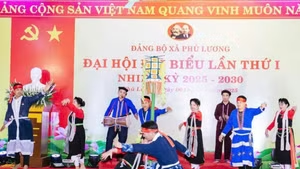
After more than 15 years, the club has been maintained with 25 members—the oldest in their 70s and the youngest in their 50s. Its excerpts and productions have become a local “speciality” at traditional community events, creating wider influence and helping spur the development of nearby Tuong clubs such as Trung Ban, Nghiem Xa and Ngo Noi.
Nguyen Duc Ty also proudly noted that Phu Man has nurtured many Tuong talents for the country. In some families, four to five generations have remained tied to Tuong, with many pursuing professional careers and receiving titles such as Meritorious Artist and People’s Artist.
Alongside Phu Man, the Tuong Club of Giai Lac Commune in Nghe An Province is another bright spot in village Tuong life. A traditional troupe with a long history, it also went through periods of interruption until being revived again in 2005.
The club head, artisan Le Thi Hue (63 years old), said around 30 members currently take part regularly, ranging in age from 13 to 75. Most are farmers busy with fieldwork by day, but in the evenings they gather, becoming quiet “village artists” who keep Tuong’s rhythm alive. From just a few performances each year, the club’s number of shows has steadily increased. After the success of the Tuong play Pham Cong–Cuc Hoa, staged in mid-2025, the Giai Lac brand has travelled further. During early spring 2026 alone, the club’s schedule has been packed for many days. Notably, each performance night attracts large numbers of local residents.
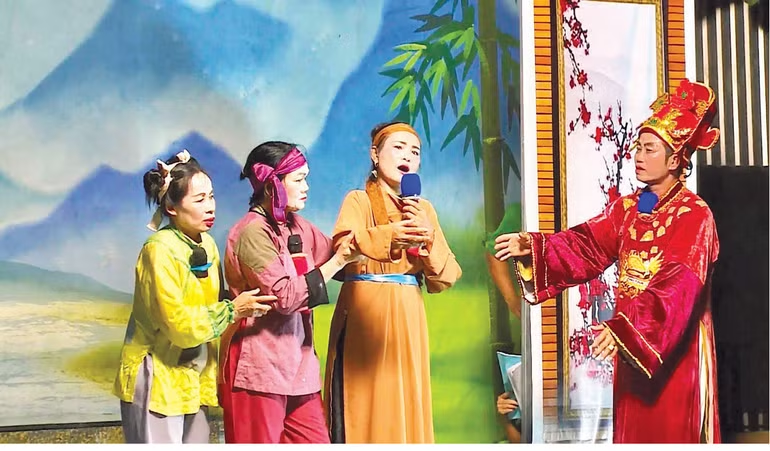
Many experts believe that developing the amateur Tuong movement means strengthening the roots of traditional theatre and preserving ancestral arts. That is why amateur Tuong festivals are occasionally organised in localities to create momentum for consolidating grassroots Tuong organisations—especially in the former Binh Dinh Province, now Gia Lai Province, where more than a dozen amateur Tuong troupes operate actively.
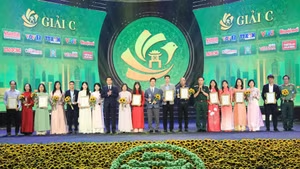
In the past three seasons, the Dao Tan Awards have reserved a separate category to honour outstanding amateur Tuong units. Alongside Phu Man and Giai Lac, the awards have also recognised Nhon Hung Tuong Troupe (former Binh Dinh Province), the Ke Gam Village Tuong Team (Nghe An Province), and the Thach Loi Tuong Club (former Hai Duong Province, now Hai Phong City).
However, sustaining amateur Tuong troupes is far from simple. Nguyen Duc Ty said the Phu Man club has been fortunate to receive strong support from local leaders, who have provided space at the traditional house for shared activities and offered modest financial assistance to encourage the club. Yet there remains a “gap” in the next generation. Finding young faces with the voice and stage presence — and, crucially, enough passion to persist with tuong training — is extremely difficult. This is also an ongoing concern for Le Thi Hue, head of the Giai Lac Tuong Club.
Therefore, despite continuing financial constraints, she and several club members still try to scrape together funds and time, proactively contacting and visiting schools in the commune to share knowledge of Tuong with students, hoping to plant the seeds of love for Tuong early on.
According to People’s Artist Le Tien Tho, former President of the Viet Nam Stage Artists Association, and Director of the Institute for Research on the Preservation and Promotion of National Culture, Viet Nam has policies to confer artisan titles on those who have made significant contributions to preserving and promoting traditional cultural values. However, mechanisms to encourage and support young people and successor forces remain insufficient, while cultural preservation requires trainers, practitioners and participants alike. Therefore, more nurturing and motivating policies are needed because only when cultural sources are cultivated by communities and younger generations can traditional values truly be preserved and spread sustainably.