
Small and medium-sized enterprises (SMEs) are the backbone of the economy, yet they continue to face numerous barriers to accessing credit, from collateral requirements and cumbersome lending procedures to inadequate financial management capacity.
Even when cash flows are stable and capital turnover is rapid, the lack of collateral makes it difficult for firms to access bank lending. And when capital flows remain constrained, the growth potential of the private sector suffers accordingly.
Nguyen Van Dinh, Chairman of the Viet Nam Association of Realtors, noted that although interest rates have fallen and banks are willing to lend, many businesses, particularly SMEs, are still unable to access capital.
“This reflects underlying weaknesses in business fundamentals; they are not sufficiently robust and do not meet the conditions required to absorb capital. What they need now is not only money, but markets and orders,” he said.
From a sectoral perspective, Huynh Thi My, Secretary-General of the Viet Nam Plastics Association, pointed out a paradox: to obtain loans, firms must demonstrate stable cash flow, yet when orders decline and cash flows are disrupted, they are even less able to meet lending conditions. This vicious cycle effectively shuts out many capital-starved firms from the credit system entirely.
A new approach needed to unlock capital flows
According to Tran Hoang Ngan, a National Assembly Deputy from Ho Chi Minh City, broadly loosening lending conditions is not feasible, as the safety of the banking system must be ensured.
“We need a combination of flexible monetary policy and strict credit discipline. The challenge is to find solutions that help businesses access capital without undermining credit quality,” he stressed.
In reality, most Vietnamese enterprises are SMEs with limited financial capacity and a lack of viable collateral. Nguyen Van Than, Chairman of the Viet Nam Association of Small and Medium Enterprises, believes this is the biggest obstacle to accessing loans, given that banks cannot extend unsecured lending on a large scale.
In response, many experts have proposed expanding credit guarantee funds and credit insurance schemes. According to Pham Xuan Hoe, former Deputy Director of the Banking Strategy Institute, experience from countries such as Japan and the Republic of Korea (RoK) shows that establishing a national-level credit guarantee system, operating under a dedicated state-backed mechanism, can significantly improve SMEs’ access to capital.
At the same time, businesses have called on banks to be more flexible in their lending conditions, for example, by accepting inventory, raw materials, or commercial contracts as collateral rather than relying solely on real estate assets.
Creating markets to unlock capital flows
Many experts argue that capital solutions cannot be separated from market development. Professor Hoang Van Cuong, a former National Assembly Deputy and former Vice Rector of the National Economics University, suggested that the state should act as a major customer through public procurement. With a guaranteed stream of government orders, businesses would maintain stable cash flows, thereby improving access to capital and enabling production expansion.
At the macro level, the planned establishment of an international financial centre in Viet Nam is expected to open up a new channel for capital flows. Under the National Assembly’s resolution, the centre will operate in Ho Chi Minh City and Da Nang, creating a platform to attract international capital.
Le Hong Thuy Tien, Chief Executive Officer of Imex Pan Pacific Group, believes this is an important step in mobilising financial resources and generating spillover effects across multiple sectors.
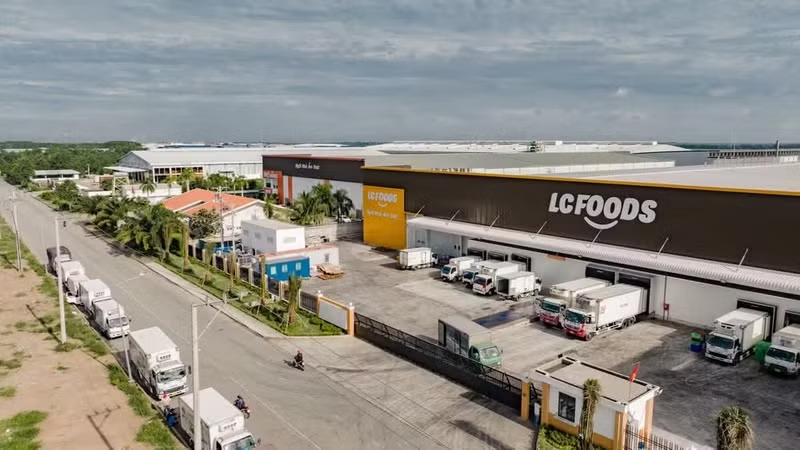
Beyond expanding the supply of capital, the State Bank of Viet Nam has also raised credit growth limits, enabling credit institutions to step up lending, particularly during the year-end period. However, as many experts note, expanding credit room is only a necessary condition; the sufficient condition lies in businesses’ capacity to absorb that capital effectively.
Accordingly, enterprises must simultaneously address three key issues: optimising their capital structure between debt and equity; managing cash flow rigorously; and focusing investment on core areas capable of delivering long-term competitive advantage.
Sharing this view, Nguyen Luong Tu, Chairman of the Board of Soul Wine Joint Stock Company, argued that instead of expanding indiscriminately, businesses should concentrate on their areas of competitive strength, build transparent financial foundations, and gradually diversify funding sources across multiple channels.
Clearly, removing capital bottlenecks requires a comprehensive and coordinated approach from both the supply and demand sides. On the policy front, this means continuing to refine credit mechanisms, develop guarantee and credit insurance instruments, and open new capital channels such as international financial markets.
For businesses, the urgent priority is to strengthen internal capacity, enhance financial transparency, standardise governance, and proactively adapt to international standards. As firms become more robust, capital will naturally follow.
In an increasingly volatile economic landscape, capital is no longer merely “fuel”; it is a measure of confidence. When that confidence is strengthened, capital flows will not only be unlocked but will become a driving force propelling Vietnamese enterprises further across the global economic map.












![[Video] Resolution No. 10 repositions FDI in Viet Nam's new development strategy](https://en-cdn.nhandan.vn/images/5992a12dd6e78b9bfb434962ff1830731c3ef6c1538d722fbb2593b0fa31ecfea73ea406e335bb4f889623e75863a3fa5de1ba084f5b1db0b5788c84a44f1d4c/anh-dai-dien.jpg.avif)