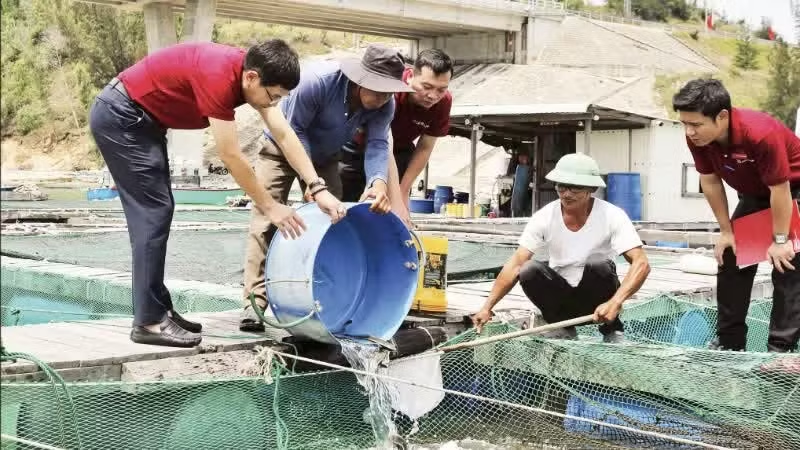
Not far from De Gi port (formerly in Binh Dinh Province, now Gia Lai Province) lies an aquaculture area along the lagoon. Amid rows of floating cages, Tran Van Le (An Quang Tay Hamlet, De Gi Commune) checks his fish and shrimp enclosures. His family began borrowing from the Viet Nam Bank for Agriculture and Rural Development (Agribank) in 2016. To date, their credit limit stands at around 3.2 billion VND (121,500 USD), with an outstanding balance of about 600 million VND (22,700 USD). However, in 2025, Typhoon No. 13 left his family with almost nothing. “We lost nearly 1.3 billion VND (49,300); many cages were swept away. We thought we could never start again,” Le recalled.
For Le, memories of the storm remain vivid: “In the morning, looking out over the lagoon, I had no idea where to begin again when the entire system for farming cobia, grouper and pompano had been destroyed.” What enabled him and his family to resume production quickly was a loan of more than 2 billion VND (75,900 USD) from Agribank, with the interest rate reduced from 6.5% to 5.5%, easing financial pressure during the most difficult period.
After nearly half a year, farming activities have recovered to about 90%. Before the storm, his family produced over 20 tonnes of fish annually, earning profits ranging from 800 million VND (30,300) to more than 1 billion VND (37,900 USD), depending on market prices.
Nguyen Ngoc Chau, Director of Ngoc Chau Co., Ltd (Gia Lai Province), also suffered a major blow when more than 40 shrimp ponds were severely affected by the storm, with losses estimated at around 18 billion VND (683,500 USD). “In all my years in this trade, I have never seen such a storm. We lost almost everything,” he said. Agribank reduced the interest rate by 1% on his outstanding loans of approximately 17.5 billion VND (664,500 USD), providing his business with additional resources to recover.
The year 2025 recorded a series of extreme natural disasters, both intense and frequent, causing estimated losses of tens of trillions of VND and directly affecting hundreds of thousands of households, especially in rural, mountainous and coastal areas.
According to statistics, total disaster-related damage reached approximately 85–100 trillion VND (3.2 – 3.7 billion USD), equivalent to nearly 2% of GDP. Hundreds of thousands of homes were damaged, more than half a million hectares of crops were affected, and hundreds of thousands of households lost their sources of income. Notably, natural disasters not only caused direct losses but also disrupted agricultural production chains, aquaculture and small household businesses.
Data from the banking sector indicate that around 250,000 borrowers were affected, with total outstanding loans of nearly 60 trillion VND (2.2 billion USD). Repayment pressure, combined with disrupted cash flows, has placed many households under dual strain, posing a risk of rising non-performing loans without timely support measures.
In response, the State Bank of Viet Nam directed the entire system of credit institutions to implement coordinated support measures. The focus has been on restructuring repayment schedules, maintaining loan classifications and reducing interest rates by 0.5–2% per year, thereby alleviating immediate financial pressure on borrowers. These measures serve as a form of “emergency relief”, creating room for people to stabilise their mindset and gradually restore production.
At the same time, large-scale preferential credit packages, estimated at around 70 trillion VND (2.6 billion USD), have been rolled out to recapitalise production and business activities. By the end of 2025, nearly 1.5 triillion VND (56.9 million USD) had been disbursed to around 6,500 customers, of which the agricultural sector accounted for about 600 billion VND (22.7 million USD).
The Viet Nam Bank for Social Policies also reduced interest rates by 2% per year for approximately 3 million customers in 22 localities, with total interest support exceeding 1.1 trillion VND (41.7 million USD), helping vulnerable groups weather difficult times.
At the micro level, many commercial banks have proactively launched their own programmes, including interest rate reductions, new preferential loans and support for customers rebuilding production. Agribank has introduced specialised credit programmes for farmers and affected households; Vietcombank has reduced interest rates by up to 2% per year for both existing and new loans; BAC A BANK has rolled out a 3 trillion VND (113.9 million USD) credit package to support recovery.
According to Agribank alone, in 2025 more than 26,300 customers affected by natural disasters received support, with total outstanding loans exceeding 13.38 trillion VND (508 million USD). At Agribank’s Binh Dinh branch, 354 customers benefited from interest rate reductions on loans totalling nearly 895 billion VND (33.9 million USD).
From a financial perspective, these figures represent costs. From a development standpoint, however, they are a way of preventing a key economic sector from “breaking down”. “Aquaculture is the main livelihood of local people. After the storm, without timely financial support, it would be very difficult for residents to restore production,” emphasised Vo Van Tai, Chairman of the People’s Committee of De Gi Commune.
Immediately after the disaster, local authorities and Agribank coordinated to assess damage and implement support policies, enabling residents to continue accessing credit. As a result, within a short period, many households were able to rehabilitate ponds, restock and gradually stabilise production.
In many localities, the banking system has proven to be a crucial “pillar” in stabilising socio-economic conditions after natural disasters. However, in recent years, disasters have ceased to be exceptional events and are increasingly becoming a constant “variable” in economic development. If support remains limited to short-term recovery, the economy—particularly rural areas—will continue to be vulnerable to similar shocks in the future.
In this context, bank credit needs to be repositioned, not merely as a support tool but as a “lever” for restructuring livelihoods towards sustainability. Experts suggest prioritising the development of green credit, directing capital towards climate-resilient production models such as high-tech agriculture, circular production and low-risk farming systems.
This is not only an economic solution but also a long-term strategy to minimise losses. In addition, stronger promotion of value chain financing is needed. When farmers are linked with enterprises and cooperatives, market risks can be shared and product outputs become more stable, thereby improving capital efficiency and repayment capacity.
Another structural issue is the lack of risk-sharing instruments, particularly agricultural and disaster insurance. When risks are borne entirely by borrowers and banks, credit expansion cannot be sustainable. Therefore, it is essential to develop a comprehensive financial ecosystem encompassing credit, insurance and budgetary support.
Policy coordination must also be elevated to a new level. While coordination between monetary and fiscal policies has improved, a more flexible and unified management mechanism is still required to ensure capital is allocated to the right beneficiaries and objectives.