Tourism as an important bridge
Over the years, Japan has consistently been among the leading key international markets for Viet Nam’s tourism industry. The Japanese outbound market is stable and holds long-term growth potential.
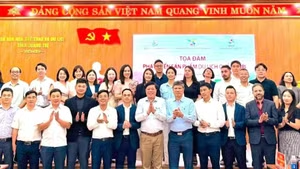
Nguyen Trung Khanh, Director General of the Viet Nam National Authority of Tourism, stated: “After decades of cultivation, Viet Nam–Japan relations have continued to grow strongly and have now been elevated to a Comprehensive Strategic Partnership. Accordingly, tourism is one of the pioneering sectors, serving as an important bridge in terms of culture, emotions, and people-to-people connections between the two countries.”
Looking at the growth momentum in 2025, the number of Japanese visitors to Viet Nam reached 814,000, up 14.4% compared to 2024. In the opposite direction, the number of Vietnamese visitors to Japan reached 678,500, up 9.2% compared to the same period last year.
These figures show a positive recovery and growth trend in two-way tourist flows, although the Japanese inbound market to Viet Nam has not yet fully returned to pre-2019 levels, before the outbreak of the COVID-19 pandemic.
After decades of cultivation, Viet Nam–Japan relations have continued to grow strongly and have now been elevated to a Comprehensive Strategic Partnership. Accordingly, tourism is one of the pioneering sectors, serving as an important bridge in terms of culture, emotions, and people-to-people connections between the two countries.
Nguyen Trung Khanh, Director General of the Viet Nam National Authority of Tourism
Not only a source market, Japan is also a strategic partner of Viet Nam in developing sustainable tourism. The two sides are implementing various cooperation programmes in human resource training, high-end tourism product development, heritage conservation, and the application of smart technologies in destination management. This opens up directions for in-depth and long-term tourism development.
According to the Viet Nam National Authority of Tourism, the agency will continue to strengthen its strategic partnership with Japan and closely coordinate with the tourism business communities of both countries. At the same time, it aims not only to promote exchanges but also to build substantive, sustainable partnerships that bring long-term benefits to both sides.
Significant potential for tourism cooperation between Viet Nam and Japan
Viet Nam is currently among Japan’s leading source markets, with Vietnamese tourists demonstrating relatively high spending levels in the country.
According to Ito Naoki, Ambassador of Japan to Viet Nam, the strong and enduring friendship between Viet Nam and Japan has been cultivated over decades through comprehensive cooperation across many fields, with tourism standing out as a bright spot.
“The continuous increase in two-way tourist exchanges shows that there remains substantial potential for tourism cooperation between the two countries,” Ambassador Ito Naoki said.

Haruna Kawai, representative of the Japan National Tourism Organisation (JNTO) in Ha Noi, shared that in 2025, Japan welcomed approximately 42.68 million international visitors, with Viet Nam among its leading source markets. In the coming period, Japan will focus on increasing international arrivals, raising spending levels, and encouraging tourists to explore localities beyond traditional tourism centres.
Haruna Kawai also suggested several distinctive tour routes to explore Japan, notably a six-day, six-night journey to Kyushu, featuring destinations such as Fukuoka, Kumamoto, Miyazaki, and Oita.
It is understood that in the coming time, the Embassy of Japan will continue to coordinate with relevant agencies and organisations to implement promotional activities such as “Japan Night” and destination promotion programmes for Hokkaido targeting communities interested in anime and video games.
With cultural similarities rooted in East Asian traditions, along with a solid foundation of cooperation and close coordination between the tourism sectors of Viet Nam and Japan, bilateral tourist flows between the two countries are expected to continue growing strongly. This growth will contribute positively to the post-COVID-19 tourism recovery and promote sustainable development in the time ahead.
Continuing to build and develop sustainable tourism models
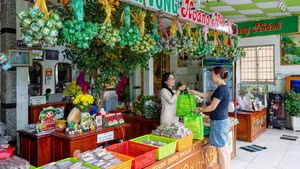
Proposing several memorable tourism experiences in Viet Nam for international visitors, including Japanese tourists, Junko Yoshida, project coordinator at the Regional Support Office for Asia and the Pacific of the United Nations Tourism (UN Tourism), shared insights on sustainable tourism models. Tra Que Vegetable Village (Da Nang) was highlighted as a typical example.
“This is a very valuable experience,” Junko Yoshida said. Here, visitors can directly participate in planting, tending, harvesting, and preparing dishes from local agricultural products. Conservation activities are implemented in parallel with tourism development.
The model in Tra Que not only provides experiential value but also creates memorable moments, allowing visitors to immerse themselves in local life and experience the friendliness and hospitality of the people.
![[Video] Viet Nam among Top three Asian destinations for return visitors](https://en-cdn.nhandan.vn/images/nyM650OGFWrOVWc-xajqN-rTZ68Rlmc1fiGJOhBRYHErj-E25MBpvJqrpphXazfrpe9t-fYCGuQU4CN0yXo3Rg/du-lich-vietnam.jpg.avif)