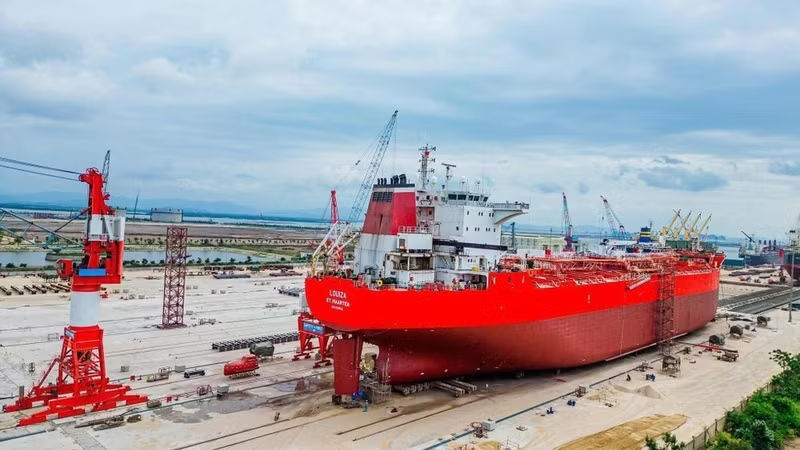
According to UN Trade and Development (UNCTAD)’s Review of Maritime Transport 2025, world maritime trade in 2024 reached about 12.72 billion tonnes, up 2.2% year on year.
Notably, transport volumes measured in ton‑miles rose sharply by 5.9% to 66,781 billion ton‑miles, reflecting that goods are travelling longer and more complex routes as a result of geopolitical effects.
Alongside rising transport volumes is the reality that the global merchant fleet is ageing markedly. By early 2025, the average age of the world fleet had reached 22.2 years (by number of ships), more than three years older than a decade earlier.
Meanwhile, the demolition rate for old vessels remains low, at roughly 0.25% of the active fleet. These figures confirm that Ship Sale & Purchase is no longer a sideline activity but has become an integral part of the maritime market, directly linked to investment cycles and owners’ asset restructuring.
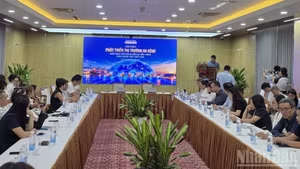
Viet Nam is emerging as a potential destination. Beyond serving as a port or a provider of basic repair services, the country has the opportunity to become a hub for on‑site technical surveys, handovers and completion of formalities for regional international ship transactions.
The second‑hand ship market is highly globalised, where a single vessel can be offered to dozens of buyers across continents each day. However, it is also replete with risks. A multi‑million‑dollar ship can effectively “vanish” in terms of technical status or ownership just before changing hands.
Daniel Ho, Director of SVC Marine Services Co., Ltd and an expert in this field, observed that the problem is not that the market lacks vessels, but finding the right vessel, the right seller and the right real cost after taking delivery.
Experience shows that a technically “neat” dossier with full certificates and photographs is not necessarily a “clean” file that reflects the asset’s current condition.
Many buyers face enormous post‑delivery costs such as repairs, equipment replacement, renewal of classification, or drydocking if technical due diligence is not carried out rigorously. In ship trading, each Memorandum of Agreement (MOA) is a bespoke structure that requires separation between technical inspection and legal‑financial control.
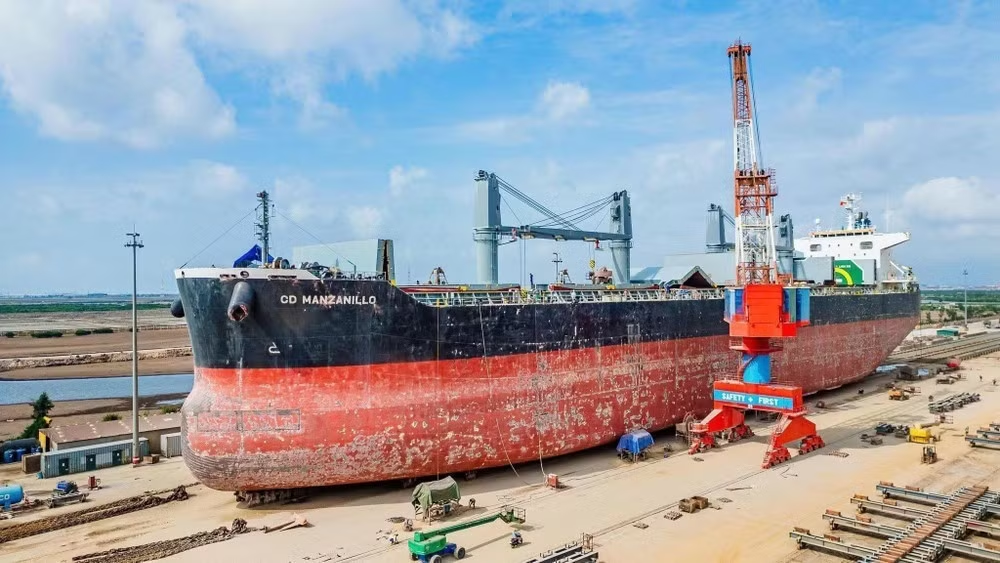
Within this landscape, Viet Nam is emerging as a potential destination. Beyond serving as a port or a provider of basic repair services, the country has the opportunity to become a hub for on‑site technical surveys, handovers and completion of formalities for regional international ship transactions.
A typical example is the case of the container vessel ZBM. The ship was sold by a Chinese owner to a Turkish buyer, yet the entire process — from inspection and handover to repairs, drydocking and preparation for operation — was carried out in Viet Nam under continuous technical‑commercial supervision.
This demonstrates that Viet Nam’s on‑site capabilities can meet the stringent requirements of international deals.
Deeper participation in this chain requires the presence of advisory units capable of conducting technical due diligence and supporting on‑site transactions. Rather than merely facilitating buy‑sell matches, these entities act to verify assets, supervise repairs and mitigate risks during the transition from “purchased ship” to “operational ship”.
Once Viet Nam builds sufficiently strong on‑site capabilities and an operational reputation, the maritime sector’s value will extend beyond service and repair fees to affirming the country’s position within global trade networks.
Viet Nam’s opportunity lies not in a single vessel but in the ability to engage across the whole value chain: inspection, handover, drydock, classification, representation of owners and commercial operation support.
With proximity to major shipping routes and a growing network of shipbuilding and repair yards, Viet Nam can become a trusted technical destination for international ship transactions.
Once Viet Nam builds sufficiently strong on‑site capabilities and an operational reputation, the maritime sector’s value will extend beyond service and repair fees to affirming the country’s position within global trade networks.
This is a path that warrants organised investment and attention to turn maritime potential into a driver of sustainable economic development.