
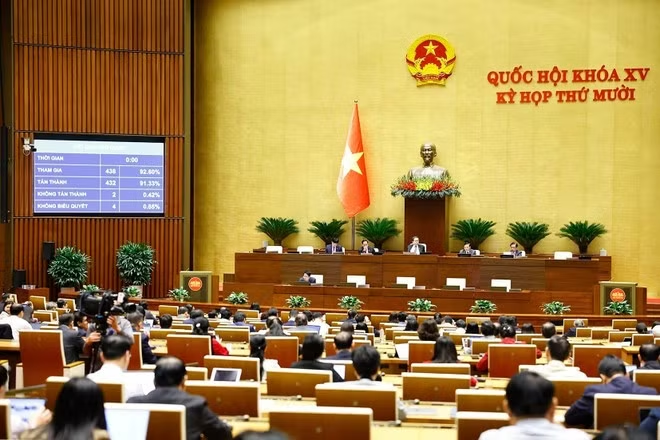
The law, passed by the 15th National Assembly on December 10, tasks the Government with issuing detailed accounting, disclosure and valuation rules to make IP fully financeable.
Companies unable to capitalise certain IP assets on their balance sheets must now maintain a separate internal registry. Self-valuation is permitted for internal purposes, encouraging enterprises to catalog and manage intangible holdings more proactively.
On administrative reform, all procedures for registering and examining industrial property rights will go fully digital. Patent examination timelines will shrink from 18 months to 12 months, with a new fast-track option cutting approval to as little as three months.
About AI-generated content, the law draws a clear line: purely autonomous AI creations are not eligible for copyright or patent protection. Those who provide substantial creative input, such as ideas, curation, editing, or selection, qualify as authors or inventors. If human involvement is limited to simply supplying prompts or context, the individual is not recognised as the author but still retains the right to use and commercially exploit the AI-generated output.
Legally published and publicly available data can be used to train AI models, provided the resulting outputs do not violate existing IP rights.
The amendments extend industrial design protection to non-physical products, in line with global digital trends, with the Government setting specific criteria.
Courts will also receive expanded IP jurisdiction and tougher penalties, treating digital infringement on par with physical theft.
The overhaul brings Viet Nam’s legislation in line with its latest international treaties and agreements.
Also adopted by the legislature the same day, the amended Law on High Technology comprises six chapters and 27 articles, laying out new incentives and policies to drive the development of strategic and emerging technologies.