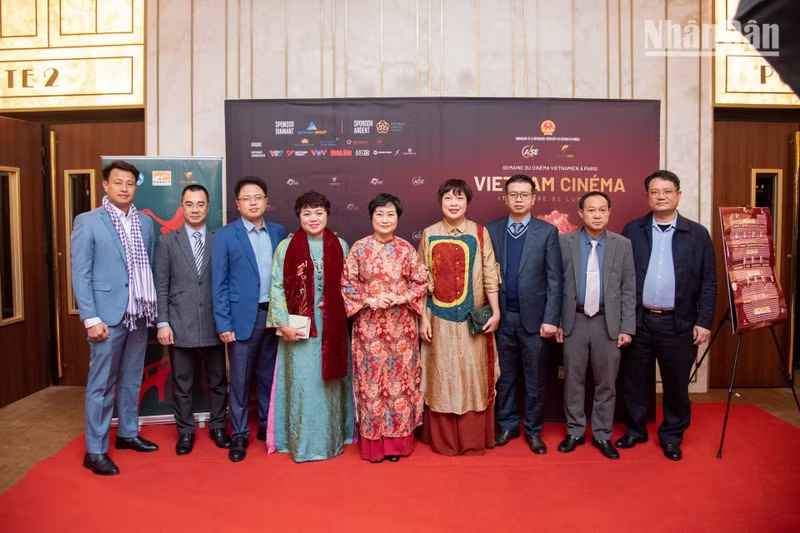
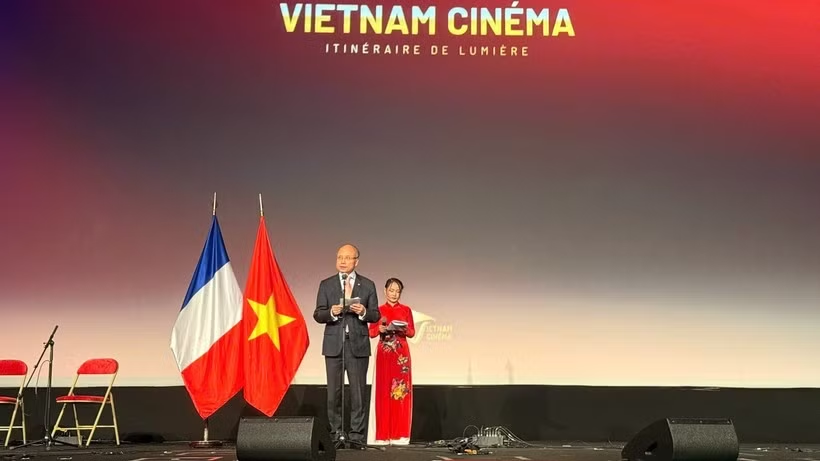
In his opening address, Vietnamese Ambassador to France, Dinh Toan Thang, recalled a famous remark attributed to Antoine Lumière—the father of Louis and Auguste Lumière, pioneers of modern cinema—who once declared: “Le cinéma n’a aucun avenir” (“Cinema is an invention without a future”).
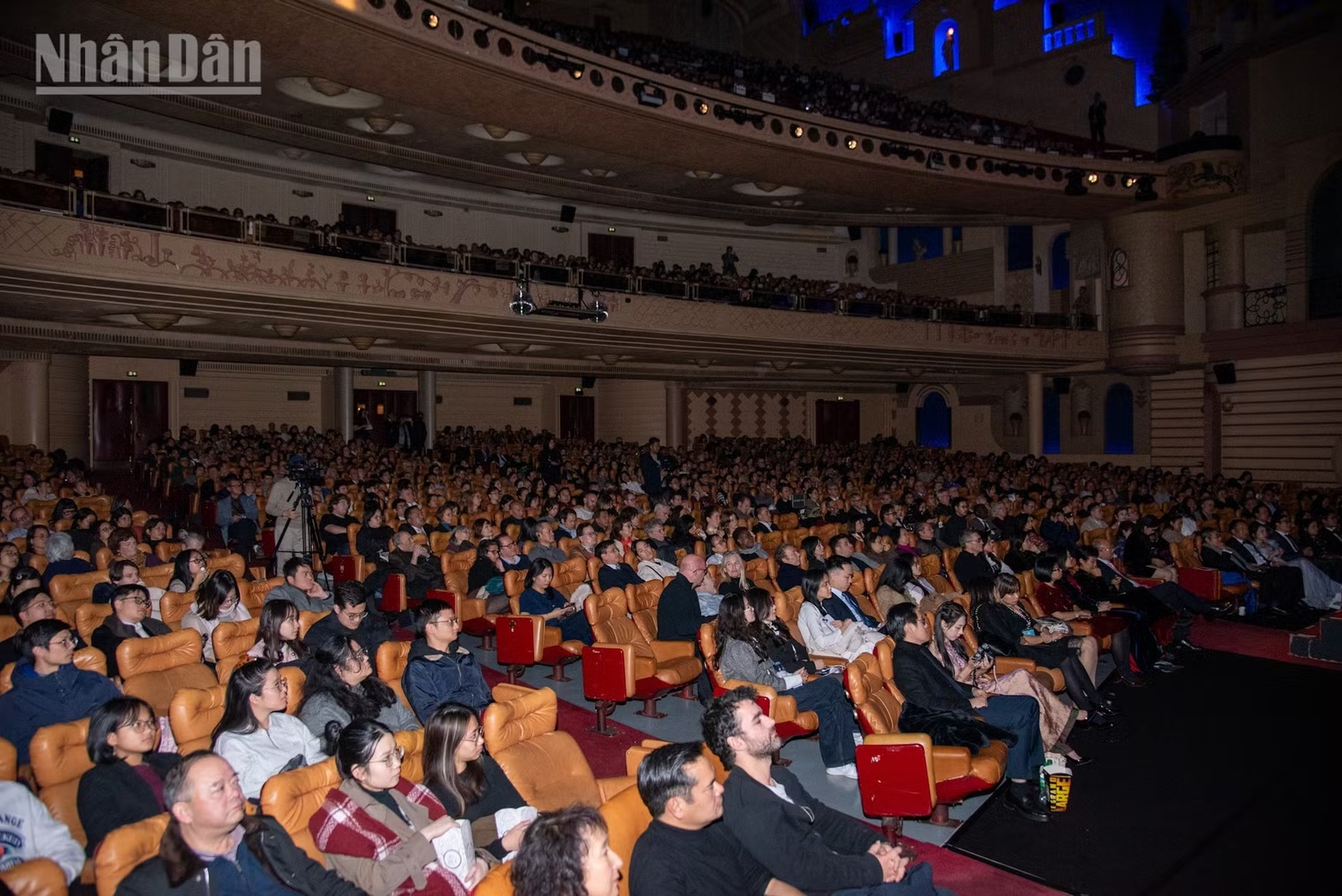
Ambassador Dinh Toan Thang noted how mistaken that prediction proved to be. Far from fading, cinema has flourished into a universal cultural pursuit. Proof of this vitality was evident on the opening night of Vietnamese Film Week in Paris, which drew an audience of 2,700 to Le Grand Rex—the legendary cinema that every Parisian film lover dreams of visiting at least once.
Vietnamese cinema through the eyes of Overseas Vietnamese youth
At the premiere, most of the audience were Vietnamese, including many second- and third-generation expatriates born and raised in France. For some, Vietnamese culture has grown faint over time, as they understand only basic phrases of the language and struggle to express themselves in it.
I met Mai Thy (she clarified her name is written as Maithy), 22, as she left the screening room. She began speaking in Vietnamese but soon switched to French: “The film was quite good. The sound and lighting effects were wonderful. The acting was very strong.”
When asked if she had watched Vietnamese films before, she explained that as a child she occasionally saw them with her grandparents but never felt connected. Now, however, she said: “If Viet Nam continues to produce high-quality films like the one I just saw, I am ready to support Vietnamese cinema.”
Mai Thy was accompanied by friends, all young Asians. One remarked in French: “I will go to see more to learn more about Vietnamese films.” Another added: “Suddenly, I want to take a trip to Viet Nam.” None had ever visited Viet Nam, but Mai Thy concluded: “If I keep watching Vietnamese films, I’ll probably go back soon.”
Vietnamese cinema through the eyes of Parisian audiences
Earlier, I spoke with a French family seated behind me: Quentin, 14, and his parents Vincent (47) and Marion (46). Both work at Ateliers Varan, founded by documentary filmmaker Jean Rouch in 1981 to train documentary makers. The organisation has held creative workshops worldwide, including in Viet Nam since 2004, expanding to Ha Noi, Da Nang, and Ho Chi Minh City.
Recently, Ateliers Varan collaborated with Vietnamese students to screen films such as Nguoi Cat Ma (Grave Diggers for Hire) by Nguyen Anh, Toan Oi (Dear Toan) by Nguyen Ho Bao Nghi, and Gio Mua Ve (The Monsoon Returns) by Le Thi Tham.
Quentin explained why he wanted to see a Vietnamese film: “Because it’s an action movie. I want to see the difference between Vietnamese action films and other Asian ones, like those from Korea or China, which I usually watch.” He added: “My friends and I, when watching foreign films, especially Asian ones, only like martial arts action films as this genre defines Asian cinema.”
Vincent and Marion, who had seen many Vietnamese documentaries, said this was their first big-screen feature. They felt Vietnamese cinema had caught up with world standards.
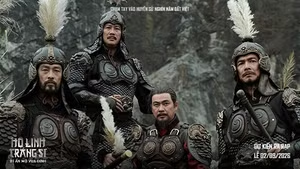
Later, I spoke with young Parisians about Tu Chien Tren Khong (Hijacked), directed by Ham Tran. Maxime (25) exclaimed: “Unbelievable!” Marie (30) added: “It’s so good! I couldn’t believe it was a Vietnamese film. I thought it was Hollywood.” Their excitement was palpable, even in the drizzle outside.
Indeed, cinema possesses a unique power to communicate. Beyond stirring emotions for characters on screen, cinema awakens a fascination with cultures different from our own daily lives.
Of course, mixed reviews followed. Some felt the film had not fully harnessed the strengths of Eastern culture, a hallmark of Asian cinema. Others noted flaws that needed refinement to win over seasoned audiences. A few suggested trimming certain segments to avoid excessive violence. Yet these varied opinions reveal one thing: Parisian audiences are paying closer attention to Vietnamese cinema.
Leaving the crowd, I recalled a remark from Stéphanie Do, a former French politician of Vietnamese origin and a prominent figure in Paris’s Vietnamese community. She had told me before the opening ceremony: “Nothing is more inspiring than cinema.”
Indeed, cinema possesses a unique power to communicate. A good film is not merely a measure of a nation’s film industry—or its technical prowess—but a spark that ignites curiosity about that country. Beyond stirring emotions for characters on screen, cinema awakens a fascination with cultures different from our own daily lives.