However, to further penetrate this market, Vietnamese enterprises must improve product quality and strengthen competitiveness with a focus on clean, organic, and environmentally friendly goods.
Experts note that, in recent years, Thailand has consistently remained one of Viet Nam’s largest trading partners, while Viet Nam is Thailand’s second-largest trading partner within ASEAN.
The two countries have signed numerous agreements and trade arrangements, most notably the ASEAN Trade in Goods Agreement (ATIGA) and the Regional Comprehensive Economic Partnership (RCEP).
These agreements not only remove tariff barriers but also create favourable conditions for enterprises of both countries to develop supply and production chains and expand into third-country markets.
According to Ho Thi Quyen, Deputy Director of the Ho Chi Minh City Investment and Trade Promotion Centre, Viet Nam and Thailand have recently elevated their relationship to a comprehensive strategic partnership, marking a new chapter in bilateral ties.
The Viet Nam–Thailand economic relationship is not merely bilateral but plays a strategic role in reinforcing shared prosperity across the ASEAN region.
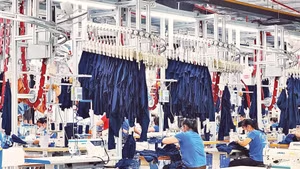
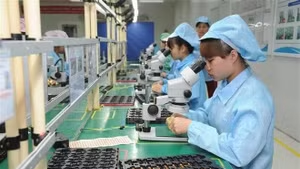
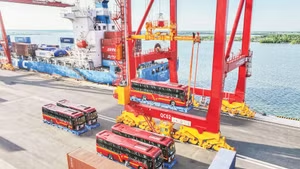
Statistics show that bilateral trade between Viet Nam and Thailand in 2024 exceeded 20 billion USD, up 6.36% from 2023. Viet Nam’s exports to Thailand reached around 7.81 billion USD, with key items including mobile phones and components, machinery and equipment, steel, computers, electronic products, and agricultural goods such as fresh fruit, seafood, and coffee.
Conversely, Viet Nam imported 12.45 billion USD worth of goods from Thailand, mainly machinery and equipment, fully built automobiles, electronic components, and household electrical appliances.
In Ho Chi Minh City, Viet Nam’s largest economic hub, trade with Thailand has also recorded encouraging results. Thailand is currently one of the city’s key partners, particularly in commerce, investment, culture, and tourism. Leading export items from the city to Thailand include agricultural products, processed foods, textiles, and industrial goods.
Ho Thi Quyen added that Thailand is not only a traditional trading partner but also a gateway that connects Vietnamese enterprises with new export opportunities.

The year 2025 marks a new milestone in Viet Nam–Thailand trade relations. Both sides have committed to raising bilateral trade turnover to 25 billion USD, aiming for greater balance and sustainability.
Notably, the two countries are vigorously promoting the “three connections” strategy: supply chain connectivity (strengthening cooperation in production and distribution), connectivity across economic sectors, localities, and enterprises (fostering collaboration among different regions and businesses), and connectivity in green and sustainable growth strategies (advancing green and sustainable economic development).
The Thai market offers significant opportunities for Vietnamese enterprises, including those based in Ho Chi Minh City. With a population of over 70 million and rising purchasing power, Thailand is an attractive destination for Vietnamese products.
However, to fully seize these opportunities, Vietnamese enterprises must overcome several challenges when exporting to Thailand. These include technical barriers and standards, strong competition from Thai domestic products, requirements concerning product quality and packaging, and the need to meet Thailand’s specific consumer preferences.
Therefore, businesses must enhance product quality, keep up-to-date with market information, proactively build sustainable development strategies, and expand international partnerships.
Such an approach is seen as essential for helping Vietnamese enterprises strengthen their position in the Thai market, thereby contributing to export growth and improving the country’s economic performance.
To support Vietnamese enterprises in entering the Thai market, Nguyen Thi Bich Van, Communications Director of Central Retail Viet Nam, noted that since 2016, through the annual “Vietnamese Goods Week in Thailand”, Central Retail has collaborated with the Ministry of Industry and Trade and the Ho Chi Minh City Investment and Trade Promotion Centre to create a platform for nearly 500 Vietnamese enterprises to introduce their products to Thai consumers and expand export opportunities.
The event not only deepens the presence of Vietnamese goods in the Thai market through a major distribution network but also serves as an opportunity to promote Viet Nam’s image, culture, and products in general, while enabling enterprises in Ho Chi Minh City to access export channels to Thailand.
Experts emphasise that to export successfully to Thailand, enterprises must prioritise attractive, modern, and internationally standardised packaging, comply with labelling regulations and orient products toward green development. Pricing must be competitive and accompanied by seasonal promotional campaigns.
Clear information and prominent presentation of product strengths are also crucial to attracting Thai consumers. Currently, Vietnamese products with strong export potential to Thailand include seafood, sweet potatoes, dragon fruit, coffee, sauces, and spices.