Building trust, forging consensus, and spreading aspirations for development
During the 2020–2025 term, alongside the country’s comprehensive development, the Vietnamese press has also undergone a strong transformation. Press agencies have strictly implemented the leadership, direction, and information orientation of the Party and the State, providing timely and truthful coverage of political, economic, and social life and serving as a reliable forum for the people. Press content has been rich and comprehensive, with a high level of social critique.
Press agencies have synchronously and effectively implemented the national master plan on press development and management to 2025, and built and gradually carried out appropriate roadmaps towards autonomy in line with the plan. The accelerated application of modern technologies in programme production, broadcasting, and news dissemination has helped press content truly keep pace with the “pulse” of life and become more engaging for readers. Journalists have continually enhanced their political steadfastness and professional competence, upheld professional ethics, and maintained a strong sense of service to the Party, the country, and the people.
In particular, in implementing Resolution No. 35-NQ/TW dated October 22, 2018 of the 12th Politburo on strengthening the protection of the Party’s ideological foundation and combating wrong and hostile views in the new situation, the press in recent years has proactively intensified efforts to counter distorted, hostile, and opportunistic political viewpoints, contributing to safeguarding the Party’s ideological foundation. Central and local press agencies have generally performed their function well of disseminating the Party’s and the State’s guidelines and policies, identifying, affirming, and multiplying positive values, good practices, role models, and new factors across society, while actively criticising negative phenomena, correcting misguided perceptions, countering wrong and hostile views, and protecting the Party’s ideological foundation.
Many newspapers have opened special pages and columns carrying direct and forthright articles countering wrong and hostile views. Typical examples include the Communist Review with its column “Identifying wrong and hostile arguments”, Nhan Dan Newspaper with “Commentary – Critique”, and the People’s Army Newspaper with “Protecting the Party’s ideological foundation”. These efforts have both raised public awareness and created strong momentum in countering wrong and hostile viewpoints and protecting the Party’s ideological foundation in the new situation.
In addition, the press has consistently been a vanguard force on the front against corruption, wastefulness, and negative practices. With its role and social responsibility, the press has truly accompanied the principles of openness and transparency, mobilising public participation in detection, struggle, communication, and oversight in anti-corruption, anti-wastefulness, and anti-negativity efforts. Many journalistic works have focused on disseminating and explaining guidelines, policies, and laws on combating corruption, wastefulness, and negative practices, thereby raising awareness among cadres, Party members, and the public. The press has provided timely coverage of the leadership and direction of Party and State leaders and competent authorities in this struggle, while encouraging and protecting exemplary figures. As a result, journalism has mobilised participation from all social strata, strengthened public trust in the leadership of the Party and the State and in compliance with the law, exposed and criticised acts of corruption, wastefulness, and negativity, and reported on the public and strict handling of violators by competent authorities.
Promoting the role of the press in the new stage
Reality shows that, alongside important contributions to national development, some press agencies have not fully adhered to their purposes and missions, have paid insufficient attention to setting examples, praising and encouraging new factors, advanced models, and good deeds, and have become overly focused on the negative aspects of society, lacking humanistic values. Some journalists have violated professional ethics and exploited journalistic activities for personal gain.
The press needs to continue upholding a spirit of revolutionary offensiveness, studying and promptly applying the provisions of the 2025 Press Law (Law No. 126/2025/QH15, effective from July 1, 2026). Each journalistic work must contribute to combating and eliminating the bad, stagnant, and backward; actively encourage and promote progressive values; pioneer and act courageously on major and new national issues; and not evade or compromise with manifestations that hinder the revolutionary cause. At the same time, it should strengthen trust, spread creative inspiration, and encourage innovation and aspirations for dedication throughout society.
Nguyen Van Hay, Deputy Secretary of the Party Committee of the PCC’s Commission for Communication, Education and Mass Mobilisation
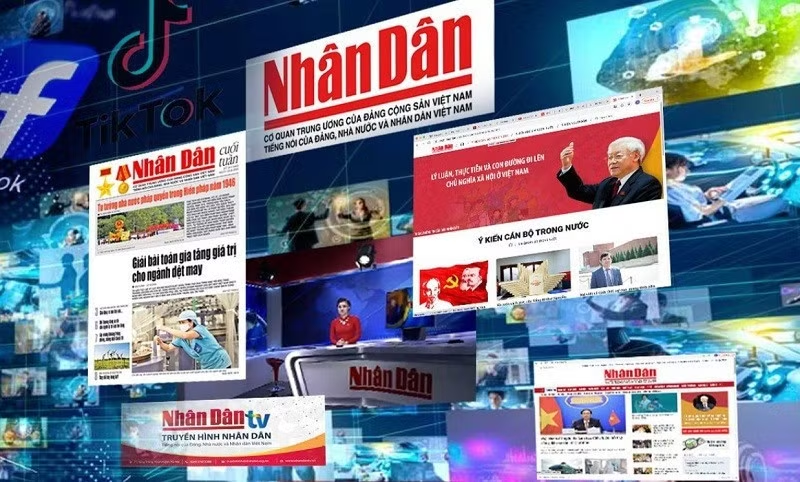
Meanwhile, the explosion of digital technology has also brought major challenges for journalists, as information spreads at breakneck speed on platforms such as Facebook, Twitter, and TikTok. The risks of fake news and changes in audience information consumption habits pose significant challenges to press development in the current new era.
As of the end of 2025, after restructuring and streamlining under Resolution No. 18-NQ/TW, the country has 778 press agencies. In the current new stage, press agencies and journalists must deeply recognise their political and social responsibilities to the Party, the State, and the people. The revolutionary press must be the voice of the Party, the State, and socio-political organisations, a reliable forum for the people, and a bridge connecting the Party’s will with the people’s aspirations, effectively carrying the Party’s and the State’s guidelines and policies to the people.
According to Nguyen Van Hay, Deputy Secretary of the Party Committee of the PCC’s Commission for Communication, Education and Mass Mobilisation, the press needs to continue upholding a spirit of revolutionary offensiveness, studying and promptly applying the provisions of the 2025 Press Law (Law No. 126/2025/QH15, effective from July 1, 2026). Each journalistic work must contribute to combating and eliminating the bad, stagnant, and backward; actively encourage and promote progressive values; pioneer and act courageously on major and new national issues; and not evade or compromise with manifestations that hinder the revolutionary cause. At the same time, it should strengthen trust, spread creative inspiration, and encourage innovation and aspirations for dedication throughout society.
Many experts also believe that the press needs to participate more actively in building an advanced Vietnamese culture imbued with national identity, contributing to cultural revitalisation and the development of modern Vietnamese people rich in identity. Each journalist and each press agency should truly be a symbol of cultured conduct, ethical standards, and a spirit of social service, contributing to preserving and promoting traditional humanistic values, spreading goodness and beauty, actively promoting the image of Viet Nam and its people to international friends, and proactively absorbing the quintessence of world cultures to enrich national cultural identity.
Keeping pace with the wave of digital transformation and the fierce competition of the global media space, the press must quickly adapt, pioneer strong innovation in thinking, master technology, and make breakthroughs in journalistic practices and information delivery. It should strengthen the presence of the revolutionary press on social media platforms, firmly maintaining the information and communication front amid the expansion of cross-border platforms.
It can be seen that the “key” for the press to fulfil its role in the new development era lies in accompanying the people and the Party’s ideals. Closely following all aspects of social life; providing timely information and communication on the 14th Party Congress; the implementation of the Congress’s resolutions and those at all levels; effectively promoting social critique; actively countering wrong and hostile views and strengthening the protection of the Party’s ideological foundation; proactively combating corruption, wastefulness, and negative practices; and spreading positive factors in social life. These are the foundations for more clearly affirming the role of the press in national stability and development in the new era.