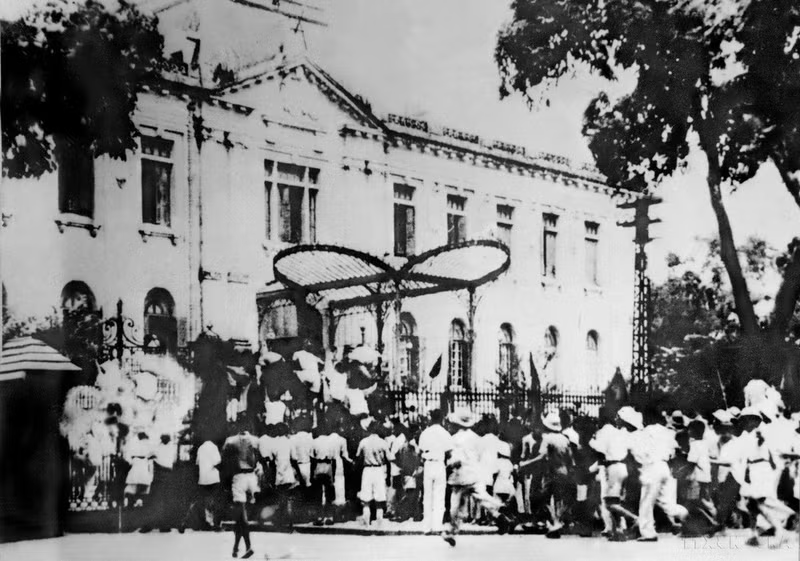
The Party Central Committee, leader Ho Chi Minh, the Viet Minh General Headquarters, and the Party and Viet Minh Front organisations nationwide demonstrated their strength and determination to lead the entire nation in a General Uprising across the country. Fascism had been defeated in Europe on May 9, 1945. On August 15, 1945, fascist Japan surrendered to the Soviet Union and the Allies, leaving the Japanese forces in Viet Nam and Indochina confused and weakened, while the puppet administration lost its support.
In these circumstances, leader Ho Chi Minh issued a Letter calling for a General Uprising to the people nationwide, stating: "The decisive hour for the destiny of our nation has come. Let all our compatriots across the country rise up and liberate ourselves with our own strength." The Standing Board of the Party Central Committee, leader Ho Chi Minh, and Party General Secretary Truong Chinh decided to convene the National Party Conference in Tan Trao, Tuyen Quang Province, on August 14–15, 1945.
The conference affirmed: "A very good opportunity for us to win independence has arrived." Its resolution decided to launch a General Uprising based on three principles: concentration, unity and timeliness, with the goals of "winning complete independence" and "building a people's administration". On August 13, 1945, the Party Central Committee and the Viet Minh General Headquarters established the Uprising Committee, which issued Military Order No. 1.
Alongside these favourable opportunities, two major risks also emerged that could hinder the Vietnamese revolution. Taking advantage of Japan's defeat, the French colonialists sought to return and reimpose their rule over Viet Nam and Indochina as it had been before Japan's coup on March 9, 1945. This intention was reflected in a statement by French leader General Charles de Gaulle on March 24, 1945, affirming that France would not abandon its interests in Viet Nam and Indochina.
The second risk was that, under the arrangements of the Allied Potsdam Conference, British troops would enter southern Indochina from the 16th parallel, from Da Nang southward, to disarm Japanese forces, while the British sought to facilitate the return of French forces. North of the 16th parallel, Chiang Kai-shek's Chinese Nationalist troops would enter to disarm Japanese forces while harbouring ambitions to invade Viet Nam, having prepared their Vietnamese collaborators, Viet Cach and Viet Quoc. The resolution of the National Party Conference clearly stated that it was necessary to "counter French schemes to restore their former position in Indochina and the schemes of certain Chinese warlords to occupy our country".
The Party stressed that, in any circumstances, only our own strength could determine victory. The Party and leader Ho Chi Minh were determined to seize the opportunity to launch the General Uprising and secure victory in August 1945 before the Allied forces, namely the British and Chiang Kai-shek’s troops, could enter and before the French could return.
This was the correct policy of both seizing the opportunity and pushing back the risks. With the victory of the August 1945 General Uprising and the Declaration of Independence on September 2, 1945, the state administration of independent Viet Nam affirmed its status as the country's sovereign authority, enabling it to receive the Allied forces and counter all schemes of aggression.
The successful lesson of correctly identifying opportunities and pushing back risks was truly both a science and an art of leadership demonstrated by the Party and leader Ho Chi Minh. It addressed the fundamental issues of the revolution — state power and national independence — and opened the Ho Chi Minh era in the nation's history. The Party has applied this lesson throughout its leadership of the revolution up to the present day.
On September 23, 1945, France launched an attack on the South, marking the beginning of its second invasion of Viet Nam (with the first having begun on September 1, 1858). By late 1953, when our forces had grown considerably stronger, an opportunity emerged to achieve a decisive military victory and end the war. On November 20, 1953, French forces parachuted into Dien Bien Phu and established there the strongest military complex in Indochina.
President Ho Chi Minh and the Politburo met on December 6, 1953, and decided to launch an offensive against Dien Bien Phu. The Dien Bien Phu battlefield became the site of a strategic decisive battle between Viet Nam and France. President Ho Chi Minh assigned General Vo Nguyen Giap to command the campaign and gave him full authority to make decisions on the battlefield.
Thanks to his strategic acumen, effective and creative tactics, and the spirit of solidarity and sacrifice of the entire army and people, the Dien Bien Phu Campaign ended in complete victory on May 7, 1954, forcing France to sign the Geneva Agreement and ending the war. President Ho Chi Minh predicted that the US would seek every means to replace France. That risk became a reality.
The country was divided into two regions, with the US establishing a puppet administration and a neo-colonial regime in the south before launching a war of destruction against the north on August 5, 1964, and massively deploying US troops to the south from March 8, 1965. This posed a grave challenge to the Vietnamese revolution and nation.
The Party led the construction of socialism in the north and the struggle against the US to save the nation. By closely combining military, political, and diplomatic struggles, the revolution achieved successive victories, strengthened its position and forces, and brought the combined strength of the entire country into play.
Viet Nam and the US signed the Paris Agreement on January 27, 1973, requiring US troops and those of its allied countries to withdraw completely from Viet Nam. This created an opportunity for the Vietnamese revolution to advance towards complete victory.
By late 1974, the balance of forces on the battlefield had shifted in our favour. The Politburo decided to mobilise the full strength of the entire country with the determination to act swiftly and boldly to ensure victory, completing the 1975 Spring General Offensive and Uprising, culminating in the historic Ho Chi Minh Campaign, which completely liberated the south and reunified the country on April 30, 1975.
In leading the construction of socialism in the north and throughout the country after 1975, the Party achieved many successes in building a strong and superior political system, developing culture, education, and human resources; and in strengthening national defence, security, and external relations. However, there were also limitations and shortcomings in economic mechanisms and policies.
In 1979, the country faced a socio-economic crisis, which was also a time when the Party began to renew its thinking, particularly economic thinking, test new approaches in practice and undertake partial reforms. By 1986, many new models and approaches, as well as new policies, had produced positive results despite continuing difficulties. This created an opportunity for the Party to decide on the renewal policy.
At the 6th National Party Congress in December 1986, taking the approach of facing the truth, correctly assessing the truth and speaking frankly about the truth, the Party decided to implement the renewal policy. Renewal became an imperative of life, enabling the country to escape the prolonged risk of socio-economic crisis, overcome its encirclement and embargo, and embark on a path of development.
In the 1990s, with mechanisms and policies to develop a multi-sector commodity-based economy operating under a market mechanism with state management and a socialist orientation, together with proactive and active international integration, Viet Nam's renewal process achieved success on many fronts. The country emerged from the crisis and the situation of encirclement and embargo, successfully integrated into the international community, and maintained political and social stability.
This created an opportunity for the country to develop and accelerate industrialisation and modernisation. In 1994, alongside its achievements, the Party also identified four risks: the risk of falling further behind economically; the risk of deviating from the socialist orientation; the risk of corruption; and the risk of "peaceful evolution". Once again, seizing opportunities and pushing back risks were directly placed on the Party's agenda, with no risk to be underestimated.
Today, Viet Nam is entering an era of nation’s rise. There are many favourable conditions and opportunities for the country to achieve rapid and sustainable development, realise the two centenary goals, and attain double-digit economic growth. The political system has been streamlined and strengthened to become more effective, efficient, and high-performing. The economy is dynamic, growing rapidly, and expanding in scale, and Viet Nam has joined the group of upper-middle-income countries.
Science and technology, particularly digital technology and artificial intelligence (AI), are being successfully applied and developed in accordance with Politburo Resolution No. 57-NQ/TW. Great national unity has been firmly strengthened, social security expanded, and people's living standards improved, with the people and human beings placed at the centre. National defence and security are strong. External relations have been expanded, while Viet Nam's international position and prestige continue to rise.
However, the 14th National Party Congress in January 2026 frankly pointed out shortcomings and weaknesses and stressed: "The four risks identified by the Party have gradually been addressed, however, some aspects remain complex. The overarching risk is that of falling behind, particularly in technology, and falling into the middle-income trap."
In every period of the revolution, opportunities, favourable conditions, and prospects have always been intertwined with difficulties, challenges, and risks. This requires strategic vision and thinking, strategic autonomy and the ability to forecast developments in order to make correct and timely decisions. This is a fundamental aspect of the Party's science of leadership.