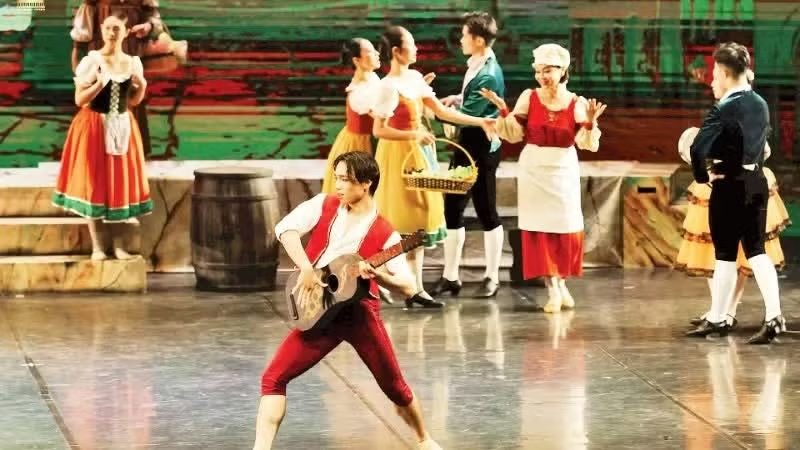
At the Viet Nam National Opera and Ballet, where he has worked since 2020, Nguyen Duc Hieu has performed leading roles in classical ballets such as Don Quixote (2025), Cinderella (2024), and Swan Lake (2024), as well as contemporary works including Dong Ho (2023) and Do (2024, 2026).
He spoke to Nhan Dan about his passion for ballet, his reflections on art, and his dedication to the craft.
A dream to develop ballet in a Vietnamese way
Q: You initially chose to study dancesport rather than ballet, yet it is ballet that has brought you significant success, including a scholarship to study in the US. How did that journey unfold?
A: My parents first encouraged me to pursue painting. In 2000, when I was six, they took me to a local cultural centre to enrol, but the painting class was no longer running. The only option available was dancesport, so that is where I began.
Seeing how passionate I was about dancing and given that our home was near the Viet Nam Academy of Dance, in 2013 my parents suggested that I apply there if I wanted to train professionally.
After my first year, I realised that ballet demands precision, discipline, and rigour, almost like mathematics, yet it is also graceful and refined, qualities that suited my personality. I decided to commit fully. To this day, I remain fascinated by ballet, even as I have explored other interests such as music and singing.
After graduating from the intermediate programme at the Viet Nam Academy of Dance and preparing for the next stage of my training, I received a scholarship to attend a summer intensive for young dancers in the US. On the final day, the artistic director of the San Francisco Ballet School approached me and offered a full position in the school, with tuition and accommodation covered. I had also received scholarships from two other ballet schools in the US at that time, but in the end I chose San Francisco Ballet School because I wanted to remain at the forefront of global dance.
Q: Some dancers who studied abroad have chosen to remain overseas, returning to Viet Nam only occasionally for projects. Could you not have followed a similar path?
A: I did receive offers to work with several dance companies in the US after completing my studies. However, I chose to return to Viet Nam because I feel most comfortable in my country.
Today, with foreign language skills and access to the internet, you can continue learning from leading artists worldwide. I also pursue short-term courses abroad, so I have no concern about falling behind by basing myself in Viet Nam. Recently, I took part in the Asia Pacific International Arts Festival in China. Beyond the competition itself, I saw it as an opportunity to learn — watching performances from other countries, exploring new stage technologies, and observing their production methods.
I also came back to better understand the domestic dance sector and to drive meaningful change from within, because you can only do so when you truly understand the environment. I need to be here to understand our audiences and colleagues, and to grasp the challenges Vietnamese dancers face in advancing professionally and contributing to the art form.
Q: So you are nurturing a particular dream for Vietnamese ballet?
A: My dream is to develop ballet in a distinctly Vietnamese way. Vietnamese dancers have different physical builds and proportions from their European and American counterparts, which means we cannot compete on equal footing in classical ballet. However, we can certainly make our mark through contemporary works that draw on Vietnamese folk tales and traditions.
By returning, I also want to demonstrate something: that as a Vietnamese artist, trained and working in Viet Nam, I can still uphold international professional standards and achieve success at the highest level.
What profession is not demanding?
Q: People often say that financial hardship is the biggest challenge for ballet dancers in Viet Nam. Would you agree?
This art form is challenging everywhere. Even in developed countries, ballet productions depend on sponsorship, as ticket sales alone cannot cover production costs. In Viet Nam, conditions are even more difficult. While ballet is deeply rooted in Western cultural life, here it remains a niche market.
Fortunately, there are encouraging signs from audiences in Viet Nam. Russian ballet performances have sold out, with audiences willing to pay several million dong for tickets, as was the case with “The Peacock”. Even our recent contemporary ballet “Do” sold strongly. I was almost unable to buy tickets in time to invite my family (laughs). As the economy grows, audiences will become increasingly willing to pay for the arts; they want to experience beauty.
The greatest challenge for Vietnamese ballet dancers today is the limited number of productions. While ballet companies in Europe and the US may stage around nine productions a year, in Viet Nam there are rarely more than two. To excel in this field, dancers need frequent stage time, constant new challenges, and the creative stimulus of fresh works. There are simply not enough productions to provide that.
Q: Yet you seem extremely busy, arranging this interview alone required careful scheduling. How do you manage it all?
A: In addition to my work at the theatre — rehearsing new productions and performing in state assignments — I am also encouraged to take on external work to supplement my income.
Beyond my theatre work, I teach dance at the Military University of Culture and Arts and other institutions, choreograph dance segments for various programmes, and continue studying foreign languages so that I can learn from international artists and vibrant artistic communities. I also read widely in the arts and literature, which helps me deepen my empathy for the characters I portray.
At times, the workload is exhausting. But when I look around, I still feel satisfied. What profession is not demanding? As long as I can continue dancing and doing what I love, I am happy.
Dancers in Europe and the US may not face the same financial pressures, but they contend with different ones, such as intense competition. In Viet Nam, ballet dancers support one another; we simply want to work together to create the best performances we can.
Q: You seem to be an optimistic person?
A: I believe that if you want to change your surroundings, you must first change yourself. You must ask whether you truly and wholeheartedly love what you do.
In the ballet “Dong Ho”, choreographed by Ngoc Anh, which I performed in 2023, I learned an important lesson about giving and receiving. As a dancer, I strive to love my craft and to share that love of ballet with others. If your love is pure, what you do will remain beautiful and that beauty will be recognised. Some may call me idealistic, but I believe art should be exactly that. I strive only for beauty.
My only burden is to dance beautifully and to find more opportunities to perform. So far, I have not done much for dance, but dance has given me so much.
Thank you for the engaging conversation!
Viet Nam has a rich folk cultural heritage, with stories deeply imbued with Eastern philosophy. The tale of Saint Giong embodies a distinctly Vietnamese spirit: when the moment demands it, the Vietnamese people can grow beyond ordinary bounds, and in defence of the nation, they rise with extraordinary strength. Bringing such a story to the ballet stage would yield magnificent scenes. There are so many compelling Vietnamese stories yet to be explored. I want to contribute to enriching Vietnamese culture through the language of ballet.
Ballet dancer Nguyen Duc Hieu