In an interview with Nhan Dan Newspaper, Pham Quoc Long, Deputy General Director of Gemadept Corporation and President of the Viet Nam Ship Agents, Brokers and Maritime Services Providers Association (VISABA) shared his concerns about the share of economic value captured by Vietnamese businesses, along with proposals for institutional reforms to realise the goal of building a strong maritime nation under Resolution No. 20-NQ/TW.
From journey of renewal to paradoxes of development
Q: Having witnessed many turning points in the maritime industry, what makes you most proud, and what concerns remain?
A: I began working in the maritime industry in 1986, just as the country embarked on its Doi Moi (Renewal) process. Having devoted 40 years to a single profession, I have witnessed many major changes. Back then, vessels measuring just 50 metres in length, tiny against the vast ocean, were still carrying Vietnamese goods across the seas to the world under extremely difficult conditions.
The subsequent emergence of container shipping introduced an entirely new mode of transport. Shipments that previously required the chartering of an entire vessel could now be packed into just a few containers, making transport more convenient, safer and more cost-effective. From operating container ships with capacities of just over 100 TEUs, Viet Nam’s deep-water port system can now accommodate the latest generation of mega container ships with capacities exceeding 24,000 TEUs and lengths of around 400 metres, providing direct connections to major markets. This is a remarkable achievement of which we can be very proud.

However, having large seaports is only a necessary condition. What continues to concern us is how many maritime services Vietnamese businesses control and how much economic value they retain from the cargo passing through these ports.
Q: Gemadept is one of the pioneering enterprises investing in and developing Viet Nam’s seaport system. From this practical experience, what bottlenecks need to be removed to make better use of this infrastructure?
A: In recent years, the participation of investors, including Gemadept, has contributed to the strong development of Viet Nam’s seaport system. Many terminals have benefited from modern investment and are operating efficiently, but connectivity between them remains limited. Even adjacent terminals often find it difficult to coordinate operations to accommodate multiple large vessels simultaneously. Containers transferred between two terminals have to be transported via public roads and undergo additional customs procedures, increasing both time and costs.
To improve operational efficiency, I believe seaport planning should follow an integrated approach, with interconnected ports and berths, moving towards an open-port model that allows terminals to connect and coordinate the shared use of berths, equipment and logistics infrastructure. At the same time, procedural obstacles must be removed, particularly those relating to customs supervision of goods moving between terminals.
Another important issue is that seaport investment must be driven by market demand. Ports require substantial capital and have long payback periods, so any expansion must be preceded by careful assessments of cargo sources, existing capacity and connectivity with industrial parks, transport networks and logistics centres in the hinterland. The goal should not be to build as many ports as possible, but to develop a well-coordinated port system that operates efficiently and is highly competitive.
Q: However, seaports are only one link in the maritime value chain. Why, in your view, have Vietnamese businesses yet to capture a proportionate share of its value?
A: A container passing through a seaport generates value at multiple stages, of which cargo handling is only one. Beyond that are shipping, insurance, maritime finance, brokerage, ship agency services, fuel supply, ship repair and other logistics services. We are performing relatively well in certain areas of port operations, but high-value-added services have yet to develop to their full potential.

Comparative figures show that the maritime industry contributes only around 0.9% of GDP in Viet Nam, compared with 7.6% in Singapore. Average value added per worker in Viet Nam’s maritime industry is also only about one-tenth of Singapore’s level. This gap demonstrates that, alongside large seaports, we must develop high-value maritime services to retain a greater share of the economic benefits generated by cargo flows through our ports.
Facilitating cargo flows, reducing logistics costs
Q: Based on businesses’ practical experience, what shortcomings in mechanisms and policies need to be addressed to enhance the competitiveness of Viet Nam’s maritime and logistics industries?
A: Shipping is an international business that requires substantial capital and the ability to respond quickly to market opportunities. While foreign shipping lines enjoy advantages in scale, route networks, cargo sources and financial capacity, Vietnamese enterprises continue to face numerous regulatory and policy obstacles. Certain regulations governing vessel age, ship inspection, financial obligations and procedures for purchasing, selling and registering vessels are not aligned with practical conditions, causing businesses to miss investment opportunities.
Comparative figures show that the maritime industry contributes only around 0.9% of GDP in Viet Nam, compared with 7.6% in Singapore. This gap demonstrates that, alongside large seaports, we must develop high-value maritime services to retain a greater share of the economic benefits generated by cargo flows through our ports.
In port operations, according to figures published by the World Bank, two Vietnamese ports rank among the world’s 11 best-performing container ports. Yet container handling charges in Viet Nam remain significantly below the global average. I believe this imbalance needs to be addressed promptly so that port operators have the resources to reinvest, improve service quality and enhance their competitiveness.
In logistics, the lack of data interoperability among shipping lines, seaports, customs authorities, warehouses and transport operators is creating additional procedures and prolonging cargo processing times. A shared data platform should be established as soon as possible, moving towards a system of “declare once, use multiple times” to reduce time and costs while improving efficiency across the entire supply chain.
Q: Waterway transport offers substantial cost advantages but has yet to realise its full potential. What bottlenecks need to be removed to facilitate the movement of goods from production areas to seaports?
A: The greatest advantage of waterway transport is its low cost. For example, transporting a 20-foot container from Ho Chi Minh City to Hai Phong by sea costs only around 3 million VND, whereas road transport can cost as much as 30 million VND. Even on short routes, waterway transport costs are only 50–70% of those for road transport. Nevertheless, although waterways account for approximately 20% of freight volumes, they have long received only around 2% of total public investment in transport.
This substantial disparity between the sector’s transport role and the resources allocated to it is one reason why waterway infrastructure has been slow to improve. Many navigation channels remain constrained by insufficient depth, limited width and inadequate bridge clearance, while connections from production areas and industrial parks to deep-water ports are still poorly coordinated.

To facilitate cargo flows, priority should be given to upgrading key transport corridors while addressing shortcomings in vessel management regulations. For example, to qualify for exemptions from pilotage and tugboat requirements, some feeder container vessels must keep their length below 80 metres and gross tonnage below 2,000 GT, with typical carrying capacities of around 250 TEUs. Meanwhile, river-sea container vessels measuring 92–99 metres in length, equipped with bow thrusters, can carry up to 400 TEUs. Regulations should therefore be reviewed and adjusted based on vessels’ technical capabilities and actual safety conditions, rather than solely on their dimensions.
I believe that once infrastructure receives investment commensurate with its importance and regulatory obstacles are removed, businesses will be more willing to invest in fleets and develop waterway transport, helping to reduce logistics costs for the economy.
Institutional reforms must pave the way for development
Q: What breakthroughs does Viet Nam need to gain control of high-value maritime services and gradually realise its ambition of becoming a strong maritime nation?
An international maritime centre is not simply a place with modern berths and large cargo volumes. It must also be a hub for transport, trade, finance, insurance, brokerage and other high-value maritime services.
Pham Quoc Long
A: It’s time for Viet Nam to look beyond simply building large seaports. An international maritime centre is not simply a place with modern berths and large cargo volumes. It must also be a hub for transport, trade, finance, insurance, brokerage and other high-value maritime services.
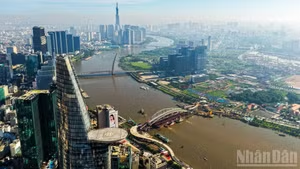
The Ho Chi Minh City–Cai Mep–Thi Vai area has many advantages for development in this direction. We have substantial import-export cargo volumes, a deep-water port system capable of accommodating the world’s largest mega container ships, and a growing network of port and logistics businesses. If linked to the International Financial Centre, the area could become a regional hub connecting cargo flows, capital flows and maritime services.
However, favourable geographical positioning and port infrastructure alone are not enough to establish an international maritime centre. We need mechanisms to attract shipping lines, financial institutions, insurance companies and international service providers, while enabling Vietnamese businesses to participate more deeply in the value chain.
Resolution No. 20 has set out the vision for developing the maritime economy. What matters now is translating that vision into concrete mechanisms capable of delivering meaningful change. A strong maritime nation must not only possess large seaports but also gain increasing control over maritime services and the economic value generated by the sea.
Reporter: Thank you very much for your insights.