Photography as a dialogue with the inner self
Q: Your quiet dedication to street photography surprises me less than the fact that you work in information technology at a government agency. The two pursuits seem to have very little in common, don’t they?
A: I often joke with people that I accidentally bought a semi-professional camera, so I had no choice but to take photographs (laughs). The accidental purchase was real. At first, I had to teach myself how to understand and use the camera properly, at least from a technical perspective. I learnt about it, started using it, and gradually made photography a habit. Other things followed naturally.
Working in IT, I am quite accustomed to reading and learning from foreign technical materials. I also read extensively about photography, particularly street photography, to broaden my knowledge.
Q: Looking at your photographs, I can see how much attention you pay to composition and contrasts of light. It made me wonder whether you enjoyed drawing as a child.
A: I would say I was more of a dreamer. As a child, I played superhero computer games with my friends, but because we didn’t know English, we had to imagine what was happening. We also loved putting on plays, inventing characters, costumes, colours, dialogue, and actions.
And then there were countless childhood games around our neighbourhood: drawing, making holes, scraping plaster off walls, writing on staircases... All sprang from our mischievous imaginations.
I realise that living in a world of imagination and dreams was perfectly natural throughout my childhood. That happy childhood has been a source of nourishment throughout my life. Having a camera gave me the opportunity to return to that world and explore it more deeply.
Later, I wanted to bring that world out into the open and share it with others, so they could better understand another part of my inner life and perhaps recognise something of themselves in my photographs.
This thought came to me when I looked back on my then seven years of photography, reviewing each series and reflecting on what all my work had in common.
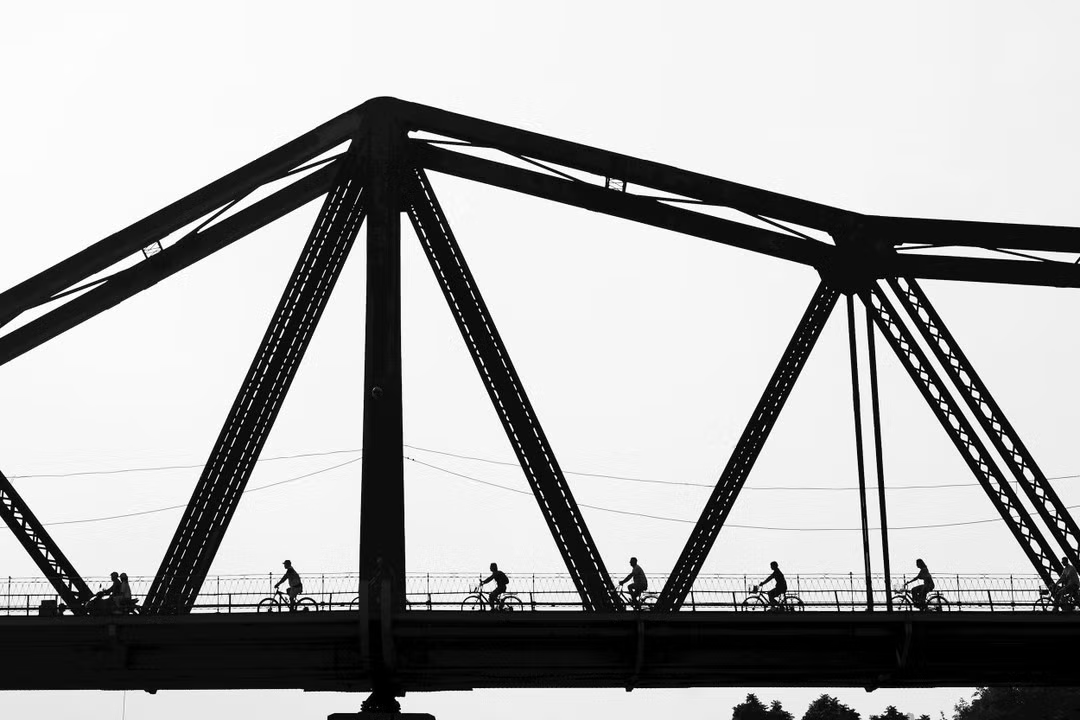
Three years later, in early 2026, while preparing my first solo exhibition, Original Identity, at Noirfoto Gallery in Ho Chi Minh City, I was also considering the content of my book “Cam tay chi pho” (Dan Tri Publishing House, 2026). I decided to use the very first street photograph I had taken in Ha Noi ten years earlier as the book’s cover.
I realised that, right from the beginning, photography had been helping me express my inner world without my even knowing it. Preparing the book and exhibition prompted me to reflect on my journey and seek answers to questions about who I am and what kind of person I have become.
Q: The two keywords, “inner self” and “street”, seem almost contradictory. How do they come together in a single photograph?
A: The street is full of unexpected elements that may catch someone’s attention at any given moment. It is a reality in which we all participate but which none of us can control through individual reason.
When I go out with my camera, I let my unconscious mind guide me: “Go on, that’s beautiful, press the shutter!”
It is rather like being in a dream, when reason relinquishes control and the subconscious rises to the surface, giving rise to an inner dialogue.
Street photography as a gift to the city
Q: Looking back over the past ten years, what do you feel street photography has genuinely brought to your life?
A: For me, street photography offers moments when I can relax my mind and emotions. It makes me feel truly alive, genuinely experiencing the deeply human emotions within myself.
In practice, when I go out to take photographs, the only thing I can plan is where to go. There is no way of knowing what I will photograph that day or whether the results will be any good, because so many unexpected external factors come into play.
All I can do is allow my rational mind to embrace the surprises of reality and gradually learn to trust its other side: intuition.
Through a long process of dialogue with my inner self, I have realised that I can always find a way to deal with the unexpected.
As you can see, life today is saturated with information, and change comes at an extraordinary pace. Moreover, in a world increasingly governed by rational calculations, targets, figures, and artificial intelligence, people can easily lose their bearings.
From my own experience, I believe we should spend more time listening to our subconscious and intuition, learning to trust them so that we can regain a sense of balance in life.
Q: Speaking of change, I am reminded of the profound transformations taking place in our Ha Noi today. Yet when I look at your photographs and read your writing, I sense a lingering atmosphere of Ha Noi as it lives in memory and nostalgia. Is it perhaps that you have not quite grown accustomed to the changes around you?
A: I am someone who lives very much in the past. As I mentioned, a happy childhood can nourish us throughout our lives.
I particularly enjoy photographing conical hats. Their beautiful shapes are one reason, but more importantly, they are closely associated with my childhood.
My mother used to take me everywhere on her bicycle. I would perch on the back while she pedalled along, always wearing a conical hat.
Street photography gives me the chance to hold on to the past by capturing images of real stories and real people who were once here, who lived, loved, laughed, and experienced sadness.
The Ha Noi of my childhood in the 1990s was a beautiful, limited-edition version of the city. After so many years of street photography, I have come to a deep understanding that nothing lasts forever (laughs).
Q: That lingering sense of the past is also present in many other photographs in Volume 1 of the series “Pho tan tam”. What about the subsequent volumes? Could you share the overarching idea behind this street photography book series?
A: Because Volume 1 includes my own photographs, I wanted the other three photographers to share a certain sensibility, giving the publication a distinctive character.
But unlike documentary or reportage photography, street photography bears the strong imprint of each photographer’s individual style. That is why Volume 2 of “Pho tan tam” will have a different character.
Let me share something with you. One of the contributors to Volume 1 is just 17 years old and still attending high school.
When I first started street photography, I found it very difficult because I didn’t have a circle of fellow photographers or an audience with whom I could share my work and find a sense of connection.
Things have improved considerably since then. More and more young people, some very young indeed, are taking up photography and street photography in particular. That is an encouraging sign.
So whenever my fellow photographers and I have an opportunity to build something together, we share the desire to look a little further ahead.
Ultimately, street photography is about people. It reflects the photographer’s thoughts on life and the relationships between people.
The city belongs to everyone, to you and me alike. So if we can share these stories with fellow photographers and the public, I believe that every photograph and every book can also become a gift to others and to the city itself.
Thank you very much for the conversation.
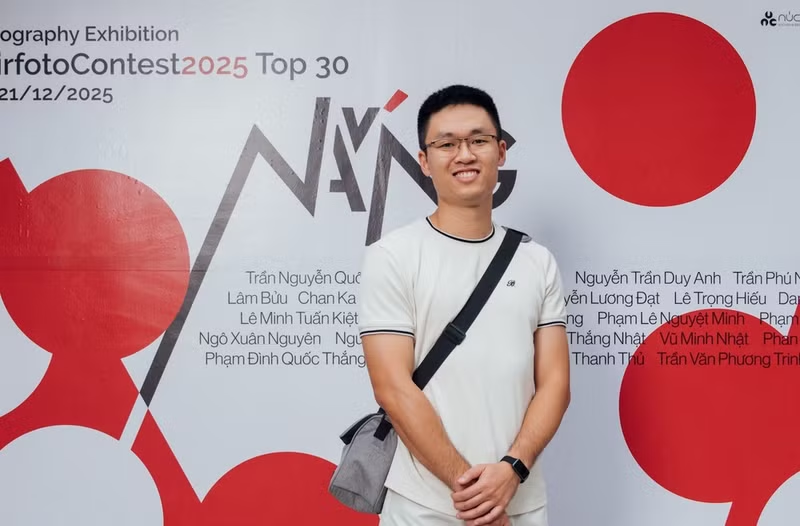
Alongside his own photographic practice, Lam Xuan Tung has quietly, thoughtfully, and meticulously connected with and encouraged many young people’s passion for street photography through displays, solo exhibitions, and several photobook projects. These include “Cam tay chi pho” (2026), which introduces 28 approaches to street photography drawn from his personal experience, and “Pho tan tam”, Volume 1 (2026), which showcases street photographers in Viet Nam.