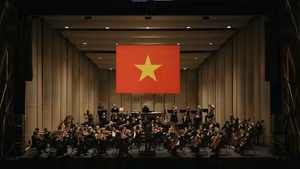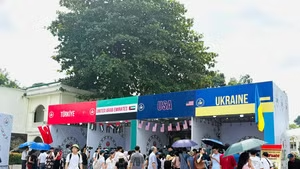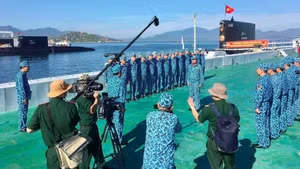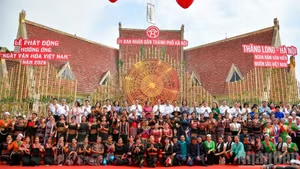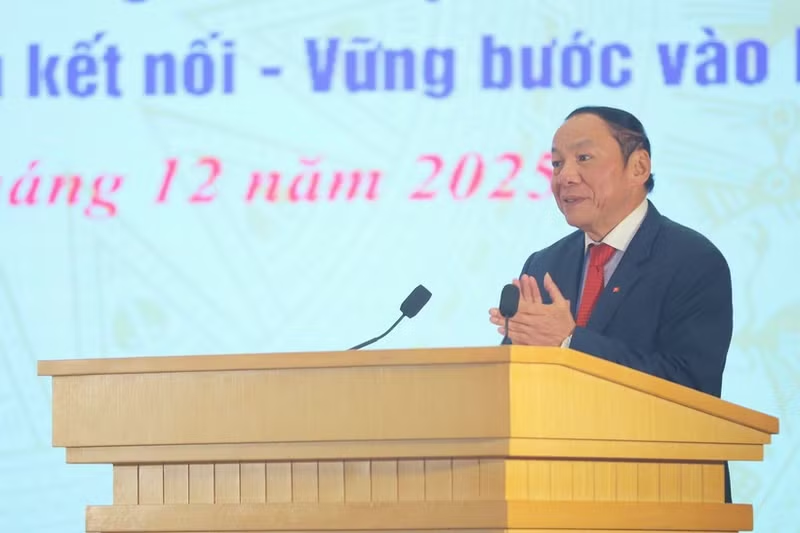
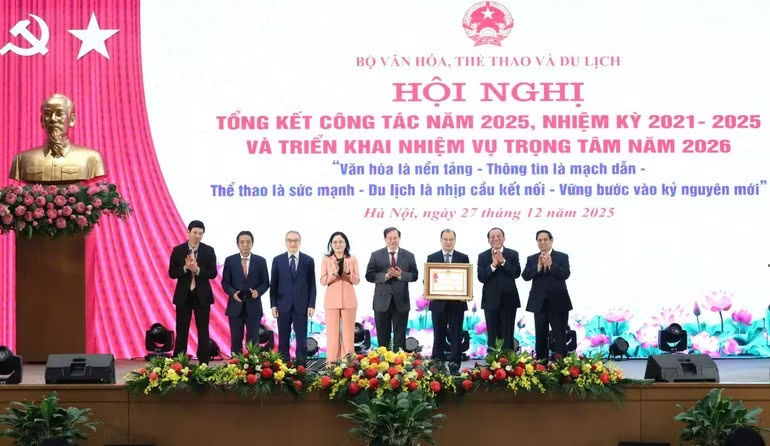
In the context of many changes in the world and the region, under the wise leadership and guidance of the Party, the National Assembly, and the Government of Viet Nam, the culture, sports and tourism sector has made strong efforts to transform itself. The most profound transformation lies not only in the impressive figures in tourism or sports medals, but in the fundamental change in thinking: From “doing culture” to “state management of culture,” creating an environment for culture, sports and tourism to take off.
Unlocking resources starts with institutions
2025 is recognised as a successful year in the work of perfecting institutions — the most important strategic breakthrough. The report of the Ministry of Culture, Sports and Tourism at the industry’s summary conference affirmed that the Ministry's legislative work has never before achieved such a high volume and quality as during this term.
Overall, during the term, the ministry has chaired the drafting, submission to competent authorities for promulgation, and completion of 146 legal documents. Specifically in 2025, the Ministry of Culture, Sports and Tourism advised and submitted to the National Assembly for approval the National Target Programme on Cultural Development for the 2025-2035 period. This programme has opened a major avenue, unlocking resources while creating the necessary infrastructure for sustainable cultural development. In addition, important laws such as the amended Film Law, the Law on Prevention and Control of Domestic Violence, and the provisions on copyright in the Intellectual Property Law have been implemented, creating a solid legal framework for specialised activities.
In his concluding remarks at the conference, Minister of Culture, Sports and Tourism Nguyen Van Hung emphasised the new management mindset, stating, “The fundamental and comprehensive shift in thinking from ‘doing culture’ to ‘state management of culture,’ governing and creating development through proposing, building, and perfecting institutions and policies, is a great achievement. This includes many new documents and policies that are unique in nature and issued for the first time, contributing to the construction of a legal framework that creates mechanisms, policies, and resources for the development of the sector.”
This change has enabled the culture, sports, and tourism sector not only to effectively manage but also to proactively seek resources and propose breakthrough mechanisms to address long-standing bottlenecks and obstacles.
Culture - Heritage: shining with Vietnamese values
In 2025, Viet Nam received a series of good news from UNESCO. In 2025, the Yen Tu-Vinh Nghiem-Con Son and Kiet Bac historical and scenic sites were officially recognised as World Cultural Heritage sites. Notably, Phong Nha-Ke Bang National Park and Hin Nam No National Park became the first multinational natural heritage sites of Viet Nam and Laos to be recognised by UNESCO. The total number of UNESCO-listed heritage sites in Viet Nam reached 37, contributing to positioning the nation’s brand on the world cultural map.
The cultural industry — a new pillar of the economy — has made new strides. Vietnamese cinema in 2025 marked a special milestone with the film entitled “Red Rain” produced by the People’s Army Film Studio achieving nearly 800 billion VND in revenue — a record for a state-funded film. Large-scale Vietnamese music festivals, with audiences ranging from 30,000 to 80,000 people, are not only a platform for artists to shine but also a testament to the immense appeal and potential of the domestic entertainment market. The estimated average production value of the cultural industries reaches 1.059 trillion VND, affirming a correct and sustainable development trend.
The solemn celebrations commemorating the 50th anniversary of the Liberation of the South and National Reunification; the 80th anniversary of the August Revolution and National Day on September 2 created a widespread impact, fostering patriotism and national unity.
Tourism experiences impressive growth
Following continuous efforts, Viet Nam’s tourism industry has fully recovered and experienced impressive growth, further affirming its role as a key economic sector. By 2025, the tourism industry is expected to welcome approximately 22-23 million international visitors and serve 120-130 million domestic tourists, with total revenue reaching approximately 980-1,050 trillion VND.
According to the United Nations Tourism Organization (UN Tourism), by 2025, Viet Nam will be among the countries with the highest growth rate of international visitors in the world (21%). Viet Nam’s position in tourism has also been affirmed through a series of prestigious awards: receiving the title of World’s Leading Heritage Destination for the sixth time, and Asia’s Leading Destination for the seventh time. Notably, Viet Nam’s tourism competitiveness has increased by 28 ranks, placing it 59th out of 119 global economies.
This achievement is thanks to innovation in promotion methods and a strong digital transformation. The national tourism website vietnam.travel has risen to second place in Southeast Asia.
In 2025, Vietnamese sports will continue to achieve success in both high-performance and mass sports. At the 33rd SEA Games, the Vietnamese sports delegation excellently achieved its goals, ranking second overall in the number of gold medals in Olympic sports.
On the cultural diplomacy front, Viet Nam has shifted from an “exchange” mindset to a “genuine cooperation” mindset. In 2025, Viet Nam shined at the EXPO 2025 World Exhibition in Osaka (Japan), winning a Silver Award in the “Exhibition Design” category and a Bronze Award in the “Best Team” category. In particular, Viet Nam’s initiative on the “International Decade for Culture for Sustainable Development” was adopted by the UNESCO General Assembly, demonstrating Viet Nam's leading role and responsibility in global issues.
Dare to think big, act big
2026 marks the beginning of the 2026-2030 five-year strategic roadmap, implementing the Resolution of the 14th National Congress of the Communist Party of Viet Nam. Anticipating a continued complex global context with fierce competition in technology and culture, the culture, sports, and tourism sector has determined that it must continue to innovate even more strongly.
The overall goal by 2030 is to strongly awaken the spirit of patriotism and self-reliance; culture truly becomes a solid spiritual foundation and an important intrinsic strength. The goal is for cultural industries to contribute 7% of GDP, as well as to welcome at least 50 million international tourists. High-performance sports maintained a position in the top 3 of the SEA Games and the top 20 of the ASIAD.
To realise these goals, speaking at the industry’s concluding conference, Minister of Culture, Sports and Tourism Nguyen Van Hung delivered a decisive directive for 2026 and the coming period. “2026 marks the beginning of a five-year journey… The Ministry of Culture, Sports and Tourism and the entire industry must ‘dare to think big, act big, and implement major reforms with the highest political determination and the most persistent efforts’ as directed by General Secretary To Lam. We must continue to strongly implement the three pillars of institutions, infrastructure, and human resources in culture, sports, information, and tourism within the context of a digital government, digital environment, digital economy, and digital society.”
Regarding institutions and resources: Focus on effectively implementing the National Target Program on Cultural Development for the period 2025-2035 from the very first year. Continue to improve the legal system, including proposing amendments to the Tourism Law and the Physical Education and Sports Law to align with new realities. Implement the "6 clear" principle: clear person, clear task, clear responsibility, clear time, clear decentralisation, and clear results.
Regarding Culture, we must: build a digital cultural environment and form a healthy cultural ecosystem; preserve and promote heritage values linked to community livelihoods, strive for 100% of provincial-level administrative units to have all three basic cultural institutions; and strongly implement the Strategy for the Development of the Cultural Industry, bringing Vietnamese culture to the world through contemporary art works.
Regarding Tourism, we must: redraw the tourism map of Viet Nam, focusing on quality and economic efficiency; strive to become one of the top 30 countries in the world in terms of tourism competitiveness; and accelerate digital transformation and form a smart tourism ecosystem.
Regarding Sports, we should: prepare the best possible team for the 2026 Asian Games in Japan; innovate the mindset for high-performance sports and invest strategically in Olympic sports; and promote sports for all to create a foundation for public health.
Regarding Journalism and Media, we should: build a professional, humane, and modern press; ensure that 100% of media outlets publish content on digital platforms; and effectively combat harmful and toxic information to protect the Party's ideological foundation in cyberspace.
Looking back on the past and towards the future, the culture, sports, and tourism sector is facing new opportunities. The achievements in 2025 are vivid evidence of the unity and tireless efforts of the entire sector. As affirmed by the Minister of Culture, Sports and Tourism, Nguyen Van Hung, “Whether all of that becomes a reality depends entirely on our aspirations and actions today, from culture, through culture, from our hearts, with our minds, and starting with those who ‘sow cultural seeds’ every day.”
With renewed vigour and determination, the culture, sports and tourism sector is confident in successfully fulfilling its glorious mission, contributing to the nation's steady progress into a new era of national development.