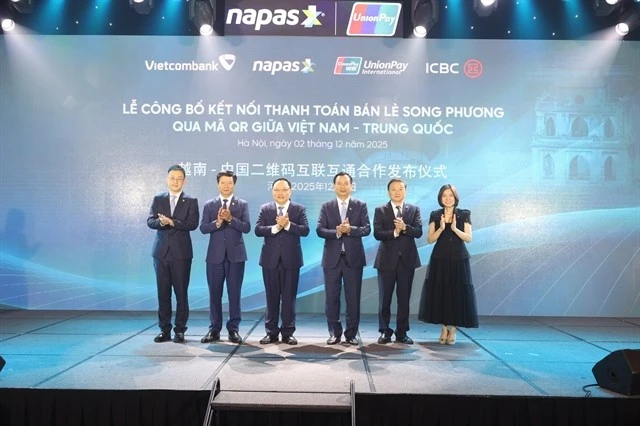
The announcement was made at a ceremony in Hanoi launching bilateral QR-code retail payment connectivity between Viet Nam and China. The event was organised by the National Payment Corporation of Viet Nam (NAPAS), UnionPay International (UPI) of China, the Industrial and Commercial Bank of China (ICBC), and the Joint Stock Commercial Bank for Foreign Trade of Viet Nam (Vietcombank).
Major retailers and service providers, including Central Retail supermarkets, Highlands Coffee and Sun World tourist sites, are now ready to accept QR payments from Chinese travellers. The initiative is expected to offer a faster, safer and more convenient payment experience, while helping Vietnamese businesses better tap one of their largest visitor markets.
The new service follows more than a year of technical coordination since UPI and NAPAS signed an MoU witnessed by high-ranking leaders of both countries in October 2024.
Under the plan, by early 2026, the reverse payment direction will also be completed, enabling Vietnamese travellers to use the apps of NAPAS member banks to scan QR codes for payment in China. Once fully operational in both directions, the system will form a complete cross-border QR payment ecosystem that supports tourism, trade and consumer spending between the two nations.
Vice President and CEO of UnionPay International (UPI) Larry Wang said that Viet Nam is a key market for China in both trade and tourism, and UnionPay has already established an extensive payment network in the country. The cross-border QR initiative leverages local currency settlement mechanisms, contributing to the internationalisation of the renminbi (RMB).
Enhancing cross-border payment convenience, he said, will further facilitate economic, trade and people-to-people exchanges between China and Viet Nam. UPI will continue to work with NAPAS to develop a safe and efficient regional payment ecosystem.
NAPAS CEO Nguyen Quang Minh noted that, under the guidance of the State Bank of Viet Nam, NAPAS has expanded international connectivity as the operator of the national retail payment infrastructure.
The bilateral QR initiative, he emphasised, reflects close cooperation among NAPAS, UPI and participating banks to deliver seamless payments for users in both countries, strengthen financial connectivity, encourage local currency payments and promote bilateral trade and tourism.