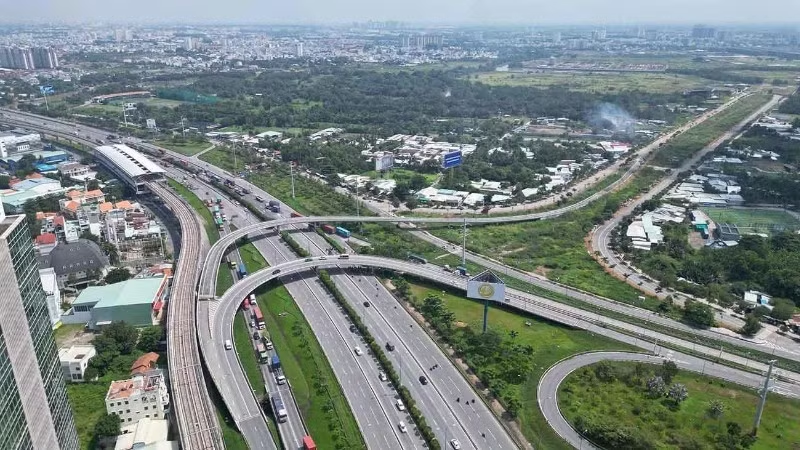
This is the list of projects using non-budgetary capital as stated in the submission of the Ho Chi Minh City People’s Committee to the Standing Committee of the City People’s Committee Party Committee on the list of groundbreaking and inauguration ceremonies of large-scale projects and works to celebrate the 14th National Congress of the Party.
The three projects scheduled to break ground on January 15, 2026, are all implemented by investors in the form of public-private partnership (PPP), including: Can Gio Bridge, Phu My 2 Bridge, and the Rach Chiec Sports Complex. Of which, the Rach Chiec Sports Complex project (An Khanh Ward) has the largest total investment, at over 91.8 trillion VND.
This project aims to build a modern sports complex, creating a highlight and enhancing the position of Ho Chi Minh City as a sports and entertainment centre of Southeast Asia. The entire project is expected to be completed by 2030.
The Can Gio Bridge project, connecting Binh Khanh Commune and Nha Be Commune, will stretch 7.3km long, including nearly 3km for the main bridge and more than 4.3km for the approach road. The total investment for the project is about 12.42 trillion VND in the form of PPP, BT contract (build-transfer). Of which, the Ho Chi Minh City budget is allocating over 2.88 trillion VND, while the remaining 9.535 trillion VND is mobilised by the investor. The project is expected to be completed in 2028.
The Phu My 2 Bridge project connects the southern area of Ho Chi Minh City with Nhon Trach District (Dong Nai) and will be about 6.3km long including the main bridge and approach road. The starting point is expected to be at Nguyen Huu Tho Street (Ho Chi Minh City), the end point will connect with Lien Cang Street (Dong Nai). The bridge is designed with 8 lanes, including 6 motor lanes and 2 mixed lanes. The total investment capital is about 12.912 trillion VND in the form of BT contract, more than 10.7 trillion VND of which will be mobilised by the investor and about 2.13 trillion VND from the budget of Ho Chi Minh City and Dong Nai to carry out site clearance. The project is expected to be completed in 2028.
The City Department of Construction assessed that the investment in the construction of Phu My 2 bridge connecting Ho Chi Minh City and Dong Nai Province will create a new traffic axis; thereby reducing traffic pressure through the existing Ho Chi Minh City-Long Thanh-Dau Giay Expressway, Phu My Bridge-Ring Road 2 of Ho Chi Minh City, and Road 25C (Dong Nai) creating a traffic axis connecting Tan Son Nhat Airport and Long Thanh Airport. At the same time, it will also connect the South Saigon urban area and the new city of Nhon Trach, creating new momentum for the development of both urban areas.