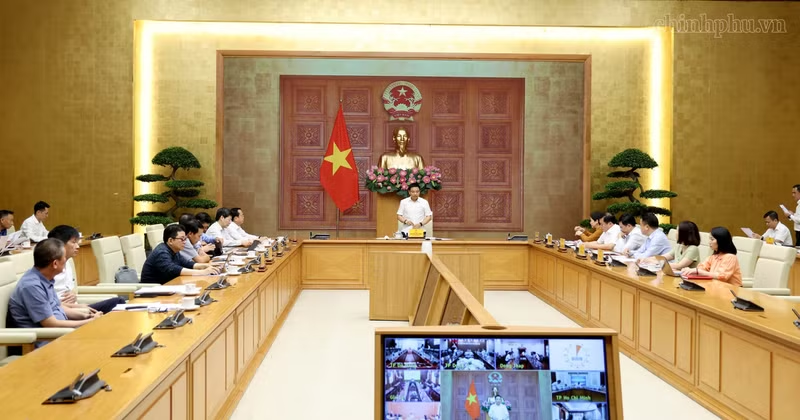
Thang, who is also head of the committee, said there is virtually no room for further consumer price index (CPI) increases in the remaining months of the year, and ministries, sectors and localities must focus on effective price management.
He pointed out that for the remainder of the year, the global economy is likely to continue facing adverse impacts that will negatively affect prices and exert pressure on inflation. In addition to external factors, the acceleration of public investment disbursement and projects, particularly key infrastructure ones, will drive up demand for electricity, construction materials, fuel, and input materials.
The Deputy PM emphasised the need to simultaneously achieve double-digit economic growth and effectively control inflation, thereby ensuring macroeconomic stability—for "only with macroeconomic stability can we achieve fast and sustainable growth."
The Ministry of Finance was tasked with leading the monitoring of CPI movements, compiling data from ministries and agencies on essential goods prices, updating inflation scenarios quarterly and annually, and advising the committee and Government on appropriate price management measures in line with global and domestic economic developments.
The ministry was also ordered to continue applying appropriate tax, fee and charge exemptions, reductions and extensions to lower business input costs and support livelihoods.
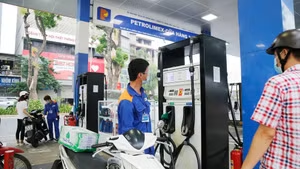
Deputy Minister of Finance Le Tan Can said average CPI growth in the first eight months reached 4.45%, approaching the 2026 inflation-control target. Prices rose during February–April on seasonal factors and higher energy and raw material costs, then eased during May–July as food and fuel prices declined. In August, CPI inched up 0.47% as fuel prices picked up again while production, transportation and input costs continued to pressure overall price levels.
The Ministry of Finance has updated two 2026 inflation scenarios, projecting hikes of 4.5% and 5%. Meanwhile, the State Bank of Viet Nam forecast average 2026 inflation of 4.5–5%, within the target range of 5% plus or minus 0.5 percentage point. International organisations project Viet Nam’s average inflation at about 3.8–5.2%.