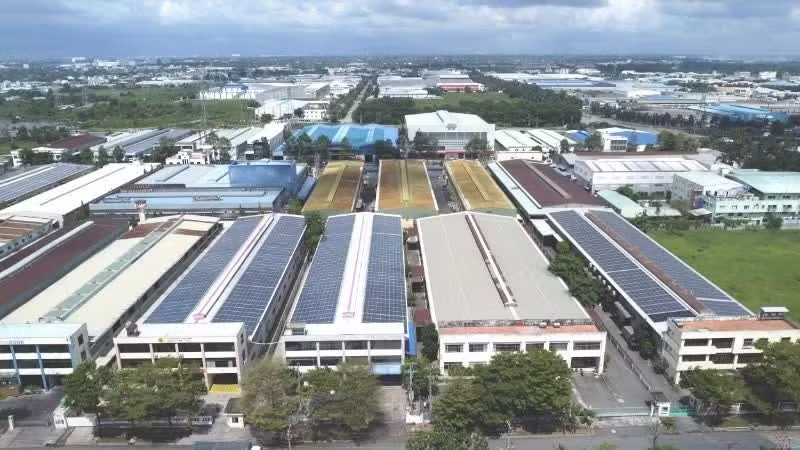
According to the development plan through 2050, the city is set to host 105 export processing zones and industrial parks covering a total area of over 49,000 hectares. Currently, 67 zones have been established; of these, 58 are operational with an occupancy rate of approximately 80%, attracting over 5,300 investment projects.
An imperative requirement
Phuoc Hoa Rubber Joint Stock Company (PHR), located in Phuoc Hoa Commune, Ho Chi Minh City, is a pioneer in developing industrial park infrastructure. Aiming for sustainable growth and the “greening” of industrial parks, PHR is researching the implementation of “Green Industrial Park” and “Net Zero Industrial Park” models.
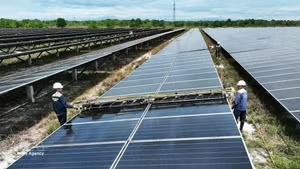
These models are expected to deliver significant benefits across energy, economic, environmental, social, and governance dimensions. PHR has identified 10 potential sites for solar power projects serving industrial parks and clusters, with a combined capacity exceeding 391 MWp.
According to Le Thanh Toan, Deputy Head of PHR’s Industrial Park Development and Management Department, this model helps increase renewable energy usage and reduce greenhouse gas emissions, thereby supporting the “Net Zero” goal. It also facilitates the development of eco-industrial parks, attracts high-quality investment, creates jobs, fosters technological innovation, and enhances the quality of growth.
The city’s large-scale industrial sector also faces an urgent need to reduce emissions. Recent industrial development has primarily been extensive in nature, characterised by high energy consumption and high emissions, and is no longer aligned with the requirements of the new era.
The expansion of the city’s territory following its merger has made the transition toward green and eco-industrial parks increasingly urgent, as the city serves as both the nation's largest industrial hub and a major centre for concentrated greenhouse gas emissions.
Tran Van Bich, former Head of the Economic Development Research Division at the Ho Chi Minh City Institute for Development Studies, noted that, based on the composition of product value, sectors with very high emission levels account for 12.07%, high-emission sectors for 18.71%, medium-emission sectors for 43.02%, and low-emission sectors for 26.2%.
Compared to the past, the city's industrial structure is shifting toward lower emissions, with the majority of industrial product value now derived from medium- and low-emission sectors.
Meanwhile, sectors with very high emission levels represent a relatively small share. Trends toward green growth, the circular economy, and low emissions are becoming global economic standards, pressuring the city’s industrial parks and enterprises to accelerate their transformation to avoid exclusion from global supply chains.
Consequently, transforming industrial parks toward low-emission models and moving toward Net Zero is not merely an environmental imperative but also a new prerequisite for maintaining competitiveness within global value chains.
Pham Binh An, Deputy Director of the Ho Chi Minh City Institute for Development Studies, observes that the green transition — once merely a trend — has now become a reality.
As the country's largest industrial hub, the city faces a dual challenge: maintaining its role as a primary engine of national growth while simultaneously pursuing a green transition and emission reductions to align with Viet Nam’s 2050 Net Zero goal. The city aims to reach net zero five years ahead of the national target
Towards Net Zero
Ho Chi Minh City has made initial strides in the green transition within its industrial zones. The industrial sector is shifting towards resource efficiency and emission reduction. Key practices — such as optimising electricity usage, controlling emissions, and adopting clean technologies — have reached the implementation stage among a number of enterprises.
A notable highlight is the pilot program to transform Hiep Phuoc Industrial Park into an eco-industrial park, supported by UNIDO (United Nations Industrial Development Organization). This initiative has enabled participating enterprises to cut CO2 emissions by nearly 23,000 tonnes annually and save approximately 66 billion VND in production costs.
Green success stories have also emerged elsewhere: industrial parks such as VSIP I and II have secured UNIDO eco-industrial park certification, achieving reductions of approximately 25% in energy use and 30% in wastewater discharge; meanwhile, Phu My Industrial Park has cut energy consumption by about 15% through the application of smart management systems.
Ho Chi Minh City’s vision for the green transition targets having approximately 20% of its industrial zones adopt eco-industrial models by 2030, rising to about 30% by 2035. By 2030, all industrial zones and clusters are expected to install rooftop solar power systems, ensuring that at least 20% of their electricity consumption comes from renewable sources.
At the same time, the city aims to increase the proportion of facilities utilising clean technology and expanding industrial symbiosis, while also boosting rates of solid waste recycling, wastewater reuse, and ISO certification
The transition of industrial zones toward Net Zero currently faces three major bottlenecks: capital costs, standards and data, and project scale. These challenges indicate that green finance for industrial zones is not merely a matter of bank lending but requires the design of a comprehensive financial architecture.
This architecture must integrate policies, standards, data, financial instruments, guarantee mechanisms, investors, and markets for carbon credits or low-emission products.
Assoc Prof, Dr Nguyen Huu Huan, Vice Chairman of the Executive Body of the Viet Nam International Financial Centre in Ho Chi Minh City, suggests that the city should select specific industrial zones to pilot a sub-zone level green finance model.
Pilot zones should demonstrate readiness regarding infrastructure, business participation, data availability, transition demand, and the capacity to coordinate with financial institutions. Rather than a broad, scattered rollout from the start, the city should implement in-depth pilots, clearly measure results, and subsequently scale up successful models.
With the largest industrial scale in the country, Ho Chi Minh City possesses significant advantages for establishing large-scale eco-industrial zones. However, to ensure the Net Zero goal moves beyond mere aspiration, the city must resolve bottlenecks related to capital, standards, data, and regulatory mechanisms.
In that context, the green transition will not merely be an environmental requirement but will also become a driving force for enhancing the competitiveness of the city's industrial sector within the global value chain.