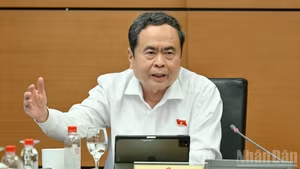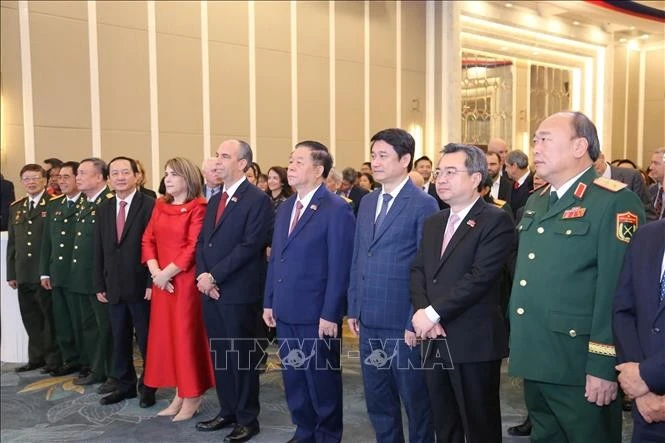
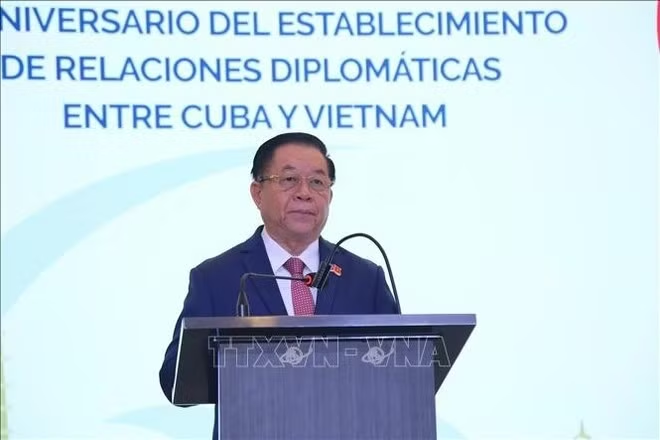
On behalf of leaders of the Party, State and people of Viet Nam attending the event, General Nguyen Trong Nghia, Politburo member, Secretary of the Party Central Committee, Chairman of the General Department of Politics of the Viet Nam People's Army, emphasised that the day of establishing diplomatic relations between the Socialist Republic of Viet Nam and the Republic of Cuba was a great event, starting the special, exemplary relationship between the two brotherly nations of Viet Nam and Cuba.
Over the past 65 years of glorious history, the two nations have always accompanied each other, stood side by side, shared the joys and sorrows, united and constantly cooperated, and fostered the relationship between the two heroic nations, making it a priceless common asset of the two countries and a unique symbol in international relations, Nghia said.
During the fierce years of Viet Nam's resistance war, when the young Cuban Revolution had just succeeded, the Cuban Government did not hesitate to become the first country in the Western Hemisphere to establish diplomatic relations with Viet Nam (1960), recognised the National Liberation Front of South Viet Nam (1962), established the Committee for Solidarity with Viet Nam (1963), established an embassy in the liberated zone (1967), sent thousands of engineers and experts to help Viet Nam, and provided non-refundable aid for many key economic and social projects to help Viet Nam rebuild the country after the war, he stressed.
In particular, the image of Leader Fidel Castro – the first and only foreign leader to visit the newly liberated zone of Quang Tri province in South Viet Nam (in 1973) in the midst of the war, has become an immortal symbol of international solidarity, a vivid testament to the loyal and steadfast sentiment that goes beyond all normal diplomatic protocols, Nghia noted.
According to the officer, Cuba has been ready to share knowledge, experience, and valuable resources, and to accompany Viet Nam in strategic yet humane and practical fields such as education, health, agriculture, architecture, and construction. Thousands of Vietnamese students have been trained and matured by Cuba, bringing with them sentiments, knowledge, and revolutionary ideals to serve their homeland. Cuba’s projects helped Viet Nam significantly improve living standards and social security, and rebuild the country in the context of Viet Nam being heavily devastated by war.
On this occasion, on behalf of the leaders of the Party, State and people of Viet Nam, Nghia expressed his deep respect and gratitude for the special friendship, solidarity, and generous, righteous and wholehearted support that Cuba gave to Viet Nam in the past struggle for national liberation and reunification, as well as in the current cause of national construction and defence.
At the ceremony, Cuban Ambassador to Viet Nam Rogelio Polanco Fuentescho emphasised that a special relationship between Cuba and Viet Nam has been built, based on mutual trust, steadfast loyalty and sincere assistance. Countless noble gestures of the people of the two countries for each other have been engraved in historical memory, passed down to generations of leaders and people of both nations.
On this occasion, the Ambassador congratulated the Party, State and people of Viet Nam on the outstanding socio-economic achievements in the past year and wished the 14th National Congress of the Communist Party of Viet Nam great success. He expressed his belief that with the determination of the leaders and the efforts of the people, Viet Nam will complete the set challenging historical goals.