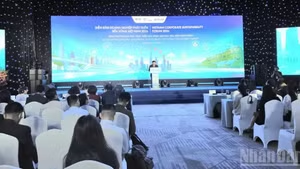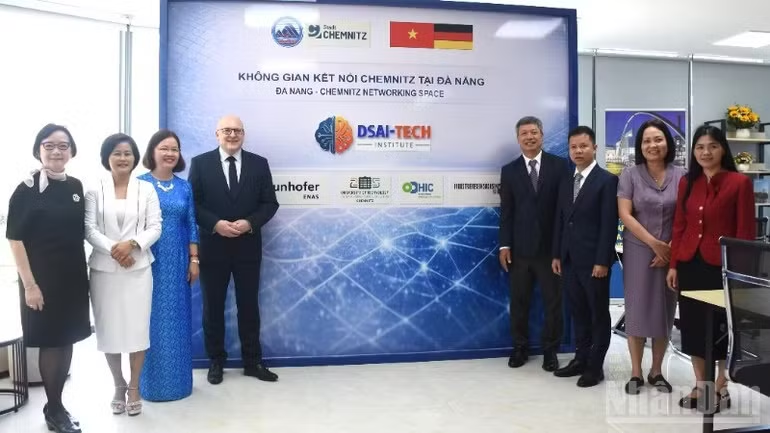
Speaking at the event, Vice Chairman of the Da Nang City People’s Committee, Ho Quang Buu, stressed that Da Nang has been designated by the Vietnamese Government as the hub of the central key economic region, with strengths in start-ups, innovation and creativity, tourism, commerce, finance, logistics, high-tech industry, and information technology.
He noted that the city is looking to deepen cooperation with Chemnitz in the near future, particularly in training and technology transfer.
Buu called on Chemnitz businesses to share and transfer solutions in smart cities, IoT, robotics, semiconductor chips, artificial intelligence, and green technology, while also creating opportunities for Da Nang’s software enterprises to integrate more deeply into the IT service supply chains of major corporations in Chemnitz.
Da Nang’s authorities pledged to continue improving the investment environment, upgrading technical infrastructure, and refining mechanisms and policies to attract investment. These efforts, Buu emphasised, will create favourable conditions for businesses and investors from Chemnitz and Germany to engage in long-term investment in the city.
For his part, Sven Schulze, Mayor of Chemnitz, remarked that Chemnitz and Da Nang share many similarities in their development orientations, particularly in economic growth, high technology, and sustainable development.
He praised the cooperation potential between the two localities, highlighting the important bridging role played by the Vietnamese community in Chemnitz in fostering mutual understanding and promoting bilateral relations.
According to Schulze, the meeting will open new opportunities for authorities, businesses, and training institutions on both sides to strengthen connections and implement substantive cooperation programmes in the future.
He expressed his hope that both sides will continue to promote exchanges and work concretely to realise the full potential of bilateral cooperation.
At the programme, the two sides presented their respective strengths and high-tech development orientations, including semiconductor technology, AI, and green technology. They also discussed cooperation opportunities between governments and businesses, and introduced specialist topics such as the AI-integrated companion robot development project designed to support the elderly.