In line with the Party’s policies and the government’s direction on administrative reform and digital transformation, the scheme aims to eliminate cumbersome procedures, modernise public administration through the application of science and technology, and streamline the administrative apparatus.
Under the scheme, the ministry will abolish entry and departure permit procedures for inland waterway vessels calling at seaports, inland ports, wharves, and anchorage areas for the vast majority of vessels, with the exception of VR-SB vessels, seaplanes, and vessels engaged in international entry and exit procedures. This represents a significant reform intended to remove a longstanding bottleneck in inland waterway transport.
The scheme also introduces a roadmap for waiving and reducing fees and charges to ease the financial burden on businesses and the public. Specifically, tonnage charges and port entry and exit fees for vessels classified as VR-SI, VR-SII, and VR-SIII will be reduced to zero. Passenger vessels operating in key tourism destinations such as Ha Long Bay, Bai Tu Long Bay, and Lan Ha Bay will also benefit from these preferential policies.
A key feature of the scheme is the transition from traditional administrative management to a data-driven approach. Vessel operations will be monitored through the Automatic Identification System (AIS) and GPS-based vessel monitoring devices.
An integrated database covering vessels and crew members will be established and connected to the National Population Database via the VNeID application. Vessel owners and captains will be able to submit arrival and departure declarations online through email, text messages, or dedicated information technology platforms, replacing the previous paper-based submission process.
The new management model is expected not only to improve monitoring efficiency and strengthen maritime safety and security, but also to enhance transparency in public administration while helping to prevent misconduct and corruption.
According to official estimates, the implementation of the scheme will eliminate approximately 750,000 administrative procedures each year, saving businesses around 61.5 billion VND (over 2.3 million USD) annually in fees and administrative charges, excluding additional savings in travel and labour costs.
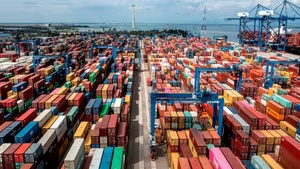
More than 1,860 enterprises operating in inland waterway transport and logistics are expected to benefit directly from the reforms, creating favourable conditions for unlocking the potential of inland waterway transport — one of the country's greenest and most cost-effective modes of transportation.
The restructuring of personnel at Inland Waterway Port Authorities will also be carried out in a leaner and more professional manner, improving service quality in accordance with the principle of the “five clear” principle: clear person, clear task, clear time, clear result, and clear responsibility.