According to the Viet Nam National Authority of Tourism (VNAT), during the first six months of 2026, Viet Nam welcomed more than 12.2 million international visitors, an increase of 14.8% compared with the same period in 2025, achieving 48.8% of the annual target. During the same period, the country served approximately 81 million domestic visitors, equivalent to 54% of the year's target. Total tourism revenue reached 569 trillion VND, representing 50.5% of the annual plan.
These figures demonstrate that Viet Nam's tourism industry has made significant progress in terms of market scale and visitor numbers. However, when measured against indicators such as the average length of stay, average visitor spending and the rate of returning international visitors, the country's tourism sector still lags behind many other nations. This situation requires the industry to establish a unified and accurate data system to optimise operations. Such a system would help monitor the carrying capacity of destinations, prevent the risks associated with overheated development, and provide a basis for identifying changes in tourist behaviour, thereby enabling timely adjustments to improve service quality and enhance destination competitiveness.
In reality, Viet Nam has already accumulated a considerable volume of data generated through immigration procedures, aviation, transport, accommodation, e-commerce, payment systems, telecommunications and other sectors. However, these datasets remain fragmented across ministries, sectors, local authorities and businesses. The lack of connectivity and interoperability has prevented them from being fully utilised.
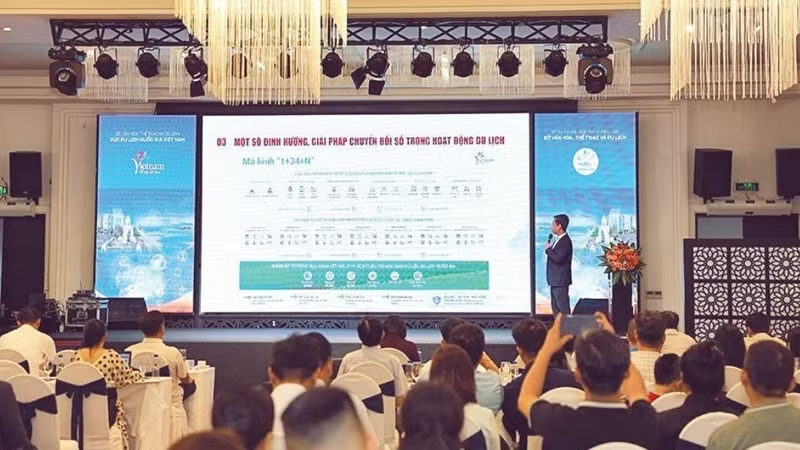
To address this bottleneck, the Ministry of Culture, Sports and Tourism has proposed the development of a National Tourism Data Ecosystem based on the "1+34+N" model, designed to ensure that data are accurate, sufficient, clean, live, unified and shared. Under this model, "1" refers to the National Tourism Data Platform coordinated by the Ministry; "34" represents the data systems of the country's 34 centrally governed provinces and cities; and "N" refers to ministries, sectors, enterprises and relevant organisations participating in data integration and enrichment.
Under this model, the data platform developed and operated by the Ministry of Culture, Sports and Tourism will connect with local data systems nationwide while expanding interoperability with ministries, sectors and the business community to establish an integrated and continuously updated data network.
According to Pham Van Thuy, Deputy Director General of the Viet Nam National Authority of Tourism, in the digital era, digital transformation in tourism is not merely about applying technology but about comprehensively restructuring management, business operations and visitor experiences. From this perspective, the National Tourism Data System is regarded as the core digital infrastructure and the "backbone" of the entire smart tourism ecosystem.
The "1+34+N" model aims to establish digital visitor profiles, thereby enhancing forecasting capabilities, operational management and real-time service personalisation. This will enable the tourism sector to develop a data-driven governance model rather than relying on decisions based solely on experience and intuition. According to the implementation plan, during 2026–2027, the model will focus on connecting dispersed data sources across ministries, sectors, localities and businesses to establish a core data system. From 2027 onwards, the Ministry of Culture, Sports and Tourism will continue refining the shared-use model while issuing data standards and mechanisms for data sharing and utilisation. This approach gives practical effect to the Party's and the State's policies on the development of science, technology, innovation and digital transformation.
In recent years, in order to develop a smart tourism ecosystem, Viet Nam's tourism sector has gradually researched and developed shared digital platforms connecting state management agencies, businesses, tour guides and visitors. These include the Tourism Database System; the Tourism Statistical Reporting System; the Tourism Management and Business Platform; the Tourism Operations Dashboard (a digital platform providing visualised data on business performance, service booking status and financial reports); the National Tourism Application "Du lich Viet Nam – Vietnam Travel"; the Viet Card – National Tourism Card; the electronic ticketing system featuring online, interoperable and multimodal functions; and the multimedia interpretation system.
According to Hoang Quoc Hoa, Director of the Tourism Information Centre, the deployment of the shared digital platforms developed by the Viet Nam National Authority of Tourism will help local authorities and businesses reduce investment and training costs. At the same time, these platforms will connect and integrate data, overcome fragmentation, create greater consistency, facilitate management and business operations, and improve visitors' experiences.
Deputy Director General Pham Van Thuy emphasised that the key issue is standardisation and shared use. If each locality develops its own separate system without connectivity, resources will be wasted and no collective strength will be achieved.
Therefore, the Viet Nam National Authority of Tourism advocates the following approach: the central government develops the platform, local authorities implement it, businesses make use of it, and visitors benefit from it. To maximise the effectiveness of digital transformation in tourism, an important solution is to reform tourism promotion and marketing through digitalisation, applying artificial intelligence (AI) to personalise promotional messages for each target market. At the same time, greater efforts should be devoted to training and capacity-building on digital transformation for local authorities and businesses, issuing practical guidance materials, and supporting the integration of tourism management information systems between central and local levels. Digital transformation can only succeed when it is built upon a foundation of high-quality human resources - people who are capable of transforming data and technology into value for visitors, businesses and the sustainable development of the tourism industry.


![[Video] Viet Nam among Top three Asian destinations for return visitors](https://en-cdn.nhandan.vn/images/nyM650OGFWrOVWc-xajqN-rTZ68Rlmc1fiGJOhBRYHErj-E25MBpvJqrpphXazfrpe9t-fYCGuQU4CN0yXo3Rg/du-lich-vietnam.jpg.avif)