Australia has become one of Viet Nam’s fastest-growing long-haul tourism markets. Viet Nam welcomed 490,880 Australian visitors in 2024, up 26% year on year and around 28% higher than in 2019, before the COVID-19 pandemic. In the first seven months of 2026, the country received 396,648 Australian tourists, a year-on-year increase of 25.8%, placing Australia among Viet Nam’s top 10 source markets.
Ho Chi Minh City plays a particularly important role in attracting Australian tourists. According to Pham Huy Binh, Director of the municipal Department of Tourism, the city welcomed 253,104 Australian visitors in the first seven months of 2026, making Australia the fifth-largest among its top 20 source markets. The figure accounted for about 63.8% of all Australian arrivals in Viet Nam.
Australian tourists are considered a stable, high-value market, with strong spending power and growing demand for local experiences, cuisine, history, culture, urban life, beach resorts, ecotourism and responsible tourism. These are also segments that Ho Chi Minh City is seeking to develop and improve.
For Australian travellers, Ho Chi Minh City can serve as a starting point for exploring a diverse Viet Nam rich in culture and identity, Binh said.
The growing appeal of Viet Nam is also reflected in the hospitality sector. Phan Trong Minh, General Director of Azerai La Residence Hue, said Australian visitors regularly rank among the hotel’s top three international markets, currently accounting for more than 10% of its international guests.
The market has many characteristics sought by Viet Nam’s tourism industry, including year-round travel, longer stays, relatively high spending and a strong appetite for exploration. Australian travellers particularly value authentic and distinctive experiences rather than mass-market products and are willing to pay for quality, although they also have high expectations for a seamless overall experience, Minh said.
According to Dr. Chung Le Khang, a lecturer in Vietnamese Studies and Tourism at Ho Chi Minh City University of Education, Viet Nam’s growing appeal to Australian tourists reflects a combination of factors, including improved air connectivity, competitive prices and diverse tourism products.
The distance between Australia and Viet Nam is convenient for one- to two-week holidays. Visitors can also access quality accommodation, diverse cuisine and a wide range of services at relatively reasonable prices compared with many other destinations.
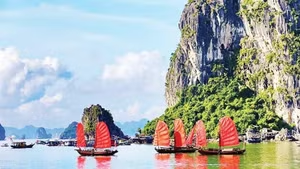
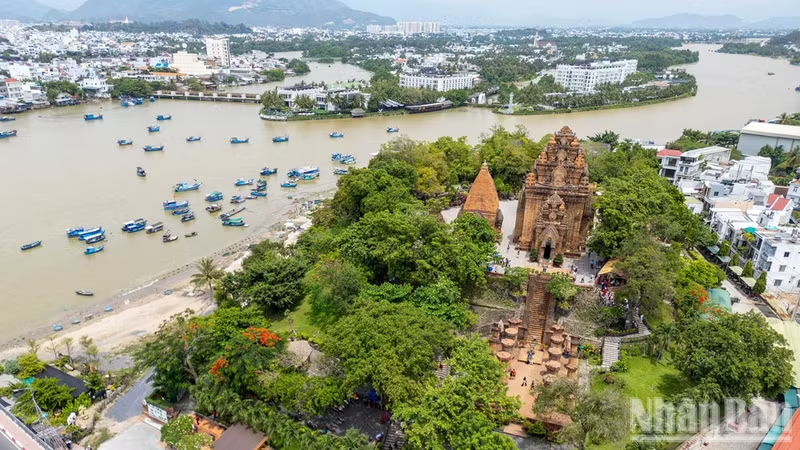
Another major advantage is the wide range of experiences available within a single trip, from Ha Noi, Ha Long Bay and Ninh Binh to Hue, Da Nang, Hoi An, Ho Chi Minh City, the Mekong Delta and Phu Quoc.
Cuisine has also become an increasingly important travel motivator, with experiences ranging from street food and market visits to cooking classes and explorations of Viet Nam’s coffee culture.
Nguyen Nguyet Van Khanh, Vietravel’s Director of Marketing and Communications, said Australian tourists tend to stay longer, visit multiple destinations and spend more time exploring local areas rather than simply visiting famous attractions.
The Viet Nam-Australia tourism market is shifting from growth in visitor numbers to growth in value, she said, adding that the opportunity lies not only in attracting more visitors but also in developing deeper experiences that encourage longer stays, higher spending and repeat visits.
Despite strong growth, tourism experts and businesses believe Viet Nam still has considerable room to further tap the Australian market, particularly by increasing length of stay and visitor spending.
Dr. Chung Le Khang noted that many existing tourism products still focus on quick sightseeing, packed itineraries and price competition. Australian visitors, however, could stay longer and spend more if Viet Nam develops more specialised products, including culinary tourism, wellness, trekking, cycling, golf, river tourism, agricultural tourism, heritage exploration and extended stays combining several destinations.
This requires a shift from simply taking tourists through multiple destinations to enabling them to experience each destination more deeply.
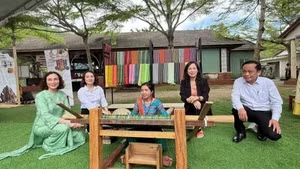
Rather than selling accommodation, tickets and transportation separately, businesses could package experiences such as meeting artisans, learning to cook local dishes, exploring architecture, discovering local history and participating in community life.
Australian travellers have strong spending power but also high expectations for quality. Issues such as litter, poor hygiene, aggressive solicitation, unclear pricing, inaccurate English-language information and unprofessional complaint handling can influence their decisions to return to Viet Nam or recommend the destination to others.
Vietravel suggested that instead of simply combining Ha Noi, Ha Long, Hoi An and Ho Chi Minh City into a conventional itinerary, tourism products should tell a coherent story about the culture, cuisine, communities, nature and lifestyle of each destination.
The company’s strategy is to develop 10-15-day itineraries for Australian visitors, connecting multiple regions while increasing cultural, culinary, nature and local-life experiences. It also plans to expand premium, wellness, golf, MICE and specialised small-group tours.
From a management perspective, Ho Chi Minh City plans to work with Australian partners to develop new itineraries connecting urban experiences with beach resorts, ecotourism, community-based tourism and high-quality services.
The city aims to increase the value of visitor experiences, extend stays and develop a dynamic two-way tourism market. It also plans to strengthen direct links between businesses from the two countries, promote familiarisation trips, press trips and B2B activities, and deepen cooperation with airlines and travel companies. High-value segments such as premium resorts, culinary tourism, ecotourism, MICE and community-based cultural experiences will be prioritised.
![[Video] Viet Nam among Top three Asian destinations for return visitors](https://en-cdn.nhandan.vn/images/nyM650OGFWrOVWc-xajqN-rTZ68Rlmc1fiGJOhBRYHErj-E25MBpvJqrpphXazfrpe9t-fYCGuQU4CN0yXo3Rg/du-lich-vietnam.jpg.avif)





![[In Pictures] Nui Chua Rock Park: A million-year-old outdoor museum of landforms on the Khanh Hoa coast](https://en-cdn.nhandan.vn/images/nyM650OGFWrOVWc-xajqNz57td8idIAL_VG9puyG2UZEKOnmq1DVlT1--ZclbO3z2WBaWZhbt6O3e8kjPZqJMWkfEz7RO9qhcwg8o8LQFK8/ndo-br-cao-nguyen-da-moi.jpg.avif)