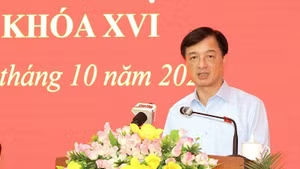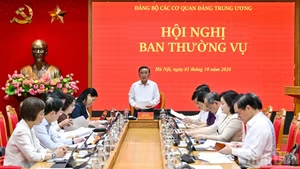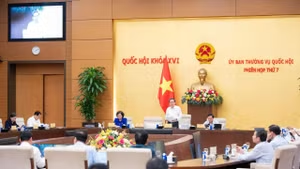
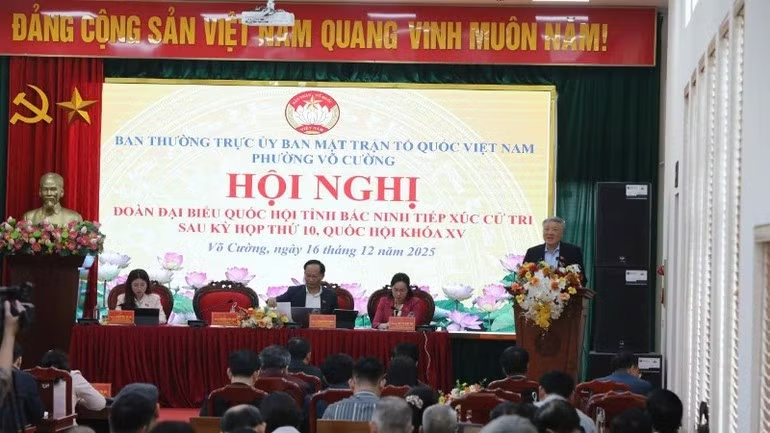
At the meeting, after hearing a report from the Bac Ninh Provincial National Assembly Delegation on the results of the 10th session of the 15th National Assembly, voters presented their opinions and recommendations on issues of public concern.
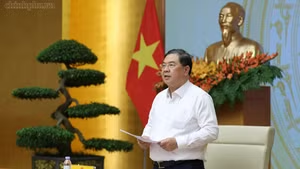
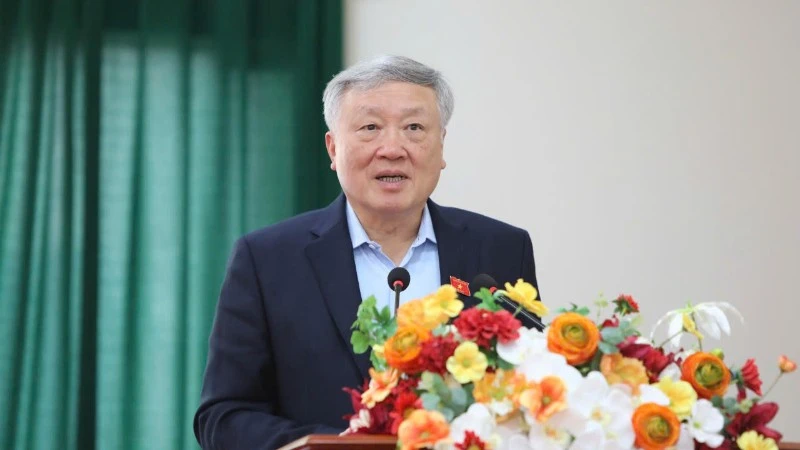
Speaking at the meeting, Permanent Deputy Prime Minister Nguyen Hoa Binh highly appreciated the democratic spirit, sense of responsibility, frankness, and dedication reflected in the voters’ opinions. He noted that the 10th session was the final session of the 15th National Assembly. This was a historic session — the longest and the one addressing the largest volume of work — during which 51 laws and eight resolutions were passed, accounting for 30% of the total workload of the entire term. During the session, the Bac Ninh Provincial National Assembly Delegation made practical and substantive contributions to items on the legislative agenda.
The Permanent Deputy Prime Minister assessed Bac Ninh as a growth pole of the country, with a large economic scale, high growth rates, and continuously improving living standards for its people. In particular, following the administrative merger, the newly formed Bac Ninh Province has created new space and momentum for development, especially in industry and services.
Permanent Deputy Prime Minister Nguyen Hoa Binh considered, discussed, and responded to voters’ opinions and recommendations, emphasising the issue of teacher staffing, which falls under local authority. The guiding principle, he stressed, is that “where there are students, there must be teachers”.
Regarding fire prevention and fighting, alongside the responsibilities of competent authorities, he also urged residents to take proactive measures to ensure fire and explosion safety.
In terms of the restructuring of commune-level administrative apparatuses and policies for grassroots officials, he said that the Government is studying and drafting a decree on the organisation of commune-level administrations, which is expected to be issued within 2025 to provide a basis for local implementation. To further promote decentralisation and delegation of authority, the central level will allocate overall staffing quotas to provinces and centrally run cities, enabling local functional agencies to select qualified personnel in line with practical requirements.
As for salary policies for commune-level civil servants, once the organisational structure is stabilised and job position schemes are approved, a new salary scale will be introduced. In the meantime, before the new pay scale takes effect, the State will continue to adjust policies to increase the basic salary in 2026.