
However, to truly embed this capability and make it a solid foundation for modern education, authorities at all levels, together with school management, must provide stronger support in terms of infrastructure, competency frameworks, training, and policies for the teaching workforce.
From solitary journeys
In 2022, Hoang Huong Lan, a teacher at Tri Le Ethnic Boarding Secondary School in Lang Son Province, experimented with the artificial intelligence (AI) application ChatGPT. “At that time, in Viet Nam, we couldn’t buy or register an account, so I, together with my friend Van Duong, a teacher in Thai Nguyen, paid out of our own pockets to open international accounts for registration and trial use,” Huong Lan recalled.
After experimenting with lesson design, creating video warm-ups for classes, and generating AI-based multiple-choice worksheets, she realised this tool could make teaching content more engaging and save a great deal of time.
Lan then shared her findings with colleagues and the school leadership. Although not everyone fully understood and some concerns remained, the school leaders supported her experimentation with technology-enhanced lessons.
Since then, Lan has felt more confident in engaging with new technologies.
69% of Vietnamese teachers engaged in team teaching and 98% expressed trust in their colleagues and principals. This is a crucial foundation for sharing knowledge, applying technology, adopting AI, and overcoming new challenges together.
In 2023, she joined the Community of Technology-loving Teachers, where she met many dedicated colleagues who had already integrated new technologies into their teaching. “We exchange a lot of experience and useful applications,” Lan said.
Lan is just one example of many Vietnamese teachers who are increasingly keeping pace with the digital revolution.
According to TALIS, 69% of Vietnamese teachers engaged in team teaching (a sharp rise from 2018), and 98% expressed trust in their colleagues and principals. This is a crucial foundation for sharing knowledge, applying technology, adopting AI, and overcoming new challenges together.
Yet 71% reported that their schools lack the infrastructure for AI application — nearly double the OECD average of 37%. This remains a significant bottleneck hindering the wider spread of modern education.
Towards wider societal efforts
Recognising this situation, some localities have proactively taken action. Thai Nguyen Province is vigorously promoting the “AI for All” movement in education. More than 18,000 teachers and educational staff in the province have been trained in digital skills and the application of technology in management, lesson design, and classroom administration.
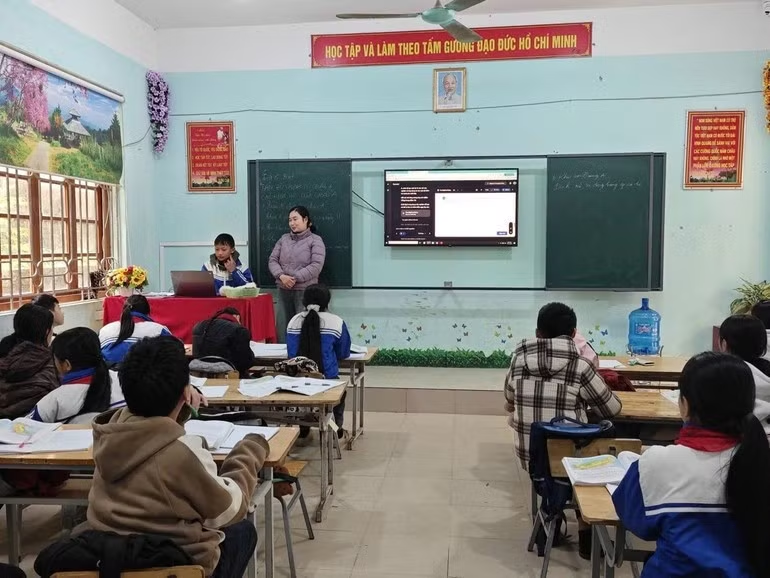
In Ha Noi, the digitalisation of records, attendance, and learning management helps save time and optimise teachers’ work.
Lan’s school, in particular, has received substantial support from local authorities — from mobilising social funding to install computers, to connecting with Ha Noi schools and centres to organise skills training for teachers.
At a broader scale, in 2022, the Prime Minister issued Decision No. 131/QD-TTg approving the project “Enhancing the Application of Information Technology and Digital Transformation in Education and Training during 2022–2025, with Orientation to 2030.”
To realise strategic goals of strengthening ICT application, building online teaching and learning platforms, and improving digital infrastructure for teachers and students, the Ministry of Education and Training has organised numerous AI seminars and training courses for teachers from primary to secondary levels.
Digital transformation in education is not simply about “having AI or not” but rather a sustained journey: teachers need to be equipped, trusted, and continuously supported.
Education expert Dr Nguyen Tung Lam
The ministry also provides digital materials and supportive platforms for teachers: guides for designing AI-enabled lessons, classroom management tools, and student assessment via data platforms.
Education expert Dr Nguyen Tung Lam emphasises that using technology and embracing digital transformation is now imperative for teachers.
However, he cautions that the line between mastering technology and being led by it is very thin; the decisive factor must always remain with the teacher.
“The newer and more convenient the technology, the more teachers need to firmly uphold professional ethics, solid knowledge, and critical thinking to verify the information provided by AI,” he stressed.
Digital transformation in education is not simply about “having AI or not” but rather a sustained journey: teachers need to be equipped, trusted, and continuously supported.
When the entire system — from the state to schools and individual teachers — works together to unlock the greatest potential of digital transformation, classrooms become more creative, students more proactive, and teachers fully empowered to teach in the digital era. This is the goal towards which modern education aspires.