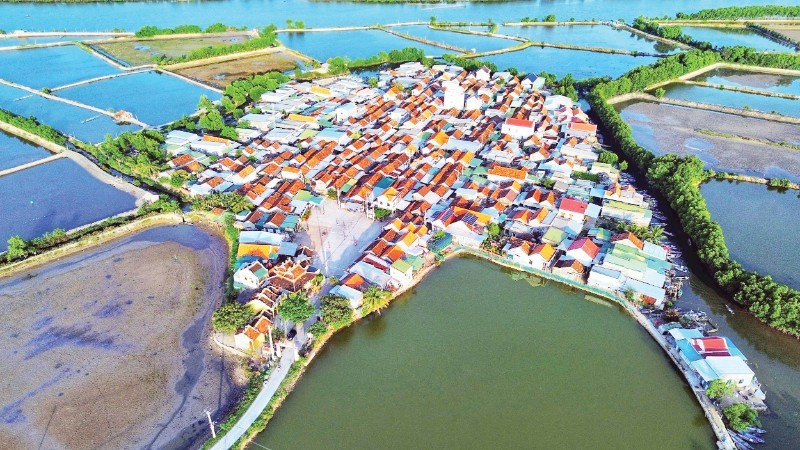
After following National Highway 1A north from Nha Trang for about 30km, we turned off towards the ancient village of Ha Lien. The driver said, “There’s only one road to Ha Lien Village. The village is surrounded by rice fields and fishponds...” Coincidentally, he had a flycam video of Ha Lien Village on his phone, so he showed it to us. In the clip, Ha Lien village stood out amidst the lush green rice fields with its bright red tiled roofs.
Previously, I'd only seen a few scattered red tiled houses in the middle of green fields. But here, a cluster of red tiled houses stood out against the endless green of the rice paddies. It was beautiful! Looking at the flycam footage, I imagined the single road into the village as the string of a kite flying over the vast rice paddies.
We arrived in Ha Lien just as the historic flood had receded. Ha Lien was deeply submerged. The mud still clung to the walls of the houses. The people of Ha Lien were diligently cleaning up after the flood. Party Secretary Le Van Sy, the head of the neighbourhood committee, took me on a tour of the village. It's called a village, but the houses are built side-by-side, in straight lines like a street.
Sy explained that Ha Lien Village is over 370 years old. It was formerly part of Ninh Ha Ward, Ninh Hoa Town, and now Hoa Thang Ward, Khanh Hoa Province. When they first came here to clear land and establish the village, the land didn't have to be bought; the people of Ha Lien arranged for themselves to build houses, each household taking their own land. Nearly 100% of the houses here are built with bricks and tiled roofs.
Then Sy told me about the more than 370-year history of Ha Lien Village, which is also the 370-year history of the Nha Trang-Khanh Hoa region. In the year Quy Ty 1653, Cai Co Hung Loc Hau, under the command of Lord Nguyen Phuc Tan, undertook the task of expanding and reclaiming the land from Deo Ca pass to Phan Rang River; The Thai Khang administrative centre was established with two subordinate prefectures, Thai Khang and Dien Ninh.
Later, this area was renamed as the districts of Binh Khang, Binh Hoa, and Binh Hoa. In 1832, during the reign of King Minh Mang, it was renamed Khanh Hoa Province. Ha Lien Village has been a companion to Khanh Hoa Province throughout its long history of construction and development.
Following the expansion of the territory by the military commander Hung Loc Hau, the first inhabitants settled in Ha Lien Village in the area of the Dinh River’s estuary, bordering Nha Phu Lagoon and near Hon Heo Mountain, with a strategic location by the river, near the sea, and close to the mountains.
Elderly villagers recount that, due to its unique geographical location, Ha Lien endured fierce raids and repression during the wars to defend the country. The people of Ha Lien bravely resisted the invaders.
A notable event was on August 17, 1945, when the people of Ha Lien joined the revolutionary movement towards Ninh Hoa District to fight, contributing to the overthrow of the colonial and feudal government and the establishment of a revolutionary government in Ninh Hoa District.
The history of the Ninh Ha Ward Party Committee records that the people of Ha Lien were the core and pillar of the revolutionary movement in Ninh Ha Commune. During the war years, wherever people from Ha Lien settled and worked, there was a revolutionary base.
Currently, the Ha Lien residential area has 333 households and 1,128 inhabitants. It's an administrative unit, but I still prefer to call it a village, because Ha Lien not only has the appearance of an ancient village but also possesses unique traditional cultural features.
Right at the village gate is the ancient Ha Lien communal house, next to it is Hue Lien Pagoda, and then the Nam Hai mausoleum. In the video clips recording Ha Lien’s communal house festival, the fishing prayer ceremony, etc., the ancient culture is very authentically displayed.
The Ha Lien communal house still retains its functions as a meeting place for discussing village affairs. It is the place of worship for the village's tutelary deity and the venue for theatrical performances and folk singing at the communal house.
Inside the communal house are altars dedicated to the Heavenly God, the Earth God, and those who have contributed to the nation, the village, and the commune. The rituals of worshiping at the communal house, as well as at the ancestral shrine, still retain strong folk characteristics, fostering community cohesion.
This shows that the people here have made great efforts in preserving the village's culture. Houses are close together, side by side. Neighbourly bonds are strong; people listen to each other.
Therefore, Ha Lien has both the characteristics of a town and a village. A few years ago, the Ninh Hoa City Party Committee awarded a certificate of commendation to the Ha Lien residential group for their outstanding achievements in implementing the “Skilled Mass Mobilisation” emulation movement.
The village is sheltered by the green of the mangrove forest, with glimpses of egrets. It is unusually quiet here at noon. I visited the lush green mangrove banks reflected in the clear blue water, feeling the pristine, poetic atmosphere of the mangrove forest with its chirping birds and crabs peeking out of their burrows at low tide — which give the impression of a tranquil ink painting.
The people of Ha Lien are accustomed to rowing boats and catching crabs and fish in the lagoon. The mangrove forest is home to shrimp, crabs, and fish. Their hard work and perseverance have resulted in over 30% of the households in the village being well-off.
Recently, several tourists have visited Ha Lien. Many shared: “The atmosphere here is so peaceful; the people are friendly and have many unique cultural features. Going with the locals to admire the mangrove forest and trying your hand at pulling nets to catch fish… is a very special experience.”
With its beautiful scenery, peaceful atmosphere, kind people, and long-standing culture, Ha Lien is facing a new opportunity: the development of tourism.
Villager Pham Minh Dinh took us on a tour of the mangrove forest in his small boat. The vast water surface and mangrove forest are valuable resources for Ha Lien, both for aquaculture, fishing, and tourism.
Dinh shared: “Recently, tourists from many places have come here to visit and explore, so I use my family’s boat to carry them. They are very pleased and praise the beautiful scenery. My family earns a little extra income while also contributing to promoting the image of our homeland.”
In April 2025, Ha Lien Village was awarded the “Top 7 Impressive Destinations in Viet Nam” certificate for 2024 by Saigon Times — a publication of the Saigon Times Group which aims to support sustainable tourism development and help discover new and unique destinations. Saigon Times described Ha Lien Village as having an impressive rural beauty seen from above.
In the tourism development plan for Ninh Hoa Town (before its reorganisation), the local authorities planned to establish a survey team to investigate the conditions for building a community-based tourism model in Ha Lien.
If the ancient village of Ha Lien becomes a community-based tourism destination, it will contribute to increasing livelihoods for the local people while preserving and promoting its unique cultural and historical values in a sustainable manner.
Party cell secretary Le Van Sy shared: “I have lived in this locality for over 30 years, I know every household, every person, and I have earned the trust of the people, who share their thoughts and aspirations.
In the future, the people here hope that the authorities at all levels will continue to invest in infrastructure; build green tourism and community tourism models; and create conditions for the people of Ha Lien to access preferential loans to change professions, develop the economy, and improve their lives.”