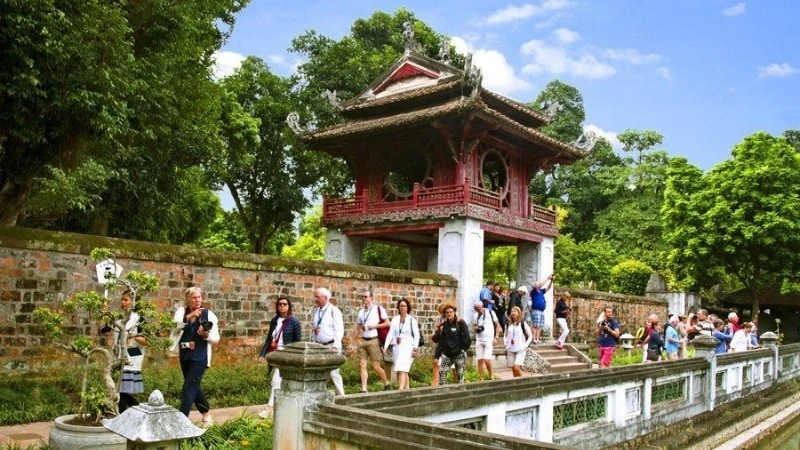
The city has welcomed more than 28.2 million visitors since the beginning of the year, reaching 91% of its annual target and surpassing the total number of visitors recorded in the whole of 2024. Of these, 6.17 million were international arrivals, while total tourism revenue is estimated at nearly 110 trillion VND. These figures underscore the capital’s growing attractiveness, with a particular driving force from the strategy to expand suburban experiential products and develop night-time tourism offerings at sites such as the Thang Long Imperial Citadel and Hoa Lo Prison.
In October alone, the number of visitors to the capital reached 2.27 million, including 695,000 international arrivals, up 17.8% year on year, 490,000 of whom stayed overnight. Domestic visitors totalled nearly 1.6 million, while overall revenue approached 9.93 trillion VND, an increase of 11.9%. The occasion of National Day celebration, together with a strategy of product diversification, has provided fresh momentum, helping Ha Noi emerge as a primary destination rather than merely a transit point in international travel itineraries.
Travel enterprises continue to serve as the “backbone” of the market. Across the city, there are 2,687 tour operators, including 2,101 international travel companies, alongside more than 9,500 active tour guides. This workforce plays a crucial role in driving market growth, expanding visitor sources and adding value to the tourism ecosystem.
In addition, the capital’s tourism authorities are updating accommodation databases, implementing the campaign “Vietnamese People Prioritise Vietnamese Goods” within the tourism sector, finalising the sector’s development plan for 2026, and proposing that Ha Noi host the National Tourism Year 2026.
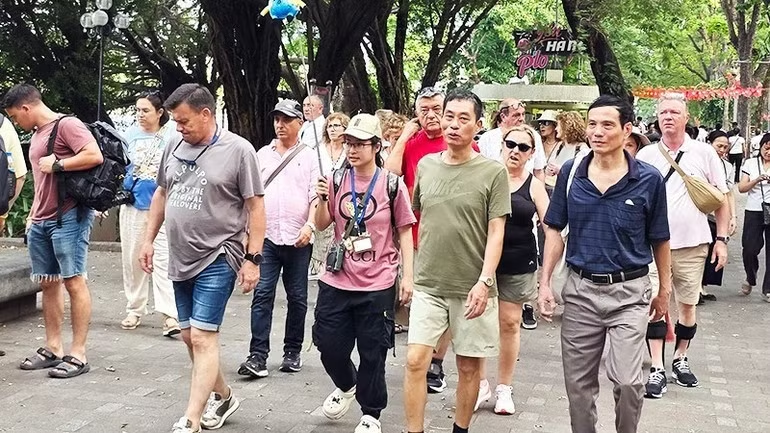
In 2025, the capital city aims to welcome 31 million visitors, including 7.5 million international arrivals, accounting for more than 30 per cent of Viet Nam’s total target for international visitors. Tourism revenue is projected to reach 130 trillion VND.
Alongside these targets, a range of new products is being developed and refined. The city has promoted a night-time tourism model at the special national heritage site of Soc Temple (Soc Son District) and is developing community-based tourism linked to ethnic minority culture in Yen Xuan Commune. Both products are expected to help extend visitors’ length of stay and increase tourist spending.
Ha Noi is also strengthening regional linkages, notably through cooperation with provinces in the Mekong Delta in tourism promotion activities for 2025, reaffirming the capital’s role as a coordinating hub within the national tourism network. Numerous training and capacity-building programmes for local communities at destinations such as Muong Coc (My Duc District) are being rolled out with the aim of positioning local residents as key stakeholders in sustainable tourism.
A large number of residents and visitors were attracted by a recent series of high-impact events, including the World Cultural Festival, which drew more than one million attendees, as well as programmes such as “World Culture Day”, “Vietnamese Ao Dai”, and the “Ha Noi Autumn Festival”. These events create a space where heritage and modern experiences intersect, reinforcing Ha Noi’s brand as a “city of events”.
A proposal to renew the management, conservation, and promotion of the Huong Son Complex (Huong Pagoda) is currently being submitted to the city for consideration, with expectations of a turning point for spiritual and eco-tourism. Meanwhile, a number of new products, including the Soc Temple night tour, agricultural tourism in Bat Trang and Ung Thien, and community-based tourism in Yen Xuan, are being finalised and prepared for launch.
With strong determination to accelerate during the peak season, the capital’s tourism sector expects that the results achieved in the final months of the year will provide momentum for Ha Noi to make a significant breakthrough in 2026.
![[Video] Viet Nam among Top three Asian destinations for return visitors](https://en-cdn.nhandan.vn/images/nyM650OGFWrOVWc-xajqN-rTZ68Rlmc1fiGJOhBRYHErj-E25MBpvJqrpphXazfrpe9t-fYCGuQU4CN0yXo3Rg/du-lich-vietnam.jpg.avif)







![[In Pictures] Nui Chua Rock Park: A million-year-old outdoor museum of landforms on the Khanh Hoa coast](https://en-cdn.nhandan.vn/images/nyM650OGFWrOVWc-xajqNz57td8idIAL_VG9puyG2UZEKOnmq1DVlT1--ZclbO3z2WBaWZhbt6O3e8kjPZqJMWkfEz7RO9qhcwg8o8LQFK8/ndo-br-cao-nguyen-da-moi.jpg.avif)